Two companies can report nearly identical methane inventories while emitting dramatically different amounts of methane. The difference often is not operational performance. It is how emissions are measured, quantified, and reconciled. OGMP 2.0 was created to close that gap.
A Level 3 estimate can allocate every pneumatic, tank, and compressor seal to a source category and still miss the intermittent release that dominates the year. That is the practical problem behind UNEP’s Oil & Gas Methane Partnership 2.0: inventories that look complete on a spreadsheet can remain incomplete in the field.
OGMP 2.0 is UNEP’s flagship methane reporting and mitigation programme for oil and gas. UNEP describes it as the only comprehensive measurement-based international reporting framework for the sector. As of UNEP’s April 2025 introduction materials, member companies represent over 150 organizations and more than 42% of global oil and gas production.
This guide explains what OGMP 2.0 is, how the five reporting levels work, what organizations actually have to do to implement the framework, and where measurement technology and data systems fit. Software appears only after the educational questions are answered.
Download: OGMP 2.0 Implementation Checklist →. One-page companion for Year 1 foundations through reconciliation readiness.
At a glance
- What it is: UNEP’s measurement-based methane reporting and mitigation framework for oil and gas, covering operated and non-operated assets across the value chain (excluding end use).
- What “Gold Standard” means: A credible pathway to Level 4/5 for material assets within three years (operated) and five years (non-operated), then progress toward annual Level 5 reporting.
- What Level 5 is: Reconciliation of a Level 4 source inventory with independent site-level measurements, not site-level measurement alone.
- What it is not: A regulation, a technology mandate, or a product certification scheme such as MiQ.
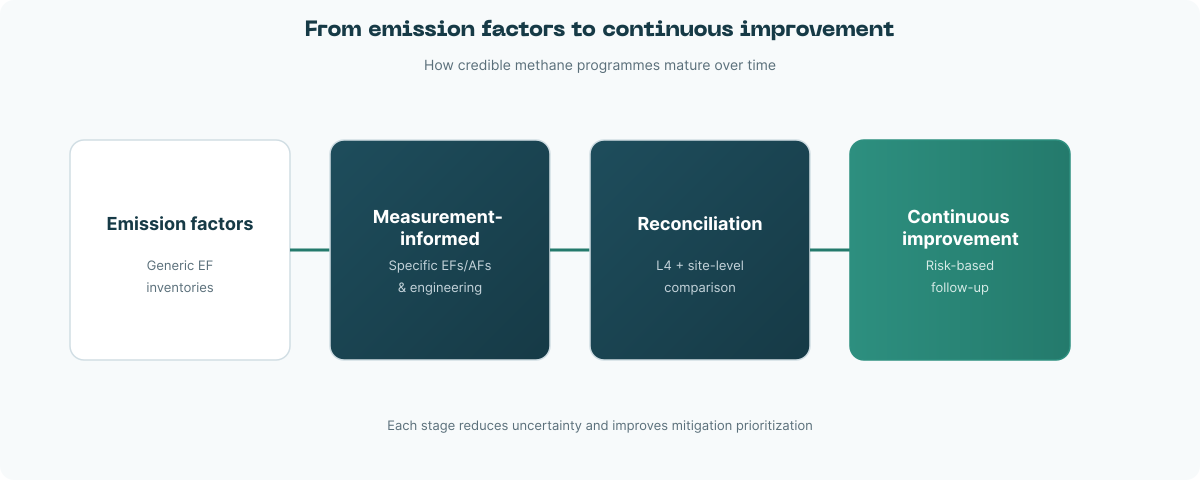
Figure 1: Credible methane programmes move from generic emission factors to measurement-informed inventories, then to reconciliation and continuous improvement.
The Four Pillars of Successful OGMP Implementation (Validere synthesis)
UNEP defines the reporting levels and Gold Standard clocks. What the Framework does not name explicitly is the operating system underneath a programme that works. Based on the OGMP 2.0 Reporting Framework, related guidance, and common implementation patterns, Validere groups successful programme design around four pillars:
|
Pillar |
What it means in practice |
What fails when it is weak |
|---|---|---|
|
1. Complete inventory |
Agreed asset / site / source hierarchies and a Level 3 map strong enough to rank materiality |
Measurement campaigns that cannot be attributed or prioritized |
|
2. Representative measurement |
Source-level and site-level designs that answer specific questions, with independent methods for Level 5 |
Expensive data that still misses fat tails or cannot support annual totals |
|
3. Governed reconciliation |
Documented comparison, investigation, adjustment, and method learning year over year |
Averaged numbers that look like Level 5 and do not survive review |
|
4. Continuous improvement |
Risk-based measurement frequency, mitigation feedback, and reusable evidence across reporting cycles |
A May scramble that resets every year |
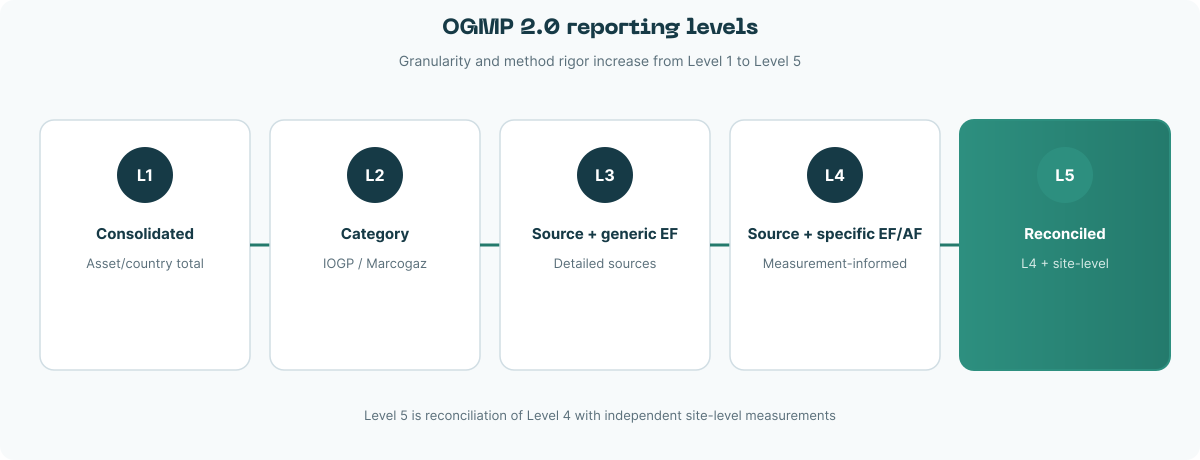
Figure 2: Validere’s Four Pillars of Successful OGMP Implementation. Reporting levels describe data quality. These pillars describe the operating model that produces it. This is Validere’s practitioner framework, not a UNEP designation.
This framing is Validere’s implementation synthesis. Use it as a diagnostic: if one pillar is missing, higher reporting levels become fragile even when the technology budget looks impressive.
What is OGMP 2.0?
OGMP 2.0 is a multi-stakeholder partnership hosted by UNEP. Member companies commit to annual Scope 1 methane reporting across operated assets and material non-operated joint ventures, using progressively more accurate quantification methods, and to a methane reduction target paired with an implementation plan.
The partnership includes companies, governments, international organizations, and NGOs. Formal governance sits with the Steering Group, which decides by consensus. Technical task forces develop guidance. Upstream and midstream/downstream mirror groups give all company members a channel into technical deliverables. UNEP provides secretariat functions: report review, feedback, aggregation into IMEO’s public products, and the community of practice (implementation conference and technical workshops).
Reality check: Joining OGMP is straightforward. There is no fee, and the MoU can be signed in weeks. Building an operating model that consistently produces defensible, measurement-informed inventories is the real challenge.
History: from OGMP to OGMP 2.0
The original Oil & Gas Methane Partnership launched in 2014 under the Climate and Clean Air Coalition and was implemented by UNEP (partnership overview). Early public reporting emphasized participation, core sources, mitigation status, and reductions. It did not put company methane emission totals into the public domain in the way stakeholders later demanded.
The Framework’s own case for revision is blunt. Emissions reported confidentially under the earlier approach covered unmitigated core sources only. In at least one cited case, those sources represented less than 5% of total methane from participating assets. Mitigated sources still emit. Non-core sources still emit. Stakeholders wanted actual performance, not only a mitigation checklist.
In November 2020, UNEP, the Climate and Clean Air Coalition, the European Commission, the Environmental Defense Fund, and 62 oil and gas companies launched OGMP 2.0. The updated framework broadened midstream and downstream coverage, expanded from nine core sources to all material sources, introduced five reporting levels, and tied reporting progress to a Gold Standard pathway.
Purpose and relationship to IMEO
The Framework sets four objectives: public and government assurance that members manage methane responsibly; a credible company demonstration of progress against targets; continuous improvement through transparency and shared practice; and wider participation so sector reductions can move in line with Mineral Methane Initiative ambition.
OGMP data also feed UNEP’s International Methane Emissions Observatory (IMEO). IMEO integrates company reporting with satellite observations, scientific measurement studies, and national inventories. On the Eye on Methane data platform, IMEO describes a four-step assurance process: data quality review, analytics across the partnership, integration of independent datasets, and implementation-plan review. IMEO is also a core implementing partner of the Global Methane Pledge.
Scope: what is in and what is out
In scope
- Scope 1 methane only
- Operated assets and non-operated joint ventures subject to materiality rules
- Upstream exploration and production, gathering and processing, LNG liquefaction and regasification, gas transmission, underground storage, and distribution
- Oil production where associated gas is co-produced
- All methane sources: venting, fugitives, and incomplete combustion (including flaring)
Out of scope under the current Framework
- Scope 2 and Scope 3
- Oil refining and chemical manufacturing (treated as end users; possible later phase)
- Gas end use
- Non-operated joint ventures where equity is below 5% (still listed as excluded)
Membership itself has no fee. Companies sign a Memorandum of Understanding with UNEP. The real cost is staff time, measurement programmes, and the operating discipline required to reach and maintain Gold Standard status.
Member requirements
Every member must:
- Define and disclose a methane reduction target (absolute or intensity-based)
- Submit an implementation plan describing the pathway to Gold Standard
- Report annually on methane emissions from operated and non-operated assets, revising the plan as needed
Annual submissions are due 31 May. Companies typically begin mandatory reporting the calendar year after joining. UNEP’s recommended industry-level ambition language includes 45% methane reductions versus estimated 2015 levels by 2025 and 60–75% by 2030, or a near-zero intensity such as the Oil and Gas Climate Initiative’s collective upstream average target of 0.25% by 2025. Those figures are aspirational sector markers. Each company sets its own target.
So what: Treat OGMP as a multi-year operating commitment, not a disclosure badge. The Framework’s public value is that it forces companies to improve the quality of the methane number over time, then connect that number to mitigation. If the only change after joining is a new slide in the sustainability report, the programme has not started.
Why the industry moved beyond emission-factor reporting
Methane is difficult to inventory precisely because a large share of emissions comes from events that are intermittent, abnormal, or poorly represented by average factors: leaks that appear between surveys, malfunctioning equipment, third-party damage, unlit or inefficient flares, and tank or compressor events that dominate annual totals.
Traditional inventories multiply activity data by generic emission factors. That approach is fast, comparable, and cheap. It is also structurally weak on the sources that matter most for mitigation. Scientific literature and UNEP’s Uncertainty and Reconciliation guidance both emphasize that methane distributions are often skewed and fat-tailed. A small number of sources or sites can account for a disproportionate share of emissions. Sampling designs that assume a neat average systematically understate risk.
The International Energy Agency’s Global Methane Tracker 2025 puts the credibility problem in numbers. Measured emissions tend to be higher than reported emissions. Little or no measurement-based data is used for reporting in most of the world. Around 10% of emissions reported into OGMP 2.0 now sit in the most stringent data category, and some companies reached that highest reporting level in 2024.
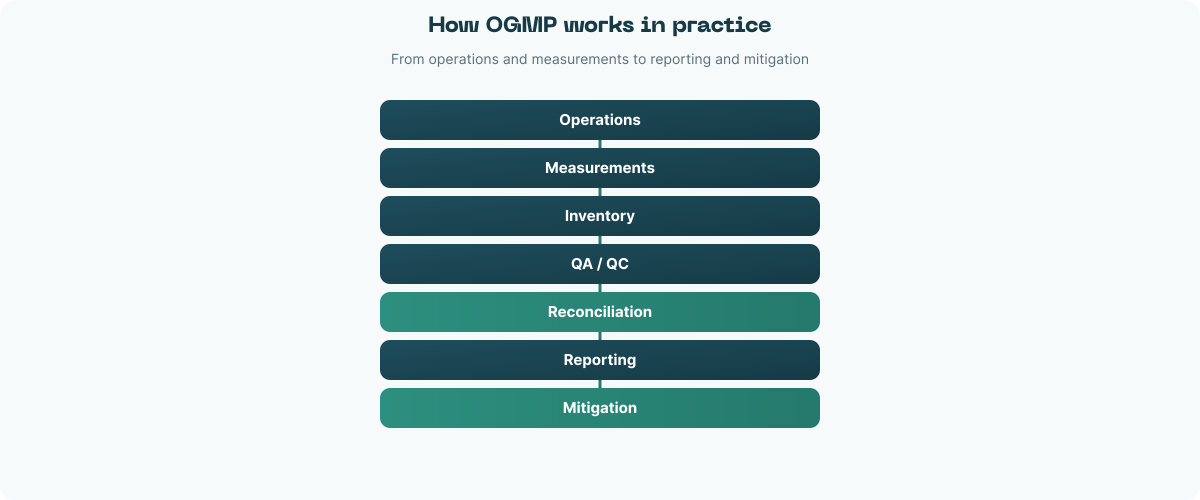
Figure 3: IEA estimates energy-related methane emissions are about 80% higher than the aggregate reported by countries to the UNFCCC (Global Methane Tracker 2025). The gap is why measurement-informed corporate reporting matters.
That underreporting gap is not an academic curiosity. It is the reason investors, regulators, and operators increasingly distrust factor-only inventories.
Regulatory systems are moving in the same direction, even where they are not OGMP itself.
|
Regime |
Shift toward measurement |
How it relates to OGMP |
|---|---|---|
|
Builds on OGMP 2.0 concepts; describes Levels 3–5 and OGMP’s 3/5-year timing logic |
OGMP is a voluntary reference framework the Regulation explicitly builds on |
|
|
US EPA Subpart W (May 2024 amendments) |
Requires empirical data, fills source gaps, allows advanced technologies for large release events, expands direct measurement options |
Mandatory US GHGRP reporting; complementary pressure, not the same programme |
|
Canada / ECCC national inventory |
Incorporates atmospheric measurement-derived improvements for sources such as tanks, compressors, and unlit flares |
National inventory evolution parallel to corporate measurement journeys |
They are no longer sufficient as the endpoint if the goal is credible mitigation prioritization, investor differentiation, or alignment with emerging MRV expectations. Here, MRV means the broader measurement, reporting, and verification process, not OGMP itself. See what MRV means in oil and gas.
|
Approach |
What it produces |
Strength |
Limitation |
|---|---|---|---|
|
Generic emission-factor inventory |
Activity × published factor |
Fast and comparable |
Misses site specificity and abnormal events |
|
Source-detailed inventory (Level 3) |
Source types with generic factors |
Guides mitigation by source |
Still weak on temporal extremes and unmapped sources |
|
Measurement-informed source inventory (Level 4) |
Specific factors, activity data, engineering methods informed by measurement |
Higher source confidence |
Sampling design and documentation become critical |
|
Independent site-level measurement |
Facility or population quantification |
Finds missing or large events |
Hard to annualize alone; weak for source prioritization by itself |
|
Reconciliation (Level 5) |
Best estimate after comparing Level 4 and site-level results |
Completeness plus confidence |
Iterative, expertise-heavy, data-intensive |
Practical insight: Factor-based inventories fail quietly. They still produce a number, a chart, and a filing. The failure shows up later as unexplained aerial results, contested investor questions, or mitigation budgets aimed at the wrong equipment. Measurement-based reporting is expensive. Misallocated abatement capital can become more expensive.
Understanding the five OGMP reporting levels
OGMP 2.0 levels combine three dimensions: reporting granularity, quantification method, and uncertainty reduction through complementary measurement. Progression is not a one-level-per-year ladder. Different assets can sit at different levels. Different sources inside one asset can use different methods. When methods mix, the Framework says the reported level should reflect the methodological complexity applied to the majority of methane emissions from that asset.
Do not equate OGMP levels with IPCC inventory tiers. The Framework warns they differ conceptually. The official FAQ notes congruence with IPCC approaches, then adds that OGMP requires reconciliation of source-level and site-level reporting beyond IPCC Tier 3.
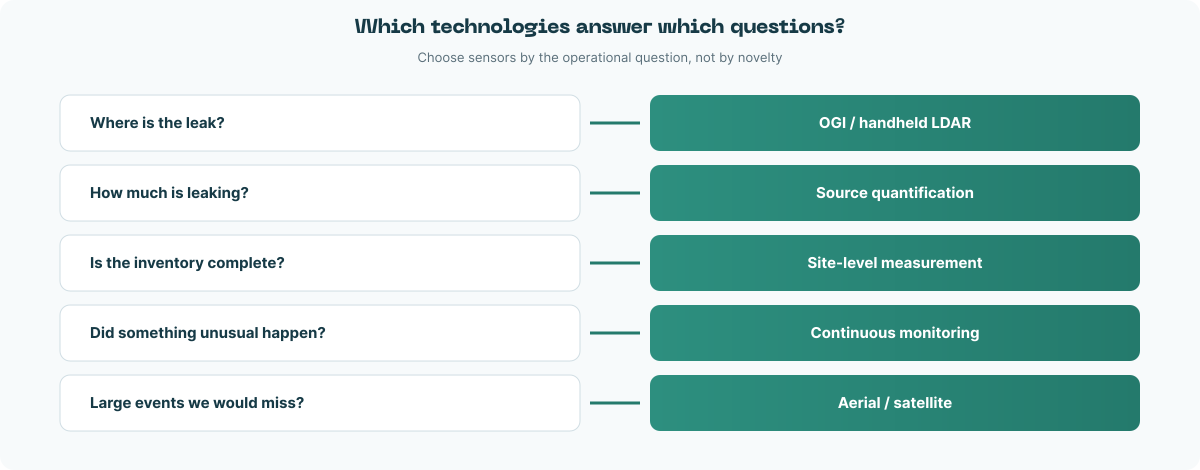
Figure 4: OGMP 2.0 reporting levels progress from consolidated estimates to source-level inventories and, at Level 5, reconciliation with independent site-level measurements.
The levels describe data quality. Validere’s Four Pillars describe how an organization produces that quality. Keep both in view as you read.
Level 1: consolidated venture, asset, or country reporting
Level 1 is a single consolidated methane figure (or a limited set of figures) for a reporting unit. Emissions are not allocated to categories or source types. The Framework reserves this level for operations with very limited information: little or no source mapping, or highly constrained data from a joint-venture operator.
Quantification typically uses high-level factors or analogy to comparable assets. Level 1 is an on-ramp, not a destination for material assets.
Level 2: category-level reporting
Level 2 adds major source categories.
Upstream (IOGP five categories): venting; fugitive losses; flaring (unburned fraction); energy/combustion (unburned fraction); other/unspecified.
Midstream and downstream (Marcogaz three categories): fugitive losses; venting; incomplete combustion.
Emissions in each category are typically quantified with generic factors, though more advanced methods are allowed. Level 2 is still too coarse for source-level mitigation planning, but it forces the first useful split between designed vents, leaks, and combustion inefficiencies.
Level 3: detailed source types with generic emission factors
Level 3 reports by detailed source type using generic but source-specific emission factors. Examples include factors in OGMP Technical Guidance Documents or similar published sources. A complete Level 3 inventory matters more than many teams expect. UNEP’s Uncertainty and Reconciliation guidance treats it as the foundation for materiality analysis and Level 4 method development.
Manufacturer estimates are typically Level 3 unless the company can justify Level 4 treatment through measurement or equivalent operating conditions.
Practitioner note: Level 3 is where many programmes should spend their first serious months. Not because generic factors are the goal, but because an incomplete source map weakens later decisions: materiality rankings, measurement budgets, and reconciliation disagreements all inherit the gaps.
Level 4: detailed source types with specific emission and activity factors
Level 4 keeps source-level granularity and replaces generic factors with company- or asset-specific emission factors and activity factors. Those specifics may come from:
- source-level measurement and sampling
- measurement-derived company emission factors
- detailed engineering calculations or simulation tools where appropriate
- combinations of the above
Level 4 does not require every source to be remeasured every year. Measurement should inform method development. Non-material sources may remain at Level 3 quality inside a Level 4 inventory. Documentation of sampling strategy, methods, technology limitations, and uncertainty is part of credible Level 4 work.
Common misconception: Level 4 is not “we flew a plane once.” It is a governed method for each material source type, informed by measurement or detailed engineering, that can be defended in next year’s report when the portfolio, operating conditions, or equipment count changes.
Level 5: Level 4 plus independent site-level measurement and reconciliation
Level 5 is among the most misunderstood concepts in OGMP 2.0.
It is not a synonym for “top-down,” “aerial survey,” or “site-level measurement.” According to the official FAQ and the Uncertainty and Reconciliation guidance, Level 5 is the reconciliation of a Level 4 source inventory with independent site-level measurements. Site-level measurements complement source-level estimates. They do not replace them.
Why that distinction matters: site-level snapshots are difficult to extrapolate to an annual total on their own, and source-level inventories remain necessary to prioritize mitigation. Reconciliation is an iterative investigation process, year over year, not a one-time average of two numbers.
Site-level methods must be independent of the methods used for the source-level inventory. One campaign cannot satisfy both requirements. Technologies may include sensors on vehicles, drones, aircraft, or boats; continuous monitoring where fit for purpose; and satellites only where resolution and detection limits support site-level characterization. Frequency should be risk-based: larger discrepancies and higher materiality justify more frequent follow-up.
If Level 4 totals and site-level results disagree, operators should investigate, report transparently, adjust the Level 5 asset estimate as appropriate, and feed findings into the next year’s measurement strategy and, where needed, revise Level 4 methods.
Common misconception: Level 5 is not “buying satellites.” Satellites can contribute, especially for large events and regional context, but Level 5 is reconciliation. Without a credible Level 4 inventory and an investigation process, a site-level number is just another disconnected estimate.
Recurring Level 5 challenge: Organizations often struggle with Level 5 less because of measurement hardware than because asset hierarchies, ownership data, and source inventories were not mature enough for site-level results to be compared, explained, and acted on. In many programmes, improving governance is what makes the next measurement investment useful.
Gold Standard versus Level 5
|
Concept |
Meaning |
|---|---|
|
Gold Standard Pathway |
Early recognition based on a compliant Level 1+ report, a granular implementation plan to reach Level 4/5 on timeline, and a methane target |
|
Gold Standard (endpoint) |
Level 4/5 for material operated assets within three years of joining, and for material non-operated assets within five years, with demonstrated efforts toward Level 5 |
|
Maintaining Gold Standard |
Continued year-over-year progress toward Level 5, ultimately annual Level 5 reporting within the set timeline |
|
Level 5 |
Methodological reporting level: reconciled Level 4 + independent site-level measurement |
The FAQ’s practical guidance on “demonstrated efforts” toward Level 5 suggests attempting site-level measurement and possible reconciliation for a nominal one-third of assets and/or covered emissions, then expanding year over year. Less coverage may be considered case by case. Companies can lose Gold Standard status if they abandon a credible path or miss Level 4/5 timing for the overwhelming majority of assets, subject to reasonable and demonstrable efforts (especially for non-operated ventures). Missing the timeline does not automatically end membership.
Keep the badge and the method separate. A credible Gold Standard path asks whether material assets are progressing on timeline. A Level 5 claim asks whether Level 4 and site-level results were actually reconciled. Conflating those questions is how programmes look advanced on slides and fragile in review.
Materiality rules that determine where Level 4/5 applies
Portfolio level
- Rank assets by absolute emissions on a 100% basis (not equity) using at least Level 3 for operated assets.
- Assets accounting for 95% of total emissions are material and must progress to Level 4/5 on the operated or non-operated timeline.
- The bottom 5% are still reported but are not required to reach Level 4/5.
- Non-operated assets below 5% equity are not material and are listed as excluded.
Asset level
- Rank sources using best available data (minimum Level 3).
- Perform Level 4 on sources that account for at least 70% of the asset’s methane emissions, with justification if coverage does not exceed 90%.
- Prioritize deeper Level 4 coverage on assets that dominate operator-level emissions.
Materiality should be refreshed when operations change significantly (for example, a 20% emissions change within three years). UNEP recommends review every three years unless portfolio changes intervene. Newly material assets or sources should reach Gold Standard reporting levels in the second year after becoming material, subject to reasonable efforts for non-operated assets.
So what: Organizations often assume reaching Level 5 is mainly about deploying better measurement technology. In practice, much of the work sits earlier: building complete source inventories, improving data governance, and designing representative measurement programmes. Materiality is the Framework’s way of forcing that prioritization. Use it as a capital-allocation tool, not only as a reporting rule.
How OGMP reporting works in practice
Definitions explain membership. Implementation is an operating model.
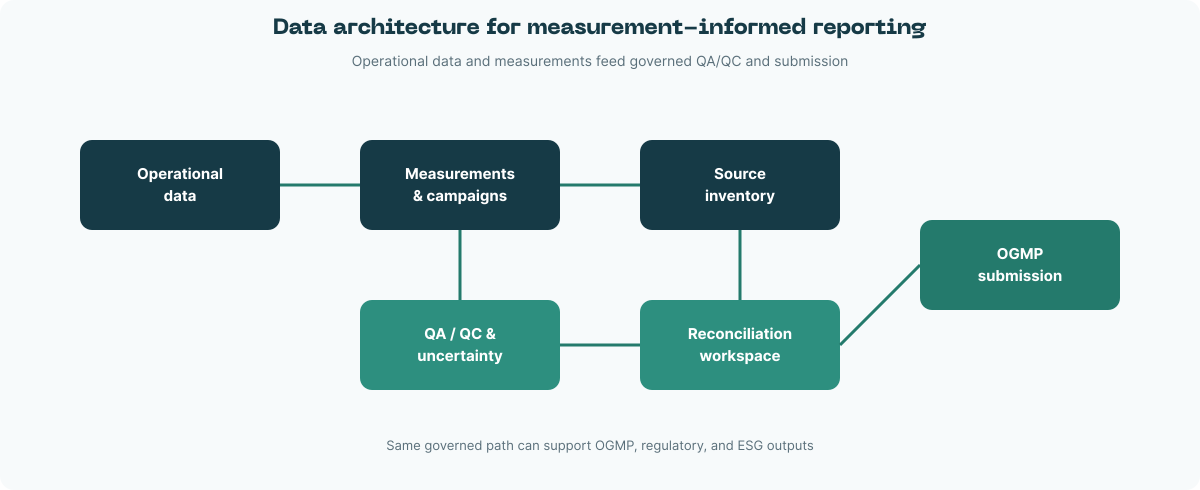
Figure 5: In practice, OGMP connects operations and measurements to inventory, QA/QC, reconciliation, reporting, and mitigation.
1. Build the asset inventory
List operated assets and non-operated joint ventures at or above 5% equity. Define each reporting unit using Framework criteria: a logical business or operating unit, typically smaller than a country if geographically bounded, with all facilities in the unit participating.
Then define sites and sources inside each asset. Site and facility boundaries matter because Level 5 reconciliation happens at that scale. Source definitions matter because Level 3 and Level 4 inventories are only as complete as the equipment and process map behind them.
2. Produce a complete Level 3 map before chasing measurement theatre
Teams under pressure to “get to Level 5” sometimes skip the unglamorous inventory work. That usually backfires. Without a complete Level 3 source map, materiality rankings are fragile, Level 4 prioritization is guesswork, and reconciliation has nothing solid to compare against.
3. Run portfolio and asset materiality
Use absolute emissions ranking to identify the 95% material asset set. Inside each material asset, rank sources and decide which reach Level 4 first. The Framework’s materiality rules exist to focus scarce measurement and engineering effort where absolute methane is largest.
4. Set the methane target and write the implementation plan
The plan is not a slogan. It should be granular by asset, describe current methods, and show a credible path to Level 4/5 within the three- and five-year clocks. UNEP evaluates plans against implementation guidance and a scorecard. Plans can be revised as portfolios and methods change, but they must remain credible.
Distinguish reductions from methodology change. The Framework explicitly asks companies to separate those effects when explaining progress.
5. Design measurement and sampling for Level 4 and Level 5 separately
Level 4 measurement informs source-specific methods. Level 5 site-level measurement must use independent methods and technologies. Sampling should account for skewed distributions and temporal variability. Characterize operating state during site-level campaigns. Where populations of similar sites exist, statistical sampling can support both Level 4 factor development and Level 5 claims, provided representativeness is justified.
6. Quantify, quality-check, and estimate uncertainty
Report in mass units of methane. Propagate uncertainty for both source-level estimates and site-level measurements. UNEP’s guidance is practical here: reduce uncertainty where emissions are material and the remaining uncertainty itself is material. Spending heavily to tighten a ±50% band on a source that is 0.1% of an asset changes almost nothing.
7. Reconcile where Level 5 applies
Compare Level 4 sums and site-level results on matching spatial and temporal bases. Investigate disagreements. Adjust the reported Level 5 estimate. Document what was learned even when reconciliation is incomplete. Feed the learning into next year’s plan.
8. Complete templates, submit by 31 May, and prepare for review
Upstream and midstream/downstream templates differ. Asset-level detail is confidential to UNEP. Public disclosure covers company targets, totals aggregated by reporting level and by operated versus non-operated assets, progress toward targets, and Gold Standard pathway or reporting status. Asset-level numbers become public only if a company voluntarily discloses them.
IMEO review can include consistency checks against similar assets and independent datasets. Treat that review as part of the operating calendar, not as an afterthought in late May.
Reasonable and demonstrable effort for joint ventures
Non-operated ventures are where many programmes stall. The Framework does not pretend every partner will share perfect data on schedule. It does require documented efforts: seeking disclosure permissions, recording barriers, and showing work with partners to improve reporting. Inability to obtain restricted data, when properly documented, should not by itself remove Gold Standard status.
Practical insight: The NOJV workstream is often a commercial and legal problem before it is a methane problem. Start permission conversations early, track barriers in the same system as operated-asset methods, and do not let a single opaque venture freeze progress on the operated portfolio that you fully control.
What an OGMP implementation roadmap actually looks like
UNEP gives clocks: three years for operated assets, five for non-operated. It does not prescribe a weekly project plan.
Attribution note: The implementation roadmap below is Validere’s synthesis of common implementation sequencing based on the OGMP 2.0 Framework and related guidance. It is intended as practical guidance and is not part of the official UNEP framework. Adjust for portfolio complexity, but do not invert the foundation → Level 4 depth → reconciliation sequence.
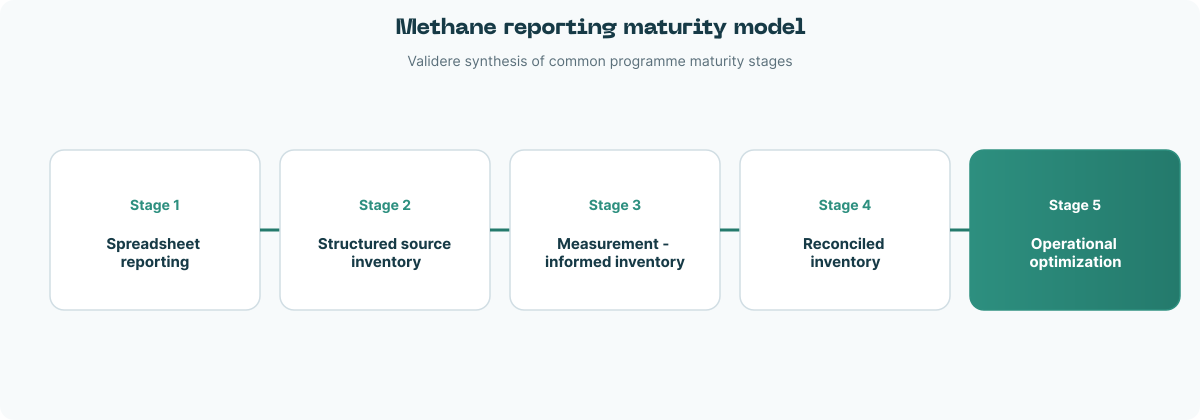
Figure 6: Programme maturity often moves from spreadsheets to source inventories, measurement, reconciliation, and continuous improvement. Validere synthesis, not a UNEP model.
Year 0 to Year 1: foundation
- Confirm MoU, governance owners, and reporting calendar through 31 May
- Build the operated and NOJV asset universe, including equity and operator flags
- Agree asset / site / source hierarchies with operations, HSE, and sustainability
- Produce a complete Level 3 source inventory for ranking
- Run portfolio and asset materiality
- Set the methane target and draft the implementation plan by asset
- Identify where existing LDAR, flare, and production data already support Level 4 methods
- Stand up evidence standards: method versions, campaign metadata, approvals
What success looks like: You can explain, for every material asset, what you emit under best available methods, why that asset is in or out of the 95% set, and what must change to reach Level 4.
Year 2: Level 4 depth
- Prioritize Level 4 methods on the largest sources inside the largest assets
- Design sampling for fat-tailed distributions, not convenience samples
- Separate source-level measurement campaigns from any planned site-level work
- Quantify uncertainty where it can change decisions
- Reconcile method changes versus actual reductions in internal management reports
- Expand NOJV engagement with documented requests and barriers
- Pilot Level 5 on a bounded set of sites or populations (often aligned with UNEP’s “about one-third” demonstration guidance)
What success looks like: Material sources have defensible specific methods, and disagreements with early site-level results produce investigations rather than surprises.
Year 3: reconciliation and Gold Standard for operated assets
- Expand Level 5 coverage across material operated assets
- Institutionalize reconciliation: compare, investigate, adjust, revise Level 4 methods, replan sampling
- Tighten QA/QC and audit trails so the May submission is a package, not a scramble
- Use reconciled results to redirect mitigation spend toward confirmed material sources
- Refresh materiality if portfolio or emissions changed significantly
- Keep the non-operated plan on the five-year clock with visible progress
What success looks like: Operated material assets are at Level 4/5 with demonstrated Level 5 effort, and the organization can show year-over-year learning rather than a one-off campaign.
Years 4 to 5 and beyond: optimize and sustain
- Bring material NOJVs to Level 4/5 where data access allows
- Move from campaign-centric measurement toward risk-based frequency, including continuous monitoring where it answers a real temporal question
- Maintain Gold Standard by progressing toward annual Level 5 reporting
- Reuse the same governed data for regulatory, certification, and ESG outputs where boundaries allow
- Treat mitigation response time as a programme KPI, not only inventory quality
Reality check: Organizations that prioritize measurement hardware before governance often discover that the hardest problems were not technical. They were organizational: disputed asset lists, unclear method ownership, and no place to put reconciliation findings.
Technologies supporting OGMP implementation
OGMP 2.0 is technology-neutral. The official FAQ states that UNEP does not recommend specific detection or quantification technologies because the fit depends on deployment and site conditions. The useful question is not “which gadget is OGMP-approved,” but “which operational question does this technology answer, and which OGMP reporting need does that question support.”
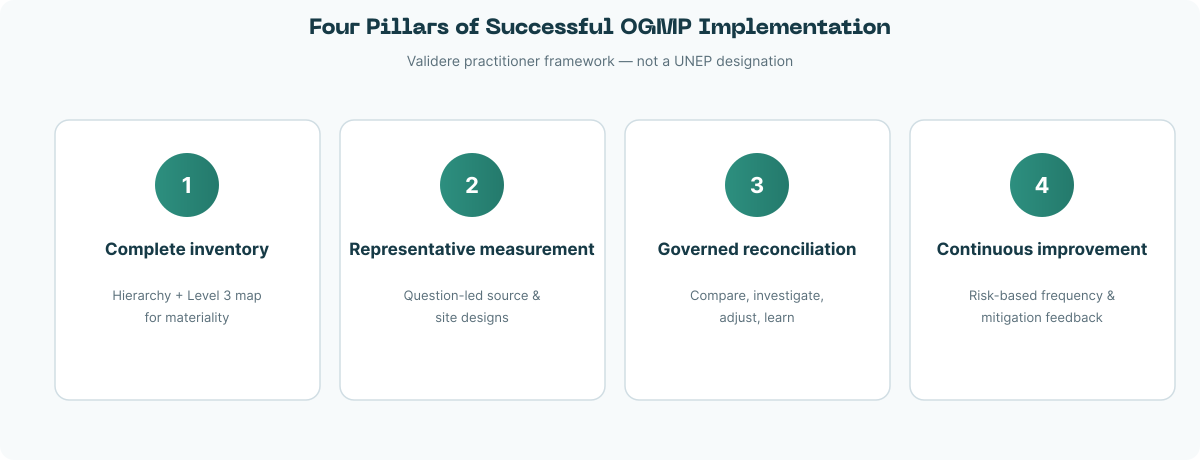
Figure 7: Choose measurement approaches by the question you need answered, not by the novelty of the sensor.
Which technologies answer which questions?
|
Question operators actually ask |
What “good enough” looks like |
Typical technology families |
|---|---|---|
|
Where is the leak or emitting component? |
Spatial attribution that supports repair |
OGI, handheld LDAR, close-range sensors |
|
How much is this source emitting? |
Quantified rate usable in a Level 4 method |
High-flow sampling, direct quantification, metered vents, engineering methods informed by measurement |
|
Is our source inventory complete for this site? |
Independent site-level characterization for reconciliation |
Aerial, drone, mobile ground, fit-for-purpose continuous systems |
|
Did something unusual happen between surveys? |
Temporal coverage of intermittent events |
Continuous monitoring, frequent revisit strategies, alert systems |
|
Are there large events we would otherwise miss? |
Detection above a stated threshold with follow-up |
Aircraft, satellite point-source mappers, super-emitter programmes |
|
Can we defend an annual total under uncertainty? |
Sampling design, operating-state metadata, and documented reconciliation |
Combination of the above plus statistical design |
|
Approach |
Typical OGMP role |
Strengths |
Limits |
|---|---|---|---|
|
OGI / handheld LDAR |
Find and fix; inform fugitive activity factors |
Source location; mitigation action |
Quantification quality varies; intermittent events |
|
High-flow / direct source quantification |
Level 4 method development |
Attribution to equipment |
Labor-intensive; limited coverage |
|
Continuous monitoring |
Temporal coverage; alerts |
Catches intermittent events |
Spatial limits; quantification uncertainty |
|
Ground mobile / truck |
Site screening |
Flexible deployment |
Access and weather constraints |
|
Drone |
Site or facility survey |
Access to difficult locations |
Flight rules; survey duration |
|
Aerial (aircraft) |
Basin or site campaigns |
Scale; strong Level 5 candidate |
Snapshot bias; cost |
|
Satellite |
Super-emitters; regional context |
Independent coverage |
Detection limits; not sole Level 5 method for most sites |
|
Engineering calculation / simulation |
Level 4 where direct measurement is hard |
Process insight |
Model assumptions must be justified |
Satellite caveats that belong in every Level 5 plan
Point-source mapper satellites can identify and quantify large emission events. Under current capabilities described in the OGMP FAQ, they generally cannot alone provide the annual site-level characterization needed for Level 5 unless a site has large continuous emissions well above detection limits. A non-detection is not a zero. Satellites can still contribute useful information inside a multi-tiered monitoring design and through IMEO’s Methane Alert and Response System, but they are insufficient as the sole site-level technology for most facilities.
How technologies should complement one another
Detection finds candidates for repair. Source-level quantification builds Level 4 methods and attributes emissions to equipment operators can change. Site-level measurement tests whether the inventory is complete. Continuous monitoring catches what infrequent surveys miss. Reconciliation improves both the inventory and the next measurement strategy.
So what: A technology roadmap that starts with “deploy continuous monitoring everywhere” often fails the budget and the Framework. A roadmap that starts with “which unanswered question is blocking Level 4 or Level 5 on our largest assets?” spends money where it changes the reported number and the mitigation plan.
Common implementation challenges
These challenges are operational, not a UNEP checklist. They show up repeatedly once companies move from membership announcements to template cells that have to survive review.
Disconnected systems and manual handoffs
Activity data live in production accounting. Component counts live in maintenance systems. LDAR results live in a vendor portal. Aerial campaign outputs arrive as PDFs. Equity shares live in finance. By May, environmental teams become the integration layer. That can work for one asset. It does not scale to a global operated and non-operated portfolio.
Inconsistent asset hierarchies
If “asset,” “site,” and “source” mean different things to operations, HSE, and sustainability, Level 4 rollups and Level 5 reconciliation become arguments about boundaries rather than emissions. Fix the hierarchy early.
Weak Level 3 foundations
Buying a flyover before finishing the source inventory usually means the programme is optimizing for visibility rather than defensibility. Measurement without a complete Level 3 map makes materiality and Level 4 prioritization unreliable.
Sampling that ignores fat tails
Too few measurements, Gaussian assumptions, or one campaign reused for both Level 4 and Level 5 all create low bias and review risk. Independence of methods is a Framework requirement, not a preference.
Reconciliation treated as arithmetic
Averaging a Level 4 total and a site-level total without investigation is not Level 5. Reconciliation is documentation of comparison, disagreement, investigation, adjustment, and method learning.
Audit and evidence gaps
Alternate emission factors without justification, undocumented engineering calculations, missing operating-state metadata for campaigns, and no lineage from sensor reading to template cell all become expensive during UNEP review or when the same data are reused for regulatory or certification programmes.
Change management
Gold Standard is a multi-year operating model. Asset managers, not only corporate sustainability teams, need enough visibility to act on material sources. UNEP’s own community of practice has moved toward asset-manager engagement for that reason.
Practical insight: The spreadsheet is often not the root problem. The deeper issue is that ownership of hierarchy, methods, measurements, and approvals was never assigned. Software can encode that ownership. It cannot invent it.
How software supports successful OGMP programmes
Measurement vendors, engineering methods, and governance decisions remain central. Software matters when those pieces have to share one governed reality: the same asset hierarchy, the same method versions, the same evidence chain, and the same ability to distinguish a real reduction from a methodology change.
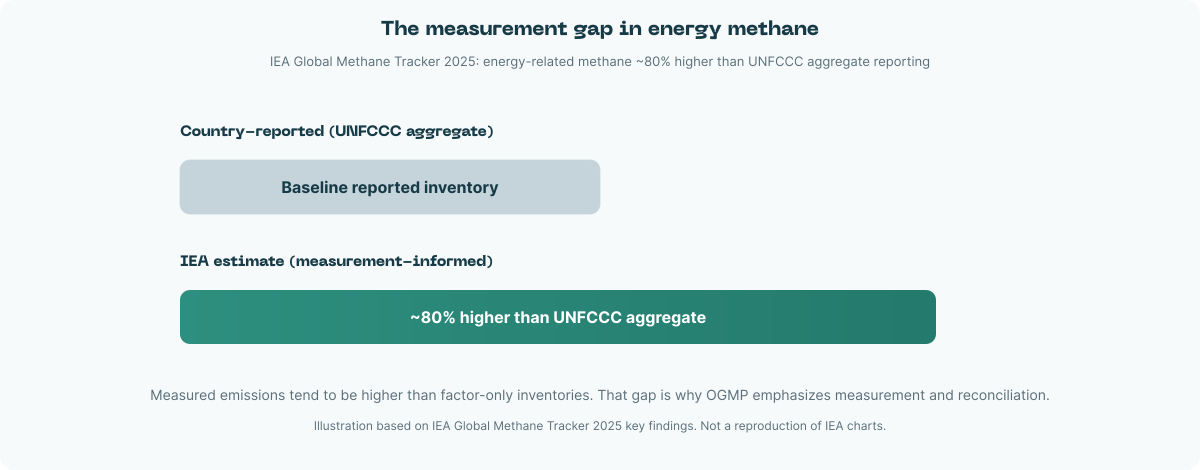
Figure 8: Measurement-informed methane reporting depends on a governed path from operational data and measurements through QA/QC to submission and mitigation.
The capabilities below are product-agnostic. They map directly to what OGMP implementation requires.
|
Capability |
Why OGMP programmes need it |
|---|---|
|
Governed asset master (operated/NOJV, equity, segment) |
Scope, materiality, and template structure |
|
Source inventory linked to sites |
Level 3 completeness and Level 4 prioritization |
|
Activity-data integration |
Defensible activity factors |
|
Multi-technology measurement ingestion with metadata |
Method, detection limit, timestamp, operating state |
|
Versioned calculation methods |
Transparent Level 3/4 work; method-change versus real change |
|
Uncertainty support |
Level 5 comparison on a defensible basis |
|
Reconciliation workspace |
Document comparison, investigation, and adjustments |
|
Workflow, approvals, and audit trail |
Internal assurance and external review readiness |
|
Reporting aligned to OGMP templates |
31 May submission without spreadsheet archaeology |
|
Multi-framework reuse |
Same underlying data for OGMP, Subpart W, EU MRV, and ESG disclosure without forcing one number to serve every boundary |
As organizations progress from Level 3 inventories toward Level 4 and Level 5 reporting, the challenge increasingly shifts from measurement alone to coordinating operational data, measurement results, calculation methodologies, QA/QC processes, and reporting evidence across multiple systems. That is where emissions management software becomes operational infrastructure rather than a reporting tool.
Platforms designed for industrial emissions programmes, including Validere, are built around that coordination problem: connecting operational data, hardware-agnostic measurement inputs, calculation methods, and reporting evidence so methane programmes can move from factor-based inventories toward measurement-informed and reconciled reporting without rebuilding the process every May.
Validere is not required for OGMP membership, is not UNEP-endorsed, and does not replace measurement providers or engineering judgment. Where it fits is as an example of an Air & GHG approach that treats OGMP as an operating workflow: asset hierarchies, measurement integration, calculation transparency, and audit-ready lineage supporting voluntary emissions reporting pathways that include OGMP 2.0 alongside regulatory air and GHG reporting.
Teams evaluating software for methane programmes should look past dashboards and ask how exceptions are investigated, how method versions are preserved, and whether the same governed data can support emissions reporting, LDAR programme management, and broader environmental compliance work without parallel shadow systems.
If you are starting an OGMP programme tomorrow
Begin with these five actions:
- Build your asset hierarchy with operations, HSE, and sustainability in the same room until “asset,” “site,” and “source” mean one thing.
- Finish your Level 3 inventory for ranking before commissioning another measurement campaign.
- Identify material assets using the 95% absolute-emissions rule, then rank sources inside those assets.
- Do not buy technology before you know your measurement questions. Map each purchase to a Level 4 method need or a Level 5 reconciliation need.
- Treat reconciliation as a recurring operating process, with owners, evidence standards, and a place to record investigation findings.
Those five steps support Validere’s first pillar (complete inventory) and set the conditions for representative measurement and governed reconciliation. Everything else scales from there.
Download the one-page OGMP 2.0 Implementation Checklist →
Final thoughts
OGMP 2.0 is often described as a reporting framework. In practice, successful implementations become operational improvement programmes.
Organizations that treat it as another disclosure obligation often struggle with governance, measurement strategy, and reconciliation. Organizations that build measurement-informed operating models create more reliable inventories, make better mitigation decisions, and are better prepared for the direction methane regulation is heading globally.
The Four Pillars are a useful diagnostic. If the inventory is incomplete, measurement will not save you. If measurement is not representative, reconciliation will not converge. If reconciliation is not governed, the May submission will not teach the organization anything. If continuous improvement is missing, next year’s report starts from zero again.
That is Validere’s takeaway from reading the Framework as an operating problem, not only a disclosure problem. The FAQs below answer the common definitional questions. The work starts with the hierarchy and the Level 3 map.
Key takeaways
- OGMP 2.0 exists because two similar inventories can conceal very different real-world methane performance. Measurement and reconciliation are how that gap closes.
- The five levels increase source granularity, method specificity, and, at Level 5, independent site-level reconciliation.
- Successful programmes tend to share four characteristics in Validere’s synthesis: complete inventory, representative measurement, governed reconciliation, and continuous improvement.
- Gold Standard is a pathway and performance designation with three- and five-year clocks. Level 5 is the methodological endpoint those clocks aim toward.
- A practical roadmap sequences foundation, Level 4 depth, then reconciliation at scale. Inverting that order is a common and expensive failure mode.
- Software should support the workflow after the educational questions are clear: hierarchy, methods, measurements, evidence, and reusable reporting.
Glossary
|
Term |
Plain-language meaning in this guide |
|---|---|
|
OGMP / OGMP 2.0 |
Oil & Gas Methane Partnership; UNEP’s voluntary measurement-based methane reporting and mitigation framework (2.0 is the 2020 update) |
|
IMEO |
International Methane Emissions Observatory; UNEP initiative that integrates OGMP data with satellites, science studies, and inventories |
|
NOJV |
Non-operated joint venture; assets a member does not operate but may need to report subject to materiality and data-access rules |
|
MRV |
Measurement, reporting, and verification; the broader discipline of producing defensible emissions data |
|
LDAR |
Leak detection and repair; programmes and tools used to find and fix fugitive emissions, often feeding Level 4 fugitive methods |
|
Source inventory |
The mapped list of methane-emitting equipment and processes used for Level 3/4 reporting |
|
Measurement-informed inventory |
A source inventory whose emission or activity factors are informed by measurement or detailed engineering rather than generic defaults alone |
|
Materiality |
OGMP rules that focus Level 4/5 effort on assets and sources that dominate absolute emissions (portfolio 95% rule; asset-level 70%/90% guidance) |
|
Gold Standard |
Annual OGMP designation for a credible pathway to, and then achievement of, Level 4/5 on required timelines with demonstrated Level 5 progress |
|
Four Pillars |
Validere’s practitioner framework (not UNEP): complete inventory, representative measurement, governed reconciliation, continuous improvement |
|
Reconciliation |
Comparison of Level 4 source estimates with independent site-level measurements, followed by investigation and method learning |
|
Site-level measurement |
Quantification that characterizes emissions at a site or facility scale for a representative sample or population |
|
Emission factor (EF) |
Coefficient converting activity into methane mass; generic at Level 3, specific at Level 4 |
|
Activity factor (AF) |
Operating or equipment activity data used with emission factors to estimate emissions |
Frequently asked questions
What is OGMP 2.0?
OGMP 2.0 is UNEP’s flagship oil and gas methane reporting and mitigation programme. Official UNEP materials describe it as the only comprehensive measurement-based international reporting framework for the sector. Member companies report Scope 1 methane across operated and material non-operated assets and work toward Gold Standard reporting levels.
What is OGMP?
OGMP is the earlier partnership launched in 2014 under the Climate and Clean Air Coalition. It was ratcheted up in scope and ambition in November 2020 to become OGMP 2.0.
Is OGMP mandatory?
No. Participation is voluntary through a Memorandum of Understanding with UNEP. The EU Methane Regulation builds on OGMP 2.0 concepts, and other market or funding mechanisms increasingly reference membership or measurement-based reporting, but OGMP itself is not a statute.
What are the five reporting levels?
Level 1 is consolidated asset or country reporting. Level 2 reports major emission categories. Level 3 reports detailed source types with generic emission factors. Level 4 uses specific emission and activity factors informed by measurement or detailed engineering methods. Level 5 adds independent site-level measurements and reconciles them with the Level 4 inventory.
What is Level 5?
Level 5 is reconciliation of a Level 4 source-level inventory with independent site-level measurements. It is not site-level measurement alone.
What is the Gold Standard?
Gold Standard is attributed annually. Companies can achieve a Gold Standard Pathway early with a compliant report, implementation plan, and methane target. Reaching and maintaining Gold Standard requires Level 4/5 reporting for material operated assets within three years and material non-operated assets within five years, with demonstrated progress toward Level 5.
How is OGMP different from EPA reporting?
EPA Subpart W is mandatory US Greenhouse Gas Reporting Program reporting for covered facilities, with prescribed methods and public facility-level disclosure rules. OGMP 2.0 is a voluntary global corporate framework with five levels, an implementation pathway, and confidential asset-level reporting to UNEP. Both are moving toward more empirical methane data, but they are not the same programme and will not automatically produce the same number for the same asset.
How is OGMP different from MiQ?
OGMP is a corporate reporting and mitigation partnership. MiQ is an independent certification framework that grades methane (and related) performance at the asset or facility level with accredited third-party audits and certificates that can travel with volumes. The two can be complementary. They are not substitutes.
Who should participate?
Oil and gas companies with material methane emissions across operated portfolios and non-operated joint ventures, including midstream and downstream operators. Public, private, and national oil companies participate.
How long does implementation take?
Formal Gold Standard clocks run three years for operated assets and five years for non-operated assets from joining. Building a complete Level 3 inventory, measurement strategy, and data governance usually starts immediately and determines whether those clocks are realistic.
Does OGMP prescribe specific technologies?
No. OGMP is technology-neutral. Companies select methods fit for their assets and must justify approaches, especially for material sources.
Can satellites alone achieve Level 5?
Generally no under current point-source mapper capabilities described in the OGMP FAQ. Satellites can contribute to multi-tiered monitoring and reconciliation, but they are typically insufficient as the sole site-level technology for Level 5.
What data becomes public?
Company methane targets; total emissions aggregated by reporting level and by operated versus non-operated assets; progress toward targets; and Gold Standard pathway or reporting status. Asset-level detail remains confidential unless a company voluntarily discloses it.
Is there a membership fee?
No membership fee. Staff time, measurement campaigns, and system work are the real costs.
Must companies climb one level per year?
No. Companies may start assets at any level based on available information and methods, then increase levels over time to meet Gold Standard timelines.
Can different assets be reported at different levels?
Yes. Assets and even sources within assets can sit at different levels. The aim is Level 4/5 for material assets within the required period.
How does materiality work?
At portfolio level, assets representing 95% of absolute emissions are material. At asset level, Level 4 should cover sources representing at least 70% of methane emissions, with justification if coverage does not exceed 90%. Non-operated equity below 5% is excluded from materiality.
What is reconciliation?
Reconciliation is the iterative process of comparing Level 4 source inventories with independent site-level measurements, investigating differences, adjusting the best asset-level estimate, and improving methods over time.