When a production environmental manager sits down to build a Subpart W report, the last click in e-GGRT is rarely the hard part. The hard part is whether the basin-level facility they report still matches the well pads, tanks, pneumatics, and survey results that existed during the year, and whether anyone can still explain how a flagged number was calculated.
That is the job this guide is about. EPA Subpart W is the Petroleum and Natural Gas Systems source category of the Greenhouse Gas Reporting Program (GHGRP). For most U.S. oil and gas reporters, it is where Part 98 stops being a program overview and becomes a year-round inventory, method, QA, and evidence problem. For GHGRP and the other oil and gas subparts (Y, MM, NN), start with Validere’s EPA GHGRP reporting guide. This guide focuses specifically on the operational requirements of Subpart W.
EPA defines the requirements. This article helps environmental teams understand what those requirements mean as work. It is not legal advice, not an applicability determination, and not a substitute for 40 CFR Part 98, Subpart W or current EPA reporter materials.
Subpart W status in 2026
As of August 21, 2026, Subpart W remains a current GHGRP source category. EPA finalized amendments in May 2024 (89 FR 42062), with most changes applying to Reporting Year (RY) 2025 reports. EPA also finalized an extension of the RY2025 reporting deadline to October 30, 2026. In September 2025, EPA proposed to permanently remove the natural gas distribution segment and to suspend the other nine Subpart W segments until RY2034. Those proposed changes are not current law unless and until EPA finalizes them. Current Part 98 Subpart W requirements remain in effect while the proposal is pending. See EPA’s rulemaking notices for GHG reporting.
What is EPA Subpart W?
If you report GHGRP for U.S. oil and gas, Subpart W is usually the part of Part 98 that actually shapes the work: which assets sit in the report, which methods apply, and what you have to be able to reconstruct later.
Subpart W is the Petroleum and Natural Gas Systems source category of EPA’s GHGRP, codified at 40 CFR §§ 98.230–98.238. It covers emission sources in ten industry segments of the petroleum and natural gas industry. Owners or operators collect the required data and calculate greenhouse gas (GHG) emissions using the methods specified for each source type and segment. Subpart W also sets requirements for monitoring and QA/QC, missing data, record-keeping, and reporting. See EPA’s Subpart W hub and information sheet.
The GHGs that must be reported depend on the source. EPA’s information sheet describes CO2 and methane from equipment leaks and vented emissions; CO2, methane, and N2O from flares under Subpart W; and combustion GHGs under Subpart W or Subpart C depending on the segment. Binding source lists are in § 98.232. EPA’s printable information-sheet table is useful orientation. It is not a complete substitute for the current eCFR source list after the May 2024 amendments.
Subpart W is not an emissions limit. It is not a corporate GHG Protocol inventory. It is not OGMP 2.0. It is a facility-level (as Subpart W defines “facility”) reporting category with prescribed methods.
Who must report under Subpart W?
In plain terms, two questions decide whether you report under Subpart W: what kind of petroleum or natural gas operation you have, and how EPA defines the facility for that segment. Most people start with a 25,000 metric ton CO2e threshold. That is the usual test. It is not applied the same way in every segment, and four segments do not use a typical plant-gate facility definition.
EPA’s Subpart W hub states that owners or operators of facilities that contain petroleum and natural gas systems and emit 25,000 metric tons or more of GHGs per year (as CO2e) report GHG data to EPA. That sentence is the right starting point. It is not the whole test.
The binding threshold section is § 98.231, not the information sheet’s citation to § 98.291. For most facilities, applicability follows the general Part 98 threshold in § 98.2(a)(2) if the facility contains petroleum and natural gas systems. Four Subpart W segments use a different, segment-specific 25,000 metric ton CO2e test under § 98.231 against the sources listed in § 98.232:
- onshore petroleum and natural gas production (§ 98.232(c));
- natural gas distribution (§ 98.232(i));
- onshore petroleum and natural gas gathering and boosting (§ 98.232(j));
- onshore natural gas transmission pipeline (§ 98.232(m)).
Natural gas processing facilities, when applying the § 98.2(a)(2) threshold, must also include owned or operated residue gas compression equipment.
The threshold question is tangled up with the facility question. Roll the wrong assets together and you can misread both.
Those four segments also have unique facility definitions in § 98.238. Onshore production and gathering and boosting roll up by hydrocarbon basin. Distribution is a statewide local distribution company (LDC) system. Transmission pipeline is total U.S. mileage owned and operated by that owner/operator. The other six segments use the general Subpart A facility definition: sources on a contiguous property under common ownership or control. Co-located operations can trigger more than one Subpart W segment and more than one Part 98 subpart.
EPA’s Applicability Tool can help with facility source categories. It does not replace the rule. This article does not determine whether a particular facility must report.
Refinery process emissions are Subpart Y, not Subpart W. Supplier reporting for petroleum products and for natural gas and NGLs sits in Subpart MM and Subpart NN. An LDC can have a Subpart W distribution report and a Subpart NN supplier report. Those are different jobs.
The ten industry segments: what actually changes
EPA lists ten Subpart W industry segments. The parent GHGRP guide names them. The table below focuses on the practical consequence: the facility you report, the inventories you keep, and where the underlying data usually lives are not the same from production to an LDC.
This is orientation, not an applicability determination. Confirm source coverage on § 98.232. The data-owner examples below are practical, not regulatory: they show where those records typically sit inside an organization.
|
Segment |
What counts as the facility |
What changes in the work |
|---|---|---|
|
Onshore petroleum and natural gas production |
Basin roll-up of well pads, associated equipment, and CO2-EOR under common ownership or control |
Widest source set (well work, tanks, associated gas; RY2025 mud degassing). Inventory is well- and pad-shaped. Many RY2025 elements report at well or well-pad, not only as a basin total. Combustion under Subpart W. Data typically with production ops, well files, and survey contractors. |
|
Offshore petroleum and natural gas production |
Platform or FPSO-style facility (not a basin). Exploration drilling not on a production platform is outside the segment. |
Methods align with BOEM. Combustion usually Subpart C. Portables not reported. Data typically with offshore ops and BOEM files. |
|
Onshore petroleum and natural gas gathering and boosting |
Basin-level gathering pipelines and equipment under common ownership or control |
Midstream equipment plus gathering pipe; no completions or unloadings. RY2025 site IDs (station, gathering pipeline site, centralized oil site, other fence-line). Combustion under Subpart W. Data typically with midstream ops and SCADA, not the well file. |
|
Onshore natural gas processing |
Contiguous plant. Residue gas compression owned or operated by the plant counts in the segment and the threshold. |
Plant sources: acid-gas and nitrogen removal, dehydrators, compressors, tanks, leaks. Combustion usually Subpart C. May sit beside Subpart NN. Data typically with plant systems. |
|
Onshore natural gas transmission compression |
Contiguous compressor station |
Station compressors, condensate tanks, leak surveys. Combustion usually Subpart C. Data typically with pipeline compression. |
|
Onshore natural gas transmission pipelines |
Total U.S. mileage owned and operated by that company, as one facility |
Blowdowns, pipeline and interconnect/farm-tap leaks, large release events. No Subpart W combustion paragraph. Data typically with pipeline integrity and gas control. |
|
Underground natural gas storage |
Contiguous storage field |
Separate leak lists for the station and the storage wellheads. Compressors, dehydrators; RY2025 condensate tanks. Combustion usually Subpart C. |
|
LNG storage |
Contiguous onshore LNG storage plant |
LNG-service leaks, compressors, boil-off equipment. Combustion usually Subpart C. |
|
LNG import and export equipment |
Import/export equipment as defined (onshore or offshore) |
Similar LNG set; blowdowns more prominent in the source list. Combustion usually Subpart C. |
|
Natural gas distribution |
Statewide LDC: distribution pipe and metering-regulating stations in one state |
Mains, services, and station leaks. Combustion under Subpart W. Customer meters are outside the segment. Current as of this article’s last reviewed date. Permanent removal after RY2024 is proposed only. Subpart NN may also apply. Data typically with LDC integrity and compliance. |
The May 2024 amendments also changed how much of production and gathering and boosting can stay rolled up at basin level. Beginning with RY2025, EPA collects additional well-pad and gathering-and-boosting site identifiers so more emissions and activity data can be reviewed below the GHGRP facility. The legal facility can still be the basin. The inventory still has to exist at the site.
What Subpart W reporting actually requires from operators
The parent GHGRP guide describes the Part 98 lifecycle. Subpart W does not add a second eight-step program. It specifies what each step has to contain.
Know the facility construct. Keep an inventory of what you actually operate. Maintain the activity, survey, and measurement inputs the methods require. Apply the prescribed method for that source and segment, including required versus optional measurement where EPA said so. Govern missing or questionable inputs. Review internally. Submit through e-GGRT. Retain enough evidence to reconstruct a value if EPA asks.
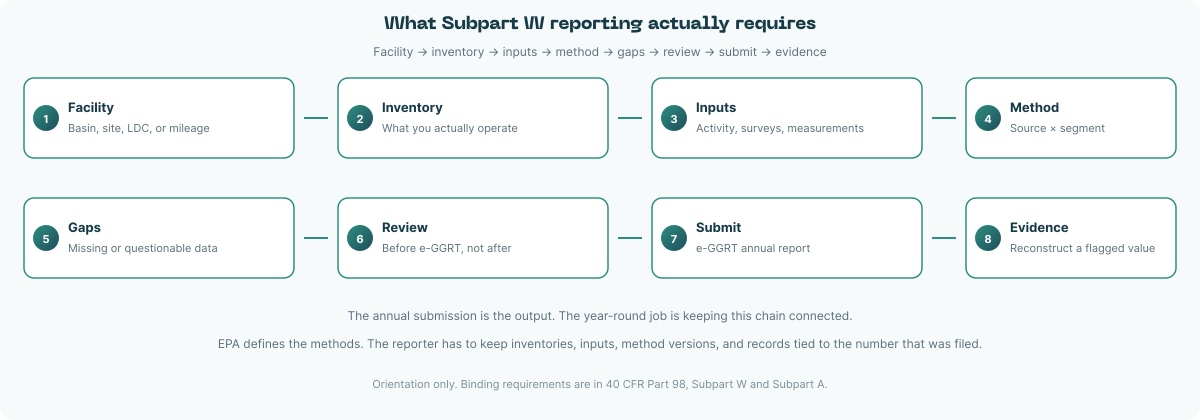
Figure 1: Facility → inventory → inputs → method → gaps → review → submit → evidence. The annual submission is the output. The year-round job is keeping that chain connected.
That chain is where reporting usually breaks. A report can still produce a number even when the underlying chain is weak. A gathering-and-boosting inventory may still rely on well-file equipment counts. A production team may not know which well-pad a tank belongs to. A compressor station may not be able to show whether it used a factor or a measured vent rate.
It is much harder to defend that number when EPA asks how it was built, or when next year’s team has to reuse the file.
If the same underlying operations also feed other GHG reporting frameworks or programs, keep the Subpart W method and boundary intact. For how teams automate multi-framework packages without forcing one number to serve every regime, see how oil and gas companies automate greenhouse gas reporting.
RY2025 annual reports are due October 30, 2026. That deadline is a final EPA action for RY2025 only. In other years, Part 98’s general timing remains March 31 for the prior calendar year, unless EPA finalizes a specific-year change. Confirm the current deadline on EPA’s rulemaking notices before filing. EPA’s Subpart W information sheet still describes the March 31 default; do not treat that sheet as the RY2025 due date.
Methods, monitoring, QA, and missing data
Once the segment is clear, the next job is governing methods, not memorizing equations.
Facilities must calculate GHG emissions using the specified methodologies in Subpart W for each source type in the applicable industry segment (§ 98.233). This section is not a method encyclopedia. Binding equations and tables stay on eCFR.
EPA’s information sheet groups the work into families environmental teams already recognize: engineering calculations and models, emission factors, direct measurement, leak detection and leaker factors, and population-count factors. Leak-detection instruments are listed in § 98.234.
In many cases the rule allows a choice among methods. In some cases it does not. EPA’s reporter training for the May 2024 amendments puts it cleanly: there is flexibility in many, but not all, cases. Do not read the 2024 amendments as “EPA now wants measurement instead of calculations.” Population factors, engineering calculations, and process models remain in the rule. Some measurement became required only where the rule says so. Some remains optional.
The useful question is not “what is the formula.” It is which method applies, where the input comes from, who owns that input, whether the correct method and version were used, whether something is missing, and whether someone can explain the number six months later.
Five source families show that pattern without copying § 98.233.
Pneumatic devices and pumps
What changes
For RY2025, if a continuous flow meter is present on the natural gas supply line, that meter method must be used. Using it was optional for RY2024. Other methods still exist: measuring vents, monitoring intermittent-bleed devices for malfunctions at production and gathering and boosting, and default factors only where the higher methods do not apply.
What operators need to govern
Device inventory, in-service time, and whether a meter exists. A company-wide factor does not answer those questions.
Equipment leaks
What changes
“Leaks” is two jobs. A leak survey plus leaker factors is not the same work as a population-count inventory. What has to be inventoried or surveyed also changes by segment: well-pad components, gathering pipe, distribution mains and services, storage wellheads versus the storage station, and LNG-service components. For RY2025, EPA added options to measure identified leaks and to develop facility-specific leaker factors, and added an undetected-leak factor in the leaker method.
What operators need to govern
Which leak method the segment actually uses, where component counts or survey results live, and how those results tie to the reported value. That is still Subpart W reporting, not an LDAR program guide.
Reciprocating and centrifugal compressors
What changes
Production and gathering and boosting historically leaned on default factors. RY2025 requires those segments to use volumetric compressor measurement data already collected under NSPS OOOOb or an applicable state or federal plan when that monitoring exists. Where those programs do not apply, volumetric measurement is an option. Other segments have their own vent-measurement and mode requirements (including standby-pressurized).
What operators need to govern
Compressor inventory and operating mode, whether OOOO or plan data already exist, and which method was used for each machine. Some Subpart W methods reuse monitoring already required under OOOO or an applicable plan, but those programs remain separate compliance obligations.
Other large release events
What changes
This source is new for RY2025 and applies across all ten segments. EPA set a single threshold of 100 kg/hr methane for events that other Subpart W methods do not appropriately estimate. Blowdowns stay in the blowdown category. Subpart W also requires reporting certain Super-Emitter Program notifications associated with the facility, subject to the rule’s exceptions. Duration is tied to monitoring or survey data, including advanced screening if available; otherwise EPA specifies a default start date of 91 days before identification. Advanced technologies may be used to help identify and quantify these events.
What operators need to govern
An event log with location and duration evidence, plus care not to double-count against a source-specific method.
Tanks
What changes
Hydrocarbon liquids tanks (and produced water tanks at production, gathering and boosting, and processing) show the model-versus-sample-versus-factor choice. If the facility is already required to use flash-emissions modeling software for federal or state rules, an air permit, or an annual emissions inventory, that model method is required for Subpart W as well. Specified model inputs must be measured on stated frequencies. Thief-hatch and dump-valve checks are part of this source. Condensate storage tanks at transmission compression, and for RY2025 at underground storage, are a related dump-valve / vent-stack job.
What operators need to govern
Which tank method applies, who owns the model inputs, and whether hatch and dump-valve checks made it into the file.
Monitoring and QA/QC sit in § 98.234: specified leak-detection methods, and calibration and operation rules for flow meters, composition analyzers, and pressure gauges used in Subpart W calculations. Offshore production follows BOEM QA requirements. Do not treat § 98.234 as a field-procedure manual. Use it as the list of which instruments and checks the selected method requires.
Missing data is a governed event. Under § 98.235, if a parameter needed for a Subpart W calculation is unavailable (except as § 98.233 specifies), the rule tells you how to substitute. Parameters that should have been measured quarterly or more often generally use the average of quality-assured values before and after the gap. Annual parameters have different catch-up rules, including that substitute data developed in a later year cannot be used for that later year’s emissions.
Missing data also creates a recordkeeping obligation. § 98.237(f) requires a record of the source type, why missing-data procedures were needed, which provision was applied, the analysis used, and the substitute value. A value entered without that record does not satisfy the missing-data procedure.
Record-keeping and EPA verification
EPA’s Subpart W information sheet states that reporters must retain records pertaining to the annual GHGRP report for at least three years after the date the report is submitted. See also § 98.3(g) and § 98.237. Subpart A also requires a longer retention period when EPA verification software under § 98.5(b) applies. Do not treat five years as the Subpart W default.
Subpart W records are specific. In addition to the general Part 98 file, § 98.237 requires records beyond the final reported values. Records include dates of measurements, results of emissions detected and measurements, calibration reports, and the inputs and outputs of calculations or model runs.
Reporters must also document how company records, engineering estimation, or best available information were used for each applicable parameter, along with the missing-data records above.
Those records are what allow a reporter to respond to EPA’s verification process. After submission, EPA reviews reports for completeness, accuracy, and consistency. If something looks wrong, the reporter can explain why the flagged issue is not an error, or correct and resubmit. If the package cannot show which inventory, method, measurement, or substitute produced a cell, the reporter has little to work with in that loop, even if the number was generated on time.
The November 2024 Waste Emissions Charge rule, which would have used certain Subpart W data, was disapproved under the Congressional Review Act and is not in effect. Do not treat a methane charge as a current Subpart W filing obligation.
Subpart W regulatory status in 2026
Keep these actions separate. A proposed rule is not a final rule.
|
Status |
Item |
What it means for Subpart W reporters |
|---|---|---|
|
Final / current |
May 14, 2024 amendments to Subpart W, with related revisions to Subparts A and C (89 FR 42062) |
Final. Limited RY2024 elements (including optional earlier use of many new calculation methods, and required quantities sent to sale for wells permanently taken out of production). Most changes apply beginning with RY2025 reports. See the Subpart W rule fact sheet. |
|
Final |
February 27, 2026 deadline extension (91 FR 9712) |
RY2025 reports are due October 30, 2026. Deadline only. EPA did not finalize the September 2025 reconsideration in this action. |
|
Proposed only |
September 16, 2025 reconsideration (90 FR 44591) |
EPA proposed to permanently remove natural gas distribution after RY2024, and to suspend the remaining nine Subpart W segments until RY2034. Proposed only. Current Subpart W requirements remain in effect. |
|
Historical / not in effect |
Waste Emissions Charge |
The WEC regulation has no force of law. |
Confirm status on EPA’s rulemaking notices before filing. This article reflects publicly available EPA materials and Part 98 as of August 21, 2026.
Subpart W is not OGMP, a corporate inventory, or an EMS
Teams often reuse methane and activity data across reporting frameworks and programs. The regimes are still not interchangeable.
GHGRP Subpart W is mandatory U.S. facility reporting (as Subpart W defines the facility) with prescribed methods and public facility-level disclosure rules. A corporate GHG Protocol inventory uses organizational boundaries and methods the company selects under that standard. OGMP 2.0 is a voluntary corporate methane framework with its own levels and reporting pathway. An emissions management system is software. Subpart W is a Part 98 source category. Using the same historian, survey file, or tank model in more than one framework or program does not make the numbers the same.
Where software can help (and where it cannot)
Software can help keep source data, method versions, QA findings, missing-data events, and supporting records connected through internal review and e-GGRT preparation. It cannot take over applicability, choose a method the rule does not allow, or sign the report.
What usually matters is keeping the reporting chain connected. Equipment and facility hierarchies need to match the segment being reported. Each source needs the method the rule required or allowed for that reporting year. And reviewers need to be able to trace a reported value back to its inputs without rebuilding the file from email. Validere supports regulatory air and GHG reporting by connecting those pieces. It may wrap around systems you already have. For a broader look at reporting platforms, see the emissions reporting software guide.
Responsibility for an accurate Subpart W submittal remains with the reporter.
Frequently asked questions
What is EPA Subpart W?
Subpart W is the Petroleum and Natural Gas Systems source category of EPA’s Greenhouse Gas Reporting Program, codified at 40 CFR §§ 98.230–98.238. It covers emission sources in ten petroleum and natural gas industry segments and includes source- and segment-specific calculation, monitoring, QA, missing-data, reporting, and recordkeeping provisions. For Part 98 program context, see the EPA GHGRP reporting guide.
Who must report under Subpart W?
Facilities that contain petroleum and natural gas systems and meet Subpart W applicability generally report if they meet a 25,000 metric ton CO2e test, but facility definitions and the way that test is applied differ by segment. Four segments (onshore production, gathering and boosting, natural gas distribution, and onshore transmission pipeline) use unique facility constructs and a segment-specific threshold in § 98.231. This article does not determine applicability for any specific facility. Confirm against Part 98 and EPA’s Applicability Tool.
What are the Subpart W industry segments?
EPA lists ten: onshore petroleum and natural gas production; offshore petroleum and natural gas production; onshore natural gas processing; onshore natural gas transmission compression; onshore petroleum and natural gas gathering and boosting; onshore natural gas transmission pipelines; underground natural gas storage; LNG storage; LNG import and export equipment; and natural gas distribution. Facility definitions and methods differ by segment. See the table above.
Does every Subpart W segment use the same calculation methods?
No. Calculation methods are source- and segment-specific in §§ 98.232 and 98.233. A production well-pad method is not interchangeable with a transmission-pipeline blowdown method or an LDC leak method. Confirm the current text on eCFR.
What did the May 2024 Subpart W amendments change?
EPA’s May 14, 2024 final rule (89 FR 42062) revised Subpart W to address reporting gaps, add or improve calculation methods so reporting is based more on empirical data, and improve verification and transparency. Implementation was phased: limited elements, including optional earlier use of many new methods, applied to RY2024. Most changes apply beginning with RY2025 reports. Population factors and engineering calculations remain in the rule. Measurement is required only where the amendments say so.
Did EPA eliminate Subpart W reporting?
No. As of August 21, 2026, Subpart W remains part of EPA’s GHGRP. In September 2025 EPA proposed to permanently remove the natural gas distribution segment after RY2024 and to suspend the other nine segments until RY2034. A proposed rule is not a final rule. Current Subpart W requirements remain in effect unless and until EPA finalizes a change. Separately, EPA finalized an extension of the RY2025 reporting deadline to October 30, 2026. That action did not finalize the reconsideration. Confirm status on EPA’s rulemaking notices before filing.