By the time oil and gas environmental, compliance, and emissions leaders reach vendor demonstrations, most of the category education is already complete. The remaining challenge is determining whether a shortlisted platform can carry operational data through calculation, exception handling, approvals, and submission-ready reporting without recreating spreadsheet workarounds. If you are still comparing platform categories or capabilities, start with the emissions management software buyer’s guide.
Quick answer
To evaluate emissions management software for oil and gas after a shortlist is in place, assess fit across nine areas: program and regulatory coverage, asset and source modeling, data integration, calculation transparency, data quality under exceptions, auditability and approvals, workflow configurability, reporting and analytics, and vendor implementation expertise. Require vendors to demonstrate each area with realistic company data and exception scenarios rather than relying only on standard product tours.
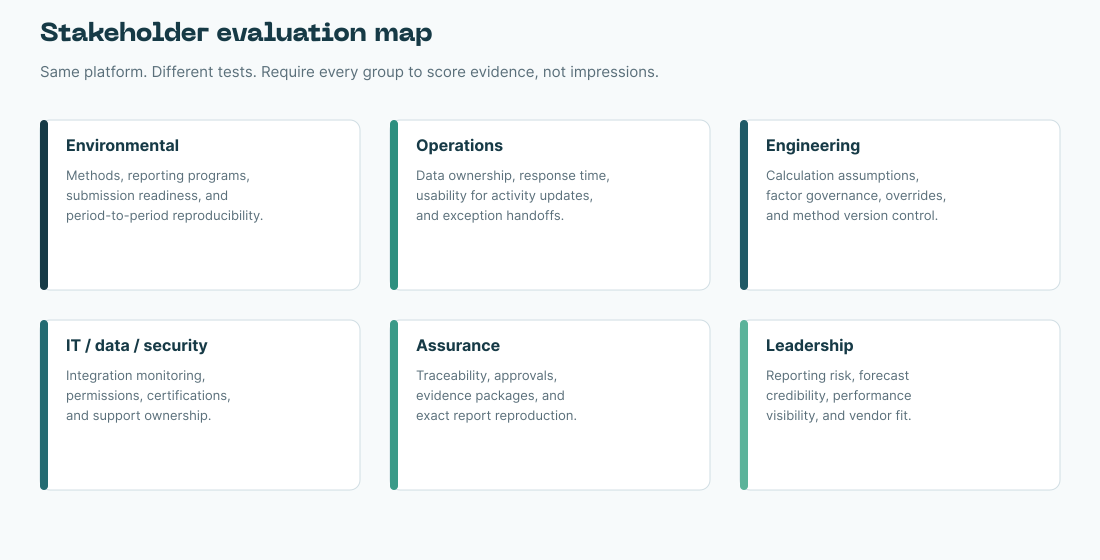
Figure: Stakeholder evaluation map. The same platform should be tested through different lenses: environmental, operations, engineering, IT, assurance, and leadership.
Download the emissions software evaluation scorecard to capture pass/fail requirements, weights, demonstrated evidence, scores, and open risks during vendor demos.
Before evaluating vendors, define the job the software must perform
A polished demo looks strong against an undefined requirements list. Before the first vendor call, document the work the platform must support in production.
Start with reporting obligations, jurisdictions, and the facilities, assets, and emissions sources in scope. Then map calculation methods and factor libraries already in use, the source systems and spreadsheets that feed them, and the people who enter, review, correct, approve, and submit. Finish with the outputs and evidence packages you need, plus known points of manual reconciliation across EHS, ERP, SCADA, historian, data-warehouse, and BI systems.
|
Define before the vendor demo |
Example questions |
|---|---|
|
Reporting obligations |
Which federal, state, provincial, and voluntary programs must be supported? |
|
Required granularity |
Do we need corporate, facility, equipment, source, or event-level information? |
|
Data environment |
Where do production, equipment, measurement, and factor data live? |
|
Governance |
Who enters, reviews, corrects, approves, and submits information? |
|
Expected outputs |
Which reports, exports, dashboards, and evidence packages are required? |
Keep the platform-type decision short. Some tools are stronger for corporate GHG inventories built on the GHG Protocol Corporate Standard. Others are built for facility and source-level industrial reporting. Organizations participating in both regulatory and voluntary programs may benefit from producing multiple reporting views from governed underlying data. Confirm that distinction in the buyer’s guide first, then use the criteria below to test shortlisted vendors.
1. Confirm that the platform supports your actual reporting programs
Feature matrices often reduce reporting coverage to a list of regulation names. That is not enough. Test whether the platform can maintain the methods, quality procedures, and outputs your programs require, and whether those requirements can coexist without overwriting one another.
Under EPA Subpart W, covered petroleum and natural gas facilities collect GHG data, calculate emissions, and follow prescribed procedures for quality assurance, missing data, record-keeping, and reporting. Seeing “Subpart W” on a brochure does not prove the software can support that process. EPA’s overview of GHGRP and the oil and gas industry spans production, gathering and boosting, processing, transmission, storage, LNG, distribution, and refining-related subparts. Our EPA GHGRP reporting guide covers program context; the EPA Subpart W reporting guide covers petroleum and natural gas systems requirements in more depth. Reporting requirements, source categories, and calculation methods can differ across production, gathering, processing, transmission, storage, LNG, and refining operations, and state or provincial programs may sit alongside federal reporting.
Voluntary frameworks add another layer. Corporate inventories often follow GHG Protocol boundaries and Scope 2 Guidance. Methane programs such as OGMP 2.0 emphasize measurement-informed, source-level reporting and progressive data quality. The software question is whether one governed dataset can support multiple reporting views without rebuilding calculations for each output. For how those program types differ in practice, see regulatory and voluntary emissions reporting. For levels, Gold Standard, and reconciliation, see the complete guide to OGMP 2.0.
Evaluate program coverage, methodology configuration by segment and reporting year, preservation of prior-year methods, and whether the platform can produce required outputs rather than only generic dashboards.
Questions to ask vendors
- Which of our reporting programs are supported through maintained templates, configurable workflows, or custom implementation?
- How are regulatory changes incorporated after go-live?
- Can the platform preserve prior-year methodologies and reproduce historical reports?
- How are state or provincial requirements handled alongside federal reporting?
- Can voluntary reporting use the same governed information without overwriting regulatory calculations?
What to request in the demo: Produce one realistic regulatory output and show the source data, methodology, QA steps, and approvals behind it.
Watch for: The vendor claims to support a regulation but can only export a generic spreadsheet or dashboard.
2. Test whether the platform reflects your operational reality
Corporate totals are only one level of work in many oil and gas emissions programs. Calculations, ownership, and reporting often sit at facility, equipment, or source level, and those structures change when assets are acquired, transferred, activated, or retired. The platform has to reflect that operational model, not a simplified org chart built for a demo.
EPA’s petroleum and natural gas reporting structure illustrates why a flat corporate model is often insufficient: production, gathering and boosting, processing, transmission, storage, LNG, and distribution each bring different equipment and source patterns. If the platform cannot represent that hierarchy with effective dates, historical reporting becomes fragile the first time the organization chart changes.
The evaluation should cover organizational hierarchy and reporting entities; facilities, basins, equipment, and sources; ownership and operational-control changes; acquisitions, divestitures, activation, and retirement; and whether historical structures remain reproducible after hierarchy updates.
Questions to ask vendors
- At what levels can calculations, ownership, responsibility, and reporting be managed?
- Can the hierarchy change over time without compromising historical reporting?
- How are newly acquired facilities added?
- Can one source contribute to different regulatory or voluntary views?
- Can users trace a corporate total back to a facility, equipment unit, or individual calculation?
What to request in the demo: Provide a simplified sample hierarchy with several facilities, assets, and source types. Ask the vendor to configure it and show how a structural change affects current and historical reporting.
Watch for: The hierarchy is rigid, or historical results change when the current asset structure is updated.
3. Evaluate data integration and source-data governance
Integration claims are easy to make and hard to prove. Many oil and gas emissions programs pull from a mix of SCADA, historians, production accounting, ERP, EAM or CMMS, data warehouses, measurement providers, and spreadsheets. Not every operator uses every system on that list. Focus on the systems you actually run and the failure modes that create reporting risk.
Most enterprise platforms now support spreadsheet imports, batch processing, and operational-data connections. The more useful evaluation is whether ingestion is monitored, exceptions are visible, and corrected or late records remain governed after they enter the platform. Ask for the operating model behind any integration claim: refresh cadence, failure handling, and lineage, not a logo slide. Buyers comparing enterprise platforms should also review how vendors integrate emissions workflows with existing systems.
Press vendors on prebuilt versus custom connections, validation at ingestion, duplicate and late-record handling, monitoring, and whether manual inputs still retain source, owner, and history.
Questions to ask vendors
- Which connections are prebuilt, configurable, or custom for our systems?
- How frequently can each data source be refreshed?
- What happens when an integration fails?
- How are duplicate, late, or corrected records handled?
- Can users see the source, timestamp, owner, and transformation history?
- Can the platform accept manual data without losing governance?
What to request in the demo: Import a dataset containing missing fields, duplicated records, a revised production value, and an invalid unit. Then ask who is notified and how the exception is resolved.
Watch for: The integration discussion focuses only on logos or APIs, with no explanation of monitoring, reconciliation, or exception handling.
4. Inspect calculation transparency and methodology control
If reviewers cannot understand how a result was produced, the number is difficult to defend. Calculation transparency is already a competitive expectation. Your differentiation as a buyer should come from how rigorously you test it.
Authorized users should be able to inspect equations, inputs, units, factors, assumptions, overrides, and method versions. Factor libraries need governance, and measurement-informed quantification, where relevant, needs a clear relationship to calculated values.
Recalculation should update affected results without erasing the historical record that supported a prior submission. That means testing equations and factors, units and operating conditions, method selection and effective dating, versioning and overrides, ownership of factor libraries, and reproducibility after recalculation.
Questions to ask vendors
- Can users inspect the equation, inputs, units, factors, and assumptions behind a result?
- Who can change a method, and how is that change approved?
- Are changes effective-dated and version controlled?
- Can the platform recalculate affected results without overwriting the historical record?
- How are vendor-maintained factors distinguished from customer-managed factors?
- Can the system explain why a result changed between reporting periods?
What to request in the demo: Change one factor or methodology and show which results are affected, how the change is approved, how prior versions remain reproducible, and how the change appears in the audit history.
Watch for: Users can see the final number but not the complete calculation path.
5. Challenge the platform with missing, inconsistent, and corrected data
Reporting delays are more likely to emerge from missing operating data, inconsistent units, late measurements, or unresolved corrections than from the absence of another dashboard. Corrected production values that arrive after a draft report has already circulated create the same kind of risk.
EPA’s Subpart W resources specifically call for procedures addressing quality assurance, missing data, and record-keeping. Exception handling is a reporting requirement, not an optional analytics feature. Test detection, ownership, resolution, documentation, and the effect on calculated results, including whether estimated, substituted, measured, and calculated values remain distinguishable.
Questions to ask vendors
- How are missing inputs identified and assigned?
- Can validation rules differ by source, facility, jurisdiction, or reporting program?
- Can users distinguish estimated, substituted, measured, and calculated values?
- How are material exceptions prioritized?
- What happens after a source value is corrected?
- Can reviewers see unresolved issues before approval or submission?
What to request in the demo: Use a sample with a missing operating-hour value, inconsistent units, an outlier, a late measurement, and a corrected production value. Ask the vendor to show the entire exception path inside the platform.
Watch for: The system identifies an error, but resolution occurs outside the platform through email or spreadsheets.
6. Examine auditability, assurance and approval controls
A report that cannot be reconstructed is difficult to assure. Reviewers and verifiers need source traceability, methodology history, comments, attachments, approval chains, locking, and permissions that preserve decision context. Those are the same controls buyers should demand when comparing emissions assurance and verification workflows across vendors.
Questions to ask vendors
- Can every reported value be traced to its source and methodology?
- Does the audit history show who changed what, when, and why?
- Can reviewers request corrections without losing the original context?
- Can approved periods be locked?
- How does the platform support external assurance or verification?
- Can a previously submitted report be reproduced exactly?
What to request in the demo: Walk backward from a final report value to its source records, calculation, reviewer comments, and approval history without leaving the system.
Watch for: The platform logs technical changes but does not preserve review decisions or supporting evidence.
7. Evaluate workflow configurability and cross-functional fit
Emissions work rarely stays inside one team. Environmental staff may own methods and submissions, operations may own activity data, engineering may own assumptions, and management may own approvals. If the real workflow remains in email while the software stores only final numbers, much of the existing coordination burden and reporting risk may remain.
Do not assume emissions management software must replace an EHS platform. Evaluate environmental compliance workflows and shared data exchange where environmental and EHS responsibilities overlap, then decide whether replacement, coexistence, or handoffs fit your operating model. Adjacent buying questions are covered in questions to ask before choosing EHS management software and how to choose environmental compliance software.
Look for role-based tasks, notifications, and escalations; facility versus corporate ownership; cross-functional participation; corrective-action handoffs; configurability without uncontrolled custom code; and field-to-office participation, including offline capture where required.
Questions to ask vendors
- Can workflows vary by facility, source type, or reporting program?
- Which changes require vendor services?
- Can tasks move between environmental, engineering, operations, and management users?
- Are reminders, escalations, and approvals configurable?
- Can field users work offline where required?
- How does the platform connect emissions exceptions with investigations or corrective actions?
What to request in the demo: Route an emissions exception through data-owner correction, environmental review, management approval, and closure.
Watch for: Every process change requires custom code, or users must coordinate the real workflow through email.
8. Separate reporting from decision support
Buyers often score dashboards highly because they are easy to demonstrate. That can hide three different jobs under one visual layer: regulatory and voluntary reporting, internal performance visibility, and forecasting or scenario analysis for operational decisions.
A submission-ready regulatory export is not the same thing as a management dashboard. A forecast is not the same thing as a reconciled inventory. Evaluate each job on its own terms, then check whether the same governed number appears consistently across them. Whatever vendor you evaluate, including emissions management software for industrial operations, require analytics that remain reconcilable to source calculations.
If the vendor presents AI-supported summaries or recommendations, treat them as optional aids and ask for the evidence behind them. Do not accept claims that the platform can make unsupervised compliance decisions.
Questions to ask vendors
- Which outputs are submission-ready, and which require manual formatting?
- Can users drill from a dashboard into the underlying source and calculation?
- Can reports be reproduced for a prior reporting period?
- How are forecasts connected to operational assumptions?
- Can teams compare expected and actual results from reduction initiatives?
- What evidence supports any AI-generated recommendation or summary?
What to request in the demo: Show one number across the regulatory report, management dashboard, detailed calculation, and forecast. The values should remain reconcilable.
Watch for: The dashboard is visually strong but cannot explain or reproduce the underlying result.
9. Evaluate implementation, security and long-term vendor fit
A strong product demo does not equal a credible production implementation. Oil and gas emissions programs depend on data migration, calculation validation, training, change management, regulatory updates, integration ownership, and support after go-live.
Ask who will design the production configuration, what oil and gas reporting experience that team has, and how security, availability, and data portability are governed. Verify current security documentation for any vendor rather than relying on marketing summaries. Enterprise buyers often need evidence of controls such as SOC reports, ISO-aligned practices, permissions, and integration ownership after launch. Also ask how product updates are introduced without disrupting validated reporting processes.
Questions to ask vendors
- Who will configure the platform, and what oil and gas experience do they have?
- What customer work is required before and during implementation?
- How are calculation results validated before launch?
- How are regulatory updates managed after launch?
- How are product updates introduced without disrupting validated reporting processes?
- What security certifications and controls are current?
- Who owns integration monitoring and maintenance?
- How can customers export their data and calculation history?
- Can the vendor provide references with similar operations and reporting needs?
What to request in diligence: a sample implementation plan, named responsibilities, data-migration and validation approach, security documentation, support model, and a relevant customer reference.
Watch for: The software is demonstrated by an experienced presales team, but the vendor cannot identify who will design and maintain the production implementation.
Emissions software evaluation scorecard
Use one shared scorecard across the shortlist. Score demonstrated evidence, not brochure claims. Establish weighting before demonstrations. Regulatory reporting and calculation integrity often deserve more weight than visualization, but weighting should reflect your use case rather than a universal formula.
Before averaging scores, apply pass/fail gates. A serious failure here should not be offset by strong dashboard or usability scores:
- Required reporting program unsupported
- Security requirement unmet
- Historical results cannot be reproduced
- Unacceptable data-portability terms
Use the summary below to align the evaluation team, then capture weights, scores, evidence notes, and open risks in the downloadable kit.
|
Evaluation area |
What strong evidence looks like |
|---|---|
|
Reporting coverage |
One required report produced from source data, with methods and approvals intact |
|
Asset and source model |
Facility add or transfer that preserves historical results |
|
Integration |
Flawed data imported and resolved in-platform |
|
Calculations |
Factor or method change with version history |
|
Data quality |
Missing and corrected data resolved before approval |
|
Assurance |
Final value traced backward to source and approvals |
|
Workflows |
Exception routed to closure across roles |
|
Reporting and analytics |
One value reconciled across report, dashboard, and forecast |
|
Vendor fit |
Credible project plan, security documentation, and support model |
Vendor Demo Test: operational data through validation, calculation, exception, correction, approval, submission, and audit evidence, with one question to ask the vendor at each stage
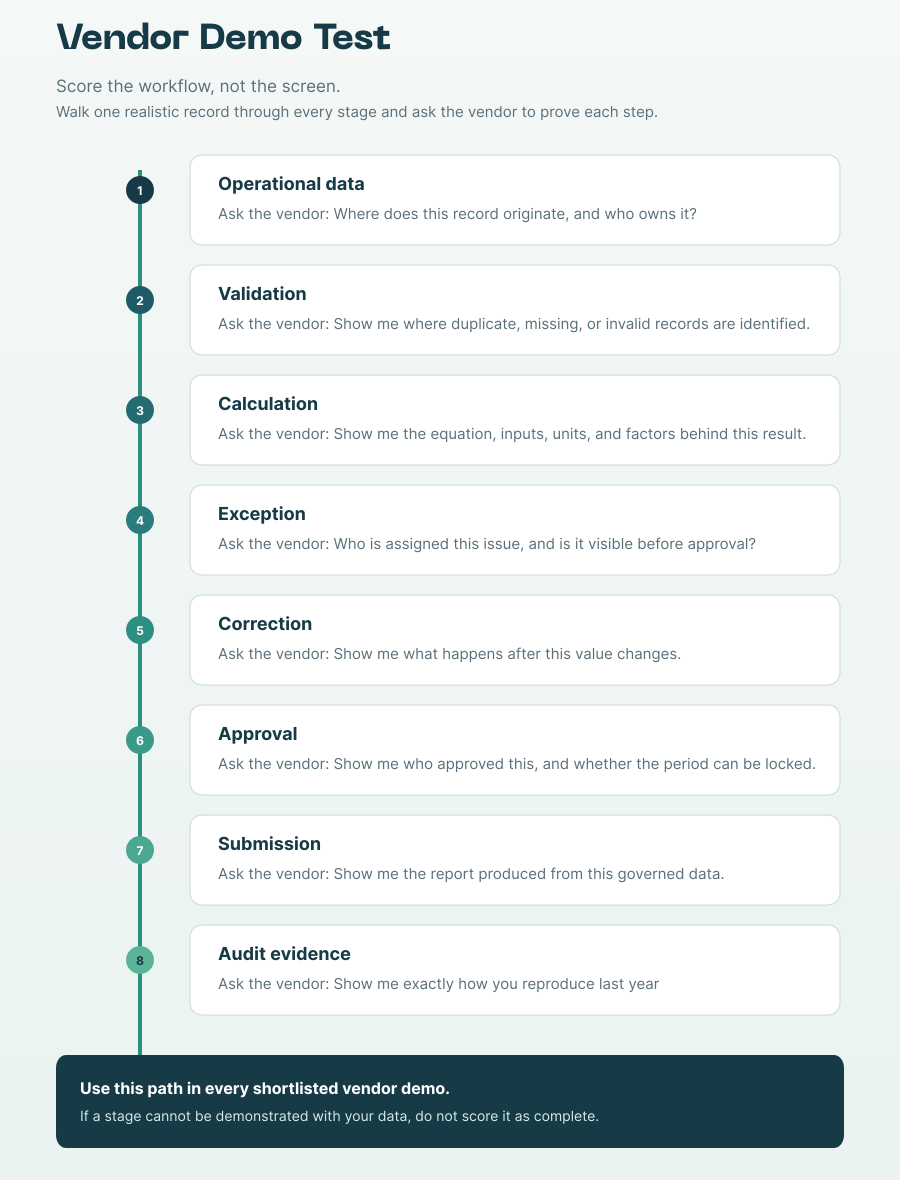
Figure: Vendor Demo Test. Score the workflow, not the screen. Walk one realistic record through every stage and ask the vendor to prove each step.
Download the printable scorecard to capture pass/fail requirements, weights, scores, evidence notes, and open risks during vendor demos.
Want to see these evaluation criteria against real emissions workflows? Explore Validere product demos or review emissions management software for industrial operations.
Conclusion
A vendor should not receive a high score because its standard demonstration looks polished. It should receive a high score because the evaluation team can follow its own data from ingestion through calculation, review, correction, approval, and reporting, and because the platform can preserve that process as regulations, assets, and organizational responsibilities change.
The best emissions management software is not the platform with the most features. It is the one that can explain every reported number, adapt as operations evolve, and stand up to scrutiny long after the report has been submitted.
Explore how Validere’s emissions management software supports auditable reporting, measurement integration, approval and verification controls, and scenario modelling for oil and gas operations.
Frequently asked questions
What is the most important capability in emissions management software?
There is no universal single capability. For regulated oil and gas programs, calculation traceability, source-data governance, and reporting fit are usually foundational because they determine whether results can be defended, reproduced, and submitted on schedule. Visualization and forecasting matter, but they should not outrank the controls that produce the numbers.
How should oil and gas companies compare emissions software vendors?
Use a shared requirements matrix, consistent demo scenarios, weighted scoring, and participation from environmental, operations, engineering, IT, and assurance stakeholders. Score what each vendor can demonstrate with representative data, not what appears on a feature checklist. Treat unsupported required programs, unmet security requirements, unreproducible historical results, and unacceptable data-portability terms as pass/fail issues rather than items that can be averaged away.
What should a vendor demonstrate during an emissions-software demo?
Ask for data ingestion, a transparent calculation, an exception, a correction, approval, audit history, and a final reporting output. The strongest demos follow one realistic workflow end to end rather than jumping among disconnected modules.
Is emissions management software the same as carbon accounting software?
Not necessarily. Carbon accounting software is often strongest for corporate GHG inventories and disclosure. Industrial emissions management software is often stronger for facility- and source-level calculations, operational data, and regulatory workflows. See how emissions management and carbon accounting platforms differ for the full distinction.
Should emissions software integrate with EHS systems?
It depends on the operating model. Some organizations need shared workflows for inspections, investigations, and corrective actions. Others need reliable data exchange while keeping EHS and emissions platforms separate. Evaluate integration and handoffs rather than assuming replacement is required.
Can emissions management software automate regulatory reporting?
Software can automate data ingestion, calculations, QA workflows, and report preparation. Organizations still retain responsibility for applicability determinations, methodology choices, review, and submission. Automation reduces manual reconciliation; it does not replace expert judgment.
How long does emissions-software implementation take?
There is no universal timeline. Duration varies with source systems, calculation complexity, number of facilities, integration scope, data migration, governance readiness, and vendor resources. Ask each vendor for a plan tied to your scope rather than a generic average.