Most EHS software evaluations begin with feature comparison spreadsheets. Teams compare incident management, inspections, corrective actions, permits, dashboards, mobile access, reporting, and integrations. Those comparisons are useful, but they rarely reveal whether a platform supports how work actually moves through an energy organization.
Feature lists are a useful starting point, but they rarely show how work actually moves through an energy organization. If you are still researching the category rather than comparing vendors, start with the EHS management software buyer's guide. This article is for the next stage: challenging vendor claims during shortlists, RFPs, and demonstrations.
Consider a few practical tests. Can a field observation remain connected to its investigation and corrective action? Can corporate teams establish common requirements while facilities retain necessary local processes? Can an environmental result be traced back to the data, calculation method, review, and evidence supporting it? Can the platform work with operational systems that will remain in place?
Those questions reveal whether software actually supports the way work moves through your organization. The eight questions below give evaluation teams a structured way to verify workflow fit across multi-site operations, field participation, environmental and emissions data, integrations, audit traceability, and measurable implementation outcomes.
If leak detection and repair is one of your evaluation priorities, our LDAR Software Buyer's Guide provides a detailed framework for assessing inspection workflows, repair management, and field capabilities.
Quick answer
Energy companies evaluating EHS management software should ask how the platform supports complete workflows, multi-site governance, field participation, corrective actions, environmental and emissions data, existing integrations, audit traceability, and measurable implementation outcomes. Vendors should demonstrate these capabilities using representative company workflows and data rather than relying only on feature lists or roadmap descriptions.
Download: EHS Software Vendor Evaluation Checklist →: score requirements by demonstrated capability, evidence, dependencies, and ownership across the eight questions.
1. Which workflows must the software support from field activity through reporting?
A feature’s practical value depends on how well it supports the people, decisions, records, and handoffs involved in a required process. A module-based review can still leave process gaps undiscovered until later: the inspection form exists, but ownership transfer does not; the emissions dashboard exists, but the review chain does not.
Before reviewing vendors, document several real operating scenarios. Useful categories include field observation or hazard reporting, inspections, incident investigation, corrective action, permit obligation management, compliance task completion, environmental data collection, emissions calculation and review, regulatory submission preparation, management review, and audit evidence retrieval.
For each workflow, capture:
- What initiates it, and who owns it?
- Which teams participate, and which systems are involved?
- Which data, reviews, approvals, outputs, and evidence are required?
- What happens if work is late, incomplete, or follows an exception path?
OSHA's recommended practices for safety and health programs organize effective programs around connected elements such as management leadership, worker participation, hazard identification, hazard prevention and control, education and training, program evaluation, and communication. That framing supports evaluating software as part of a wider management process rather than as isolated record-keeping. ISO 14001 similarly frames environmental management as a systematic and continually improving management system.
Consider a facility inspection that identifies an equipment condition requiring follow-up. The evaluation should determine whether the software can connect the original observation with ownership, investigation, action, verification, and any relevant environmental or compliance records. That does not mean every finding triggers an emissions calculation or regulatory report. It means the platform should preserve the relationships the company's process requires.
Ask vendors:
- Can you demonstrate the complete workflow with representative data?
- Which steps, records, or approvals remain outside the platform?
- How does the process handle site differences, exceptions, and overdue work?
Mapping priority workflows is also one of the most important steps in an EHS software implementation.
2. Can the platform support common standards while accommodating facility-level requirements?
Vendors often say they support multi-site operations. Buyers should verify whether common standards can coexist with site-specific assets, obligations, owners, schedules, and evidence. Scalability language in a brochure rarely answers that question. For why multi-site EHS gets harder as operations expand, see the buyer's guide on multi-site EHS management.
Corporate-level requirements may include standard terminology, common classifications, shared approval controls, consistent reporting periods, minimum required evidence, enterprise-level metrics, common escalation rules, and centralized permissions. Facility-level differences may include asset structures, applicable permits, reporting obligations, responsible personnel, inspection schedules, operating conditions, contractor involvement, jurisdictional requirements, and local documentation.
The objective is not unlimited site customization. Excessive site-level customization can make consistency and administration harder to maintain. The buyer should determine which elements are globally standardized, configurable by business unit, configurable by site, controlled through exceptions, or prohibited from local alteration.
| Evaluation area | Corporate need | Facility-level need |
| Data definitions | Consistent terminology | Locally relevant assets and sources |
| Workflows | Common control requirements | Site-specific owners and schedules |
| Reporting | Consolidated visibility | Facility-level evidence |
| Configuration | Controlled standards | Managed exceptions |
Vendors say: We support multi-site operations.
Buyers should verify:
- Can corporate requirements be inherited across facilities?
- Which settings can local administrators change?
- Can site-level exceptions be approved and documented?
- Can corporate users drill from aggregated results into underlying site records?
- Can the platform preserve historical configuration when standards change?
3. Can field, contractor, and operational users participate effectively?
Having a mobile application is not the same as supporting the people closest to the work. Practical participation by field and operational users is one important condition for adoption. Leadership, training, incentives, governance, and change management matter as well.
OSHA states that worker participation includes involvement in establishing, operating, evaluating, and improving safety and health programs. Its guidance includes contractors, subcontractors, and temporary staffing workers. Evaluation teams should treat that as a process requirement, not a checkbox for a mobile icon.
Group the evaluation around four areas:
- Access and usability: reporting effort, required fields, navigation, accessibility, and training burden
- Field conditions: mobile access, offline or low-connectivity use, photo and attachment capture, and asset identification
- Permissions and contractor participation: limited access models, multilingual needs where required, and confidential reporting where required
- Feedback and follow-up: visibility into assigned actions, status after submission, clear responsibility, and escalation for unresolved issues
Do not accept a polished field demo as proof that every required user group can complete real work under real conditions. Ask what happens when connectivity is weak, when a contractor needs limited access, or when a technician needs to know whether a reported issue was reviewed.
Ask vendors:
- Can a field user complete the process with minimal navigation?
- What happens when connectivity is unavailable?
- Can contractors participate without receiving inappropriate system access?
- Can users see whether reported issues were reviewed or resolved?
Adoption planning should account for the people who initiate and complete work, not only the administrators who configure the platform. That theme runs through EHS software implementation planning as well.
4. Can the software preserve relationships between issues, actions, and supporting records?
A platform may contain inspection, incident, maintenance, environmental, and corrective-action features without preserving meaningful relationships between them. Separate modules are not the same as operational connectivity.
Where the company's workflow requires it, evaluate whether records stay connected across a chain such as:
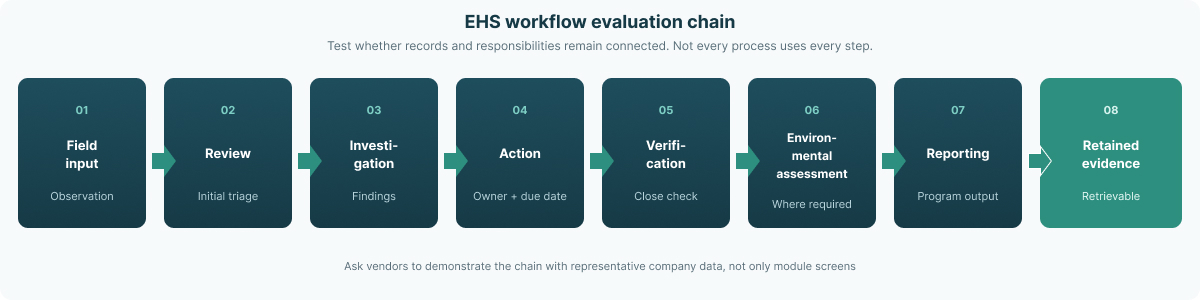
Figure 1: Buyers should test whether records and responsibilities remain connected across the full workflow. Not every process uses every step.
The system should be able to retain the originating record, related equipment or asset, responsible site, investigation findings, assigned owner, due dates, status history, supporting files, related work orders, verification results, reopened actions, and closure rationale.
Distinguish carefully among linking to another record, copying information into another module, maintaining a governed relationship, integrating with another system, and manually referencing an external identifier. Those are different capabilities with different failure modes. A copied field can look complete in a demo and still break the audit trail later.
Consider an inspection that identifies a damaged component. Operations may need to assess the condition, maintenance may perform work, and the environmental team may need to determine whether the event has reporting or emissions implications. The evaluation should test whether the platform can preserve that relationship when the company's process requires it.
Ask vendors:
- Can related records be viewed together?
- How does the platform prevent related records from being closed prematurely or left unresolved?
- Can an action be reopened?
- Can responsibilities transfer between teams?
- Can an external work-order number remain linked to the originating record?
- Can the full history be exported?
Evaluation teams should identify which workflows require shared governance, which need specialized functionality, and where systems must exchange reliable data.
5. How does the platform govern environmental and emissions data?
Environmental and emissions management is not simply data entry followed by a dashboard. Regulated reporting can require source-data collection, calculation methodologies, QA procedures, missing-data handling, record-keeping, and reporting. For energy operators reporting air and GHG information across dispersed assets, the hard work usually sits in those controls, not in the final exported number.
For facilities subject to EPA GHGRP Subpart W, owners and operators collect data, calculate emissions, and follow specified procedures for quality assurance, missing data, recordkeeping, and reporting. Subpart W applies to defined petroleum and natural gas facilities that meet relevant applicability requirements. It is an example of the control depth buyers should probe, not a universal obligation for every reader.
Group the evaluation around:
- Source data and ownership: collectors, units, validation, and asset or source hierarchies
- Methods, factors, units, and boundaries: formulas, emission factors, methodology selection, assumptions, and reporting boundaries
- QA, missing data, and approvals: incomplete loads, data-quality checks, review steps, and approval controls
- Versioning and recalculation: factor effective dates, methodology changes, and recalculation history
- Record retention and reproducibility: supporting evidence, submission support, and prior-period reproduction
The system should not merely display a final emissions number. An authorized reviewer should be able to determine where the number came from, which source data were used, which formula or factor applied, which reporting period and asset boundary applied, who reviewed it, whether it was subsequently changed, and what supporting evidence exists.
Buyers should also determine whether calculation logic is transparent to authorized users or functions as a vendor-managed black box. That distinction matters when internal specialists need to defend a methodology change or reproduce a prior period during an audit.
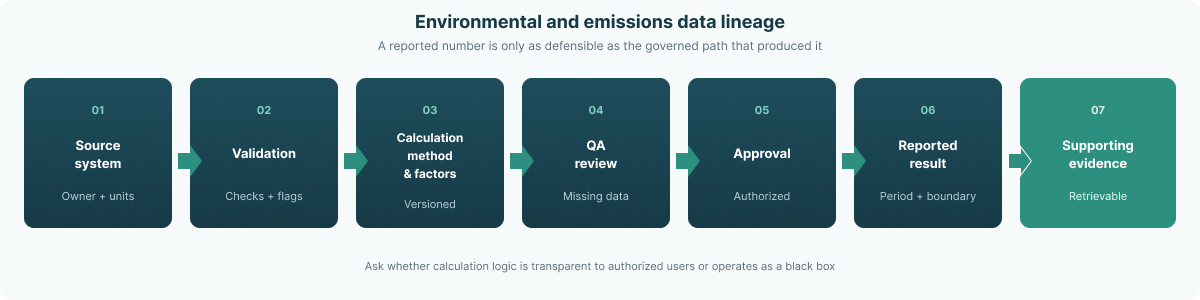
Figure 2: A reported number is only as defensible as the governed path that produced it: source data, method and factors, QA, approval, result, and evidence.
Vendors say: We automate emissions reporting.
Buyers should verify:
- Can a reported result be traced to source inputs?
- Are factor and methodology changes versioned?
- Can the system distinguish estimated, measured, calculated, and manually entered information?
- How are incomplete or failed data loads handled?
- Can calculation logic be reviewed by appropriate internal users?
- Can prior reporting periods be reproduced?
Emissions management software should support both the final reporting output and the calculations, controls, and records that produce it. Environmental data governance becomes even more important when the same source data must support regulatory and voluntary emissions reporting. Organizations evaluating that depth should also understand how Air and GHG emissions management differs from broader EHS workflows, particularly when calculation traceability and recurring submissions are priorities. Teams whose scope includes permits and obligation tracking should review environmental compliance requirements in the same evaluation.
6. How will the platform connect with systems that remain in place?
An EHS platform will often operate alongside existing business and operational systems. The important question is not whether the vendor claims to integrate, but how data ownership, transfer, monitoring, and maintenance will work.
Depending on the organization, relevant systems may include ERP, EAM or CMMS, SCADA, data historians, GIS, laboratory information systems, monitoring and sensor platforms, HR systems, training systems, document repositories, regulatory-content services, and business-intelligence platforms. Inventory only what the target workflows actually require.
For each required data flow, determine the source system, destination system, system of record, data owner, transfer frequency, transfer method, required transformation, validation process, failure handling, duplicate handling, monitoring responsibility, and long-term maintenance owner.
Classify proposed integrations carefully: native connector, standard API, file-based transfer, scheduled import, customer-built integration, vendor-built custom integration, or manual upload. Each approach may involve different implementation, latency, ownership, and maintenance considerations. An API’s existence does not establish that a production integration is configured, monitored, or included in implementation scope.
Vendors say: We integrate with your systems.
Buyers should verify:
- Which system is authoritative for each data type?
- How frequently does information move?
- How are failed or incomplete transfers identified?
- Can users see when data were last refreshed?
- Who maintains the integration after implementation?
- Are integration services included in the quoted price?
- Does the platform preserve source-system identifiers and lineage?
“Unified” and “integrated” are architecture claims, not implementation details. Those answers determine whether the EHS platform reduces manual reconciliation or simply relocates it. The evaluation should identify which systems remain authoritative and how the EHS platform will connect existing operational systems.
7. Can teams reconstruct how a decision or reported result was produced?
Document storage is not the same as traceability. A system may retain a file without showing who supplied it, which record it supported, whether it changed, which version was reviewed, who approved the result, or why a prior decision was revised.
A practical framework is:
- Who created, changed, reviewed, or approved the record
- What changed, including status, fields, calculations, and documents
- When those events occurred
- Why a correction, exception, or revision was made
- Which information or method was used
- What evidence supports the result
Traceability can help teams reconstruct how a decision, action, or reported result was produced. It does not guarantee compliance, successful audits, or the elimination of compliance risk. Treat it as reconstructability under scrutiny, not as a marketing synonym for “audit-ready.”
Ask vendors:
- Can authorized users see the complete record history?
- Are calculation and methodology changes retained?
- How are post-approval corrections documented?
- Can historical reports be reproduced?
- Are supporting records linked directly to the relevant obligation or result?
- Can evidence be exported without losing context?
Traceability is especially important when teams must demonstrate how a compliance conclusion or reported value was reached.
8. How will the organization measure whether implementation is working?
Buyers should define success measures before implementation. Software availability, user licenses, or completed configuration do not by themselves show that the platform is improving execution.
OSHA recommends establishing and tracking goals, periodically evaluating whether a program is operating as intended, and identifying opportunities for improvement. The same principle should apply to software implementation: define what success means and how it will be measured.
Representative measures may include:
- percentage of required tasks completed on time
- number of overdue corrective actions
- time from issue identification to assignment
- time from action completion to verification
- reporting cycle time
- number of manual handoffs
- number of data exceptions
- percentage of required evidence available
Additional measures belong in the evaluation worksheet, not in every shortlist discussion. For each priority measure, establish a current baseline, target outcome, measurement definition, data owner, review cadence, acceptable threshold, and escalation process. Do not treat vendor claims of reduced reporting time or fewer incidents as proven outcomes unless supported by validated customer evidence.
Ask vendors and internal owners:
- What problem is the implementation expected to solve, and how is it measured today?
- Which results should appear within the first phase?
- Who owns adoption and process performance?
- What evidence would justify expanding the platform?
An implementation plan should include measurable workflow and adoption outcomes, not only technical milestones.
How to compare vendor answers
Do not record vendor responses as only “yes” or “no.” Classify each requirement using a more precise status
| Status | Definition |
| Demonstrated | The vendor showed the capability using a relevant workflow |
| Native | The capability is part of the current standard product |
| Configurable | The capability is available through documented configuration |
| Integration-dependent | Another system or data source is required |
| Custom development | New technical work is required |
| Services-dependent | Vendor or third-party services are required |
| Roadmap | The capability is planned but not currently available |
| Not supported | The current platform cannot meet the requirement |
Roadmap functionality should be scored separately from capabilities demonstrated in the current product. Score each requirement based on business importance, demonstrated evidence, implementation effort, and dependencies rather than treating the vendor’s verbal confirmation as proof. A live walkthrough of the buyer’s own exception path usually reveals more than a catalogue of modules.
Use the EHS Software Vendor Evaluation Checklist to capture priority, site coverage, capability status, evidence, dependencies, owners, effort, gaps, and score across the eight question categories. Keep granular scoring fields in the worksheet so the article remains a method, not an inventory.
Choosing EHS software by workflow fit
Feature lists are a useful starting point, but they rarely show how work actually moves through an organization. The stronger evaluation question is whether the system can support the company's actual processes: from field participation through corrective action, from facility-level execution through enterprise oversight, from source data through environmental reporting, and from an initial decision through retained evidence.
The strongest vendor evaluations use representative workflows, realistic data, and clearly defined measures of success. They also distinguish native, configured, integrated, custom, and roadmap functionality before shortlists harden into contracts.
Validere helps energy and industrial organizations connect environmental data, regulatory requirements, and operational workflows while working with existing technology. Evaluation teams can use these questions to determine where Validere fits their requirements and where specialized or existing systems should remain in place, including Air and GHG emissions management where emissions governance is in scope.
Explore Validere’s EHS solutions for energy operations →
Frequently asked questions
What is EHS management software?
EHS management software helps organizations manage environmental, health, and safety processes such as inspections, incidents, corrective actions, obligations, environmental data, documentation, and reporting. Capabilities vary by platform. For category context, market framing, and multi-site capability definitions, see the EHS management software buyer's guide.
What should energy companies look for in EHS software?
Energy companies should look for workflow support from field activity through reporting, multi-site governance with controlled local differences, realistic field and contractor participation, connected records across related actions, environmental and emissions data governance, durable integrations with systems that remain in place, audit traceability, and measurable implementation outcomes. Feature breadth matters only when those dimensions hold up under a representative demonstration.
Can EHS software manage emissions data?
Some EHS and environmental platforms can support emissions inventories, calculations, QA, approvals, recordkeeping, and reporting. Capabilities vary widely. Buyers should confirm supported methodologies, regulations, source integrations, factor management, versioning, and calculation traceability rather than assuming that an “emissions” module covers their requirements. Ask to reproduce a prior reporting period from governed source data during the demonstration.
How should a company evaluate EHS software vendors?
Ask vendors to demonstrate representative workflows with realistic data. Classify each capability as demonstrated, native, configurable, integration-dependent, custom, services-dependent, roadmap, or unsupported. Request references, documented dependencies, sample evidence trails, and a clear distinction between current product capability and future commitments. Score each requirement based on business importance, demonstrated evidence, implementation effort, and dependencies rather than treating the vendor’s verbal confirmation as proof.
Is one EHS platform better than several specialized systems?
Not universally. A unified platform may reduce some handoffs and provide common governance, while specialized systems may offer deeper functionality in particular areas. The correct architecture depends on requirements, existing systems, data ownership, integration capacity, administration resources, and the importance of maintaining specialized workflows. An energy company may keep authoritative operational systems in place and connect the EHS platform where it adds governed process value.