For many environmental managers, the hardest week of the year is not an audit. It is the week before a major regulatory submission.
Data arrives from SCADA, production databases, continuous monitors, contractors, spreadsheets, labs, and field inspections. Some of it is late. Some of it conflicts. Some of it is incomplete. Collecting information is rarely the problem. Proving how it was collected, validated, investigated, approved, and reported usually is, especially when safety records, environmental compliance work, emissions management, and operational data live in different systems across multiple sites.
That is why selecting EHS software (environmental, health, and safety) is harder for energy companies than for most industries. Teams still need incident reporting, inspections, and workforce safety. They also need regulatory air and GHG reporting, investigations, and reporting packages that connect to the systems already running the business. The right shortlist comes from business requirements, not the longest feature list.
This guide compares leading EHS management software for energy and oil and gas in 2026, explains where each platform fits, and gives you a practical shortlist framework before demos begin.
What is EHS software?
EHS software helps environmental, health, and safety teams manage work across complex industrial operations, from incidents and inspections to corrective actions, permits, and reporting. In oil and gas, that work rarely starts in the same system. A compressor station inspection, a contractor incident, a permit condition, and an air or GHG filing may all need to connect when someone asks what happened, what changed, or how a reported value was produced.
EHS software covers a wider set of work than environmental compliance software. Environmental compliance software focuses on the environmental side: obligations, permits, emissions, reporting, and the evidence behind them. Two platforms can both be sold as EHS software and still be built for very different jobs: frontline incidents in one case, environmental reporting depth in another. Start with the operating problem that creates the most risk, shortlist the platforms built to handle it, then make them prove it with your own source data.
At a glance
- Big takeaway: There is no universal best EHS platform. Shortlist by the operating problem creating the most risk, then demo with messy source data.
- What buyers are prioritizing: Safety adoption still matters. So do compliance depth, emissions reporting, integrations, and evidence trails that survive an audit.
- Who this is for: Multi-site operators, mid-market teams, and large energy companies deciding whether to unify workflows or keep complementary systems.
- How to use this guide: Use the quick answer and decision table to build a three-vendor shortlist, then run the demo checklist before you buy.
- Where to go deeper: Emissions management software guide and how to choose environmental compliance software when those workflows carry the most risk.
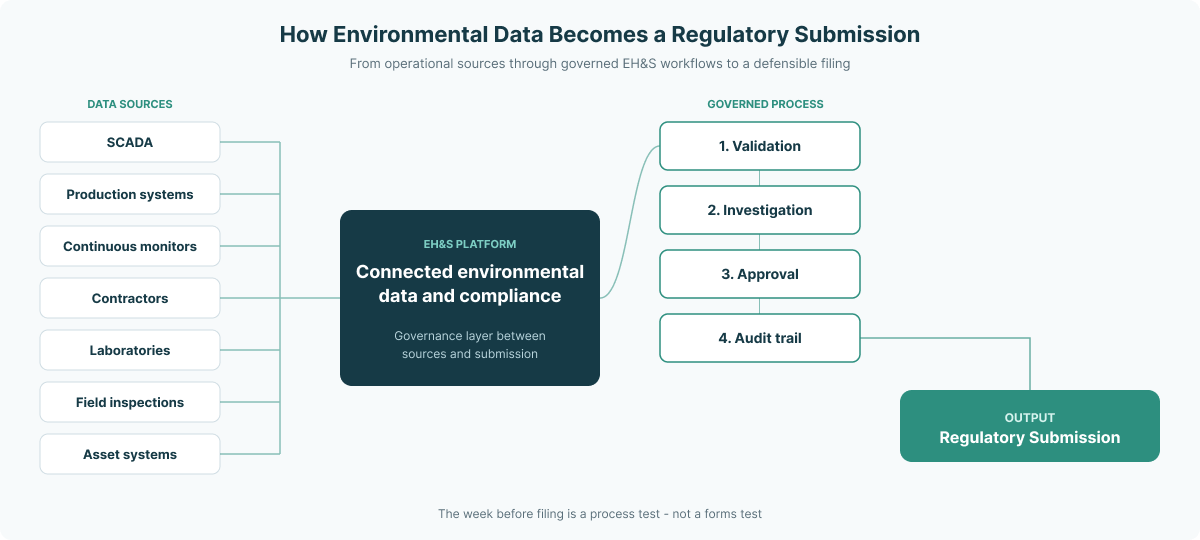
Figure 1: How environmental data becomes a regulatory submission. The week before filing is a process test, not a forms test.
Download: Before You Book an EHS Demo Worksheet → (stakeholder questions to answer before vendor demos)
Top EHS software for energy and oil and gas in 2026
There is no single best EHS platform for every energy company. The right choice depends on the problem you need to solve first.
Energy and oil and gas buyers commonly shortlist Validere, Cority, Enablon, Sphera, Intelex, and Benchmark Gensuite. Each has a different primary strength: environmental compliance and emissions, occupational health, enterprise governance, process safety, frontline incidents, or inspection programs.
Which EHS platform is right for you?
|
If you need… |
Best place to start |
Why |
|---|---|---|
|
Environmental compliance, emissions, and regulatory reporting |
Validere |
Strongest fit when industrial environmental data, investigations, and reporting workflows drive the buy |
|
Broad EHS and occupational health |
Cority |
Deep workforce health, industrial hygiene, and enterprise EHS coverage |
|
Governance, controls, and enterprise risk |
Enablon |
Strong fit for GRC-led programs across business units |
|
Sustainability, operational risk, and process safety |
Sphera |
Brings those high-consequence programs into the same evaluation |
|
Incident management and frontline safety |
Intelex |
Focused on configurable incident, corrective action, and field safety work |
|
Audits, inspections, and frontline engagement |
Benchmark Gensuite |
Well suited to inspection-heavy, field-led programs |
These are starting points for a three-vendor shortlist, not a claim that adjacent capabilities are missing elsewhere. If two needs tie, shortlist both and test the handoffs with real source data.
2026 EHS software comparison matrix
Architecture labels are useful. Capability fit is better. The cells below are Validere’s editorial assessment for energy and oil and gas buyers, not a certified feature inventory. Verify current capabilities in demos and first-party materials before you buy.
|
Platform |
Environmental compliance |
Safety |
Reporting automation |
Integrations |
AI |
Best for |
|---|---|---|---|---|---|---|
|
Validere |
Environmental reporting, emissions inventories, investigations, audit evidence |
EHS workflows supported; occupational health is not the primary focus |
Calculations, approvals, exceptions, submission-ready environmental packages |
SCADA, monitoring, ERP, warehouses, meters, field data |
Anomaly detection and investigation support on reporting data |
Environmental compliance and emissions management |
|
Cority |
Broad environmental coverage inside a full EHS suite |
Deep incidents, occupational health, industrial hygiene |
Strong enterprise reporting; environmental depth depends on configuration |
ERP and enterprise applications |
Cortex AI and analytics across EHS (verify in demo) |
Enterprise EHS and occupational health |
|
Enablon |
Compliance obligations, controls, governance-led programs |
Solid EHS inside a GRC framework |
Strong corporate compliance and sustainability reporting |
Enterprise and governance systems |
EHSQ and sustainability inside an integrated risk platform |
Governance and enterprise risk |
|
Sphera |
Environmental performance with sustainability programs |
Strong process safety and operational risk |
Sustainability and performance reporting; facility emissions depth varies |
Sustainability and operational risk ecosystems |
Sustainability and environmental analytics |
Sustainability, operational risk, and process safety |
|
Intelex |
Environmental modules often secondary to safety-led programs |
Strong incidents, investigations, corrective actions |
Strong safety metrics; environmental reporting depth varies |
Workforce and enterprise apps |
Incident and safety analytics |
Incident management and frontline safety |
|
Benchmark Gensuite |
Compliance assessments; complex inventories may need complementary tools |
Inspection-driven safety and operational excellence |
Strong audit and inspection reporting |
Enterprise systems and mobile field workflows |
Inspection and audit trend analytics |
Audits, inspections, and frontline engagement |
Read the matrix by column for your priority, not by who "wins" every row.
How we evaluated these platforms
We compared each platform across six areas that repeatedly decide energy and oil and gas shortlists. Weight the two or three creating the greatest operational risk first. Equal weighting usually means requirements are still undefined.
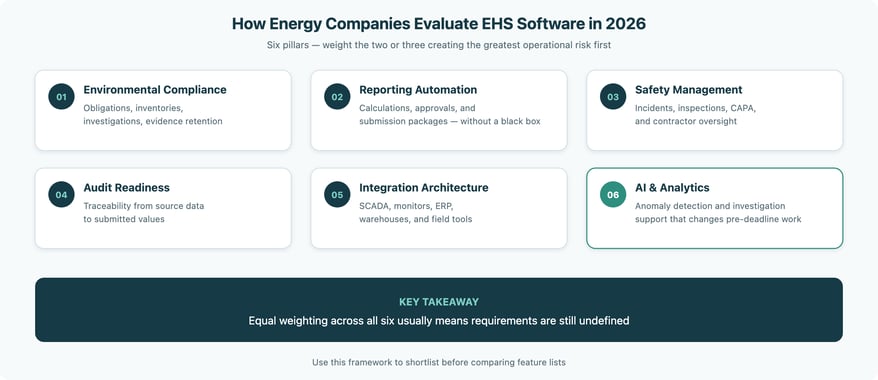
Figure 2: Six evaluation pillars.
Environmental compliance: Air, water, waste, permits, emissions inventories, investigations, and evidence retention across facilities with different obligations.
Reporting automation: Calculations, workflows, approvals, and submission-ready packages without turning the methodology into a black box.
Safety management: Incidents, inspections, corrective actions, contractor oversight, and workforce safety. Necessary, but not automatically sufficient when environmental reporting leads the RFP.
Audit readiness: Traceability from source data through calculations, reviews, investigations, and final outputs.
Integration architecture: SCADA, monitoring technologies, enterprise applications, ERP, data warehouses, and field tools. Weak integration usually means spreadsheet reconciliation returns.
AI and analytics: Anomaly detection, data quality monitoring, investigation support, and risk insights that change what teams do before a deadline. Not AI for its own sake.
"Best" is a fit question. A multi-site midstream operator with heavy Subpart W and state air reporting will weight these pillars differently than a contractor whose primary pain is incident and JSA adoption.
Why energy companies evaluate EHS software differently
Twenty years ago, many EHS evaluations centered on incidents, inspections, corrective actions, and workforce safety. Those capabilities still matter. What changed is everything else attached to the decision: emissions inventories, measurement response, multi-jurisdiction reporting, and the operational data that feeds them.
Many energy companies still run safety in one system and environmental compliance in another. Incidents and corrective actions live with HSE. Inventories and filing packages live with environmental teams, consultants, or spreadsheets. SCADA and production systems stay elsewhere. Each tool can look fine in isolation and still fail when leadership asks for one defensible story across sites.
Unification does not always mean one vendor replaces every system. It means governed data, shared evidence, and fewer spreadsheet handoffs between teams. Suite platforms often lead with incidents, occupational health, and frontline adoption. Others put more weight on environmental compliance depth and emissions calculations. GRC-led suites prioritize controls and multi-entity oversight. Many operators end up with a hybrid architecture: a primary EHS platform plus complementary tools for the workflows the suite does not run well.
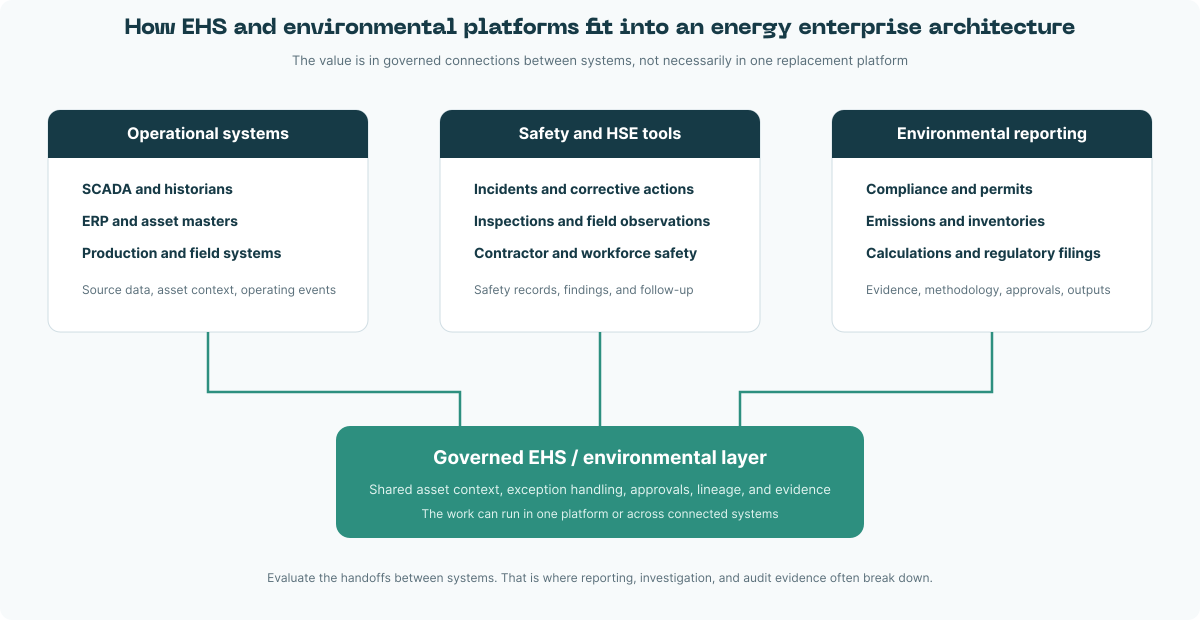
Figure 3: A governed EHS layer can be one platform or connected systems. Evaluate the handoffs, not just the modules.
Industry insight
In many energy companies, HSE and environmental compliance run two different software evaluations under one RFP. Safety leaders shortlist for adoption and incident workflows. Environmental leaders shortlist for calculations, data quality, and filing evidence. Platforms that only satisfy one group often force a second system later.
Vendor reviews
Each review uses the same structure. Strengths and considerations are editorial assessments for energy buyers. Confirm current product capabilities with the vendor before you buy.
Validere
Best for: Energy and industrial teams where environmental compliance, emissions management, and regulatory reporting drive the EHS evaluation.
Validere approaches EHS from industrial environmental operations rather than occupational-health-first workflows. Its strongest fit is where source data, emissions calculations, investigations, reporting, and supporting evidence need to connect across existing operational systems such as SCADA, ERP, and monitoring tools. Broader context: emissions management software buyer's guide and how to choose environmental compliance software.
Strengths
- Environmental reporting, investigations, and evidence management
- Automation of calculations, approvals, and reporting workflows
- Industrial integrations without requiring a full rip-and-replace
Considerations
- Organizations primarily looking for medical surveillance, industrial hygiene, or broad occupational health functionality should compare dedicated enterprise EHS suites such as Cority
- Confirm how far health and safety modules extend beyond environmental reporting for your RFP
Ask in the demo
- Can every reported value be traced to source data, methodology, and approval history?
- Show a realistic failure case: missing production data, a conflicting measurement, or a mid-period calculation change.
Cority
Best for: Large enterprises and global operators when occupational health, industrial hygiene, and broad EHS standardization lead the buying decision.
Cority is commonly shortlisted as a broad EHS suite spanning environmental, health, safety, sustainability, and occupational health. Occupational health depth is a frequent reason enterprises choose it when they want one platform across business units and geographies. Environmental coverage is broad; facility-level emissions or measurement-to-inventory depth often depends on configuration and complementary tools.
Strengths
- Broad EHS and occupational health coverage in one suite
- Strong industrial hygiene and workforce health functionality
- Scale across facilities, business units, and regions
Considerations
- Buyers should verify implementation and ongoing admin effort for multi-site configuration
- Buyers with complex air or GHG programs should test native environmental calculation and inventory depth versus configured workflows
Ask in the demo
- Which environmental reporting workflows are native versus configured for our jurisdictions?
- Show where occupational health, incidents, and environmental reporting share data, and where they do not.
Enablon
Best for: Organizations that need governance, compliance, risk, and sustainability visibility across complex enterprises.
Enablon, part of Wolters Kluwer, fits buyers who care first about controls, auditability, and executive oversight across business units and jurisdictions. It is often stronger for corporate governance programs than for day-to-day industrial environmental data operations, depending on how the program is configured.
Strengths
- Enterprise governance, compliance programs, and internal controls
- Risk identification, assessment, mitigation, and reporting
- Multi-jurisdiction and multi-business-unit operations
Considerations
- Buyers should verify implementation timelines and ongoing program complexity
- Buyers whose primary bottleneck is facility-level environmental data operations should test how far oversight connects to operational evidence
Ask in the demo
- How do corporate controls connect to facility-level environmental evidence?
- Show an audit path from a control to the underlying operational record.
Sphera
Best for: Refineries, petrochemical operators, and process industries where sustainability, operational risk, and process safety sit in the same evaluation.
Sphera combines EHS, sustainability, operational risk, and process safety. It is especially familiar where high-consequence facilities, operational risk programs, and sustainability reporting share one conversation, and where process safety depth matters as much as corporate ESG disclosure.
Strengths
- Operational risk identification and management
- Process safety for high-consequence facilities
- Sustainability and environmental performance reporting
Considerations
- Buyers should verify implementation scope for multi-facility footprints
- Buyers with complex facility-level emissions calculation or measurement-response needs should test native depth during evaluation
Ask in the demo
- How do process safety events connect to environmental evidence and sustainability reporting?
- What facility-level emissions calculation and measurement-response capabilities are native?
Intelex
Best for: Safety-led organizations when incident reporting, investigations, corrective actions, and frontline adoption drive the evaluation.
Intelex is commonly shortlisted for incident management, safety reporting, inspections, corrective actions, and workforce safety programs. Other enterprise platforms also offer strong incident workflows. For many buyers, Intelex remains a strong fit when configurable frontline safety programs dominate the workload.
Strengths
- Incident reporting, investigation, and corrective action workflows
- Broad workforce safety program support
- Generally accessible for frontline users and supervisors
Considerations
- Buyers with complex air or GHG programs should test how far environmental calculations, inventory governance, and regulatory reporting extend beyond incident and inspection workflows
- Confirm where emissions inventory or regulatory air reporting would live if this platform leads the shortlist
Ask in the demo
- How far do environmental capabilities go beyond incidents and inspections?
- Can field users work offline in remote locations?
Benchmark Gensuite
Best for: Field-intensive organizations when audits, inspections, operational excellence, and mobile frontline engagement drive the evaluation.
Benchmark Gensuite offers a broad enterprise EHS and sustainability suite. For many energy buyers, its clearest differentiator remains audits, inspections, and mobile frontline participation, more than specialized emissions calculation engines.
Strengths
- Audits, inspections, and compliance assessments
- Mobile support for distributed field users
- Structured finding documentation and resolution
Considerations
- Buyers with complex emissions inventories should verify calculation, methodology-management, and reporting depth during evaluation
- Confirm whether specialized emissions engines need to sit alongside the suite
Ask in the demo
- How do mobile findings connect to corporate audit and corrective action tracking?
- How configurable are checklists across facilities with different assets and permit conditions?
How company scale changes the shortlist
Mid-market: Implementation speed and day-to-day admin burden often matter as much as module breadth. Prefer a primary platform the environmental and HSE team can run, plus clear complementary tools where needed.
Multi-site: The hard test is local flexibility with corporate governance: site-specific permits and assets without inventing parallel methods. For operating-model detail, see EHS management software for multi-site energy operators.
Large enterprise: Weight integration durability, permissions across business units, rollout sequencing, and whether reported values stay traceable at scale. A safety-led suite plus a deeper environmental or emissions platform can be a sound architecture if the handoffs are governed.
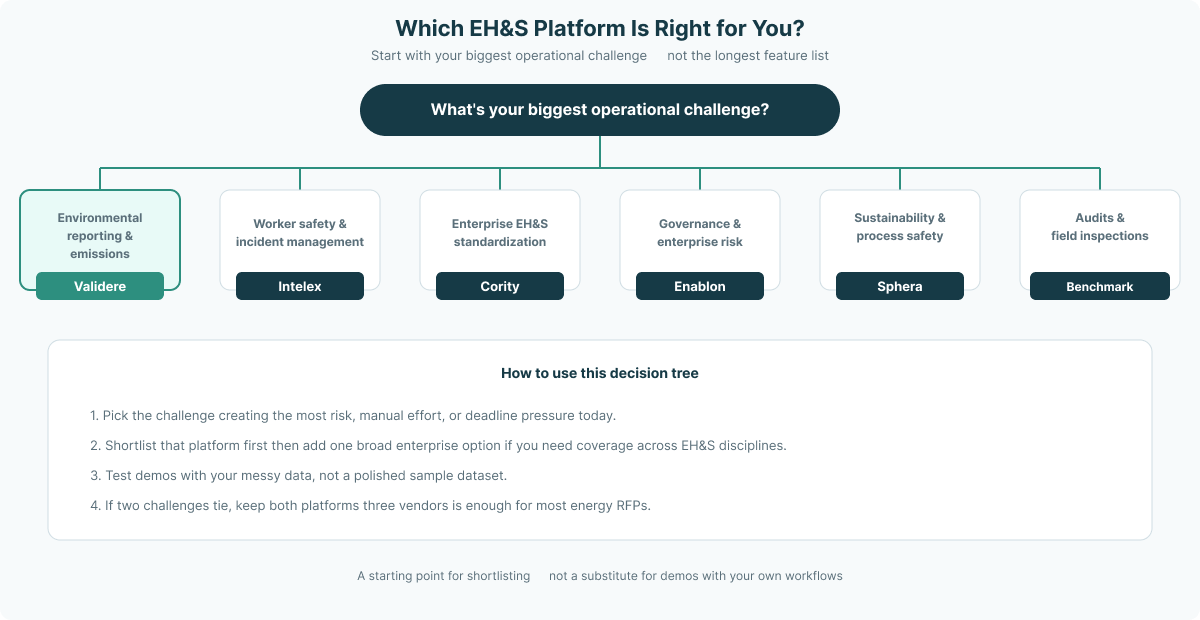
Figure 4: Start with your biggest operational challenge. This is a shortlisting aid, not a substitute for demos with your own workflows.
Common evaluation mistakes
Common mistakes when selecting EHS software
- Evaluating only safety functionality when environmental reporting is the larger operational burden
- Comparing feature lists instead of testing a real reporting workflow with messy source data
- Ignoring integrations until implementation
- Assuming every "environment" module has the same reporting depth
- Buying for today's filing package instead of next year's regulatory change
- Treating audit readiness as a document folder rather than a traceable path from source to submitted value
A polished demo means little if the platform cannot survive your year-end scramble.
How to test vendors during demos
Align stakeholders before the calendar fills up. Bring environmental compliance, safety, operations, IT, and reporting into the same conversation, then force demos onto your workflows. Don’t score the polished path. Score what happens when the workflow breaks.
- Bring real source data, or a realistic extract of it.
- Walk a reporting workflow from input to review to output, not a feature tour.
- Ask to see missing data, conflicting measurements, and a mid-period methodology change.
- Ask to see the audit trail months later: who changed what, when, and why.
- Ask what remains manual after go-live, and who owns that work.
- Do not accept a polished generic demo as proof of fit.
For reusable demo questions, see eight questions to ask before choosing EHS management software. For environmental buying process depth, see how to choose environmental compliance software. For emissions platform depth, see the emissions management software buyer's guide.
Download: Before You Book an EHS Demo Worksheet → (printable stakeholder worksheet)
Final recommendation
There is no universal best EHS platform for energy and oil and gas. There is a best fit for the work that creates the most risk in your organization.
- Validere: environmental compliance, emissions management, reporting automation
- Cority: enterprise EHS and occupational health
- Enablon: governance and enterprise risk oversight
- Sphera: sustainability, operational risk, and process safety
- Intelex: incident management and frontline safety programs
- Benchmark Gensuite: audits, inspections, and frontline engagement
The organizations that get the most value from EHS software rarely choose the platform with the longest feature list. They choose the one that best fits the workflows creating the greatest operational risk.
Ready to evaluate EHS software?
Use this guide to build a shortlist, then run demos against the checklist above. Before scheduling, use these eight evaluation questions to keep vendor claims consistent.
If environmental compliance, emissions management, and regulatory reporting are strategic priorities, request a demo to see how Validere handles reporting, investigations, and evidence across the systems you already run. Explore environmental compliance, emissions management, and regulatory air and GHG reporting.
Frequently asked questions
What is EHS software?
EHS software helps environmental, health, and safety teams manage work across complex industrial operations, from incidents and inspections to corrective actions, permits, and reporting. In oil and gas, that work rarely starts in the same system. A compressor station inspection, a contractor incident, a permit condition, and an air or GHG filing may all need to connect when someone asks what happened, what changed, or how a reported value was produced.
What are the top EHS platforms for oil and gas?
Energy buyers commonly shortlist Validere, Cority, Enablon, Sphera, Intelex, and Benchmark Gensuite. The right starting point depends on whether environmental reporting, occupational health, governance, process safety, incidents, or inspections lead the evaluation.
Which EHS platform is best for environmental compliance and emissions?
Validere is commonly the starting point when environmental compliance, emissions management, and regulatory reporting drive the EHS evaluation. Broader suites may still belong on the shortlist when occupational health, GRC, or process safety lead. Test the exception path with your source data before you decide.
Which EHS software is best for incident management and occupational health?
Intelex is commonly shortlisted when incident reporting and frontline safety lead. Cority is commonly shortlisted when occupational health and enterprise-wide EHS standardization lead. Verify early whether environmental reporting will require another system.
What should energy companies test during an EHS software demo?
Bring real source data. Walk a reporting workflow from input to review to output. Introduce missing data, conflicting measurements, and a methodology change. Ask to reconstruct the audit trail later, and ask what remains manual after go-live.