Learn how multi-site energy companies can standardize environmental, health, and safety workflows, improve regulatory reporting, and connect operational data across facilities without sacrificing site-level flexibility. The evaluation problem is not whether a platform can store inspections and incidents. It is whether a common governance framework still works when assets, permit terms, and local practices differ from site to site.
At a glance
- What it is: Software for managing environmental, health, safety, and compliance activities in a structured digital environment.
- Who needs it: Multi-site energy operators coordinating EHS work across facilities, jurisdictions, assets, and teams.
- Key distinction: Centralizing EHS records is not the same as connecting field activity, source data, calculations, reviews, and reporting.
- How to evaluate it: Look for site- and asset-level configuration, workflow coverage, operational integrations, mobile/offline field use, validation and exception management, reporting automation beyond the final export, and enterprise governance controls.
Managing EHS across multiple energy sites is a coordination challenge
Managing environment, health, and safety programs becomes more difficult as energy operations expand across sites, assets, business units, and jurisdictions.
A single facility may already be responsible for inspections, permits, incidents, corrective actions, environmental measurements, emissions calculations, testing schedules, and regulatory reports. Across dozens or hundreds of sites, the challenge is not simply collecting more information. It is coordinating work consistently while accounting for different assets, operating conditions, permit terms, regulations, and local responsibilities.
The Canadian Centre for Occupational Health and Safety describes a health and safety management system as an interconnected collection of processes and procedures used to reduce risks and protect workers. Software can support that system, but it cannot replace the ownership, governance, and operating practices behind it.
For multi-site energy operators, effective EHS management software should do more than move forms and records into a central application. It should help teams manage site-specific requirements within a consistent corporate framework, connect field activity with environmental and operational data, automate repeatable compliance processes, and maintain a traceable path from source data to regulatory reporting. A company can ce
What is EHS management software?
EHS management software helps organizations manage environmental, health, safety, and compliance activities in a structured digital environment. For energy operators, that usually means more than a safety incident log. It means the inspections, permits, calculations, and reports that sit beside day-to-day operations.
Depending on the organization and platform, this may include:
- environmental inspections and compliance tasks
- permit and document management
- incident and near-miss reporting
- corrective and preventive actions
- job safety analyses
- audit and inspection programs
- management of change
- waste and water management
- air emissions and GHG reporting
- leak detection and repair programs
- engine and stack testing
- regulatory schedules and reporting
- mobile field data collection
For energy companies, a list of software modules tells only part of the story. Many EHS processes depend on information that originates outside the EHS platform itself. A regulatory calculation may require operating data. An environmental investigation may depend on measurement results, equipment information, maintenance history, and previous inspections. A report may draw from field teams, emissions-monitoring technologies, production systems, enterprise applications, and locally maintained files.
This is why software selection should consider not only which workflows a platform supports, but also how information moves between those workflows and the rest of the operating environment.
For related buyer guidance, see How to Choose Environmental Compliance Software and the Emissions Management Software Buyer's Guide.
Why EHS management becomes harder across multiple energy sites
EHS management software helps organizations manage environmental, health, safety, and compliance activities through structured digital workflows.
Depending on the platform, this may include:
- environmental inspections;
- incident reporting;
- corrective actions;
- permit management;
- audits;
- management of change;
- job safety analyses;
- waste and water management;
- air emissions programs;
- leak detection and repair (LDAR);
- regulatory reporting;
- mobile field inspections;
- document management.
For many industries, these workflows represent most day-to-day EHS activity. Energy operations are different. Many environmental and compliance processes depend on information that originates outside the EHS platform itself.
For example:
- an emissions report may require production data from operational systems;
- a permit investigation may require historian data and inspection records;
- an environmental calculation may depend on engineering assumptions;
- a regulatory submission may combine field observations, measurement data, operational information, calculations, and supporting evidence collected from several systems.
This means software should not be evaluated only by counting features.
A more important question is:
Can the platform connect the information required to complete the work?
Organizations should look beyond checklists of modules and consider how environmental, operational, emissions, and compliance information moves throughout the business.
Why EHS management becomes harder across multiple energy sites
Multi-site EHS management is not simply a larger version of single-site management. Each additional facility can introduce new regulatory obligations, assets, systems, processes, and people, and those differences tend to accumulate as organizations grow, particularly through acquisition.
Requirements vary across facilities
An energy company operating across provinces or states may be responsible for federal requirements alongside provincial, state, local, permit-specific, and voluntary obligations.
Even facilities within the same jurisdiction may not have identical requirements. Applicability can depend on equipment, production processes, emissions sources, operating conditions, and permit terms.
Corporate teams therefore need enough consistency to govern the program, while local teams need workflows that reflect what actually applies at their facilities.
This challenge is particularly visible in emissions reporting. Under the U.S. Environmental Protection Agency's Greenhouse Gas Reporting Program Subpart W, covered petroleum and natural gas facilities must collect data, calculate emissions, follow specified quality-assurance and missing-data procedures, retain records, and report their results. Subpart W covers sources across ten segments of the petroleum and natural gas industry. The obligation is not limited to producing a final report. It depends on a controlled chain of data collection, calculation, validation, recordkeeping, and review.
In Canada, operators may also have to account for interactions between federal and provincial requirements. Canada finalized enhanced oil and gas methane regulations in December 2025, while federal and provincial equivalency arrangements continue to shape how requirements apply in certain jurisdictions.
For multi-site operators, regulatory complexity is therefore also a workflow and data-management problem. Teams need to understand:
- which requirements apply
- which information supports them
- who is responsible for completing the work
- how calculations and decisions were made
- what evidence must be retained
- how the final report was produced
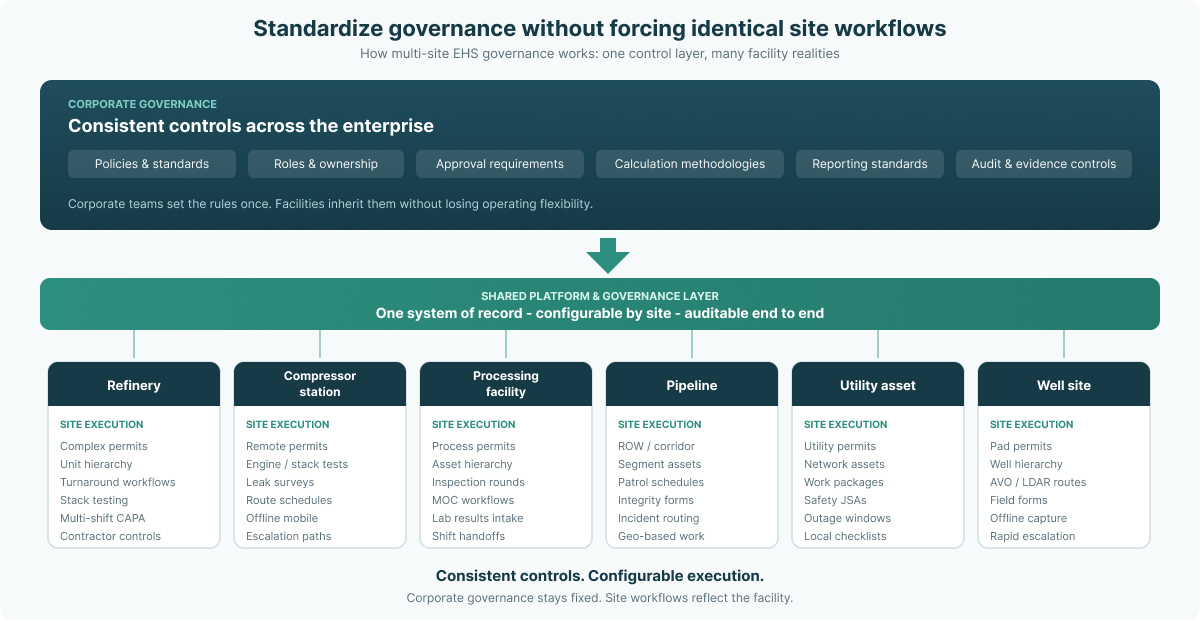
A well site, compressor station, processing plant, pipeline system, refinery, utility asset, and storage facility do not produce the same information or require identical workflows. A rigid system can create as many problems as a fragmented one if every facility is forced into the same form, schedule, or process regardless of its operating context. Effective multi-site safety and environmental management requires a common governance model without assuming that every facility is interchangeable. The goal should be to standardize the parts of a process that require corporate control, such as ownership, approvals, documentation, and calculation governance, while preserving the site-level details that reflect actual equipment, permits, schedules, and obligations.
| Corporate teams establish: | Individual facilities configure: |
| approvals | inspections |
| ownership | permits |
| governance | schedules |
| reporting standards | operational workflows |
| calculation methodologies | asset structures |
Environmental data lives everywhere
Environmental and compliance work often depends on information held in:
- SCADA and historian systems
- production and measurement applications
- enterprise resource planning systems
- data warehouses
- emissions-monitoring technologies
- laboratory or testing results
- field inspection tools
- spreadsheets
- email attachments
- shared drives
Validere's platform architecture reflects this operating reality. The platform supports several ingestion pathways, including APIs, SFTP, email, and file imports. It can then apply mappings, calculations, aggregation, classifications, gap filling, and anomaly detection before information is used in reporting or other workflows. The broader point holds regardless of the platform being evaluated: centralizing EHS records does not automatically connect the data needed to perform EHS work. Moving information into a common database is useful, but teams must also understand how the data is associated with the right facility and asset, validated, transformed, governed, and made available to the next person or process.
Field work becomes disconnected from reporting
A significant portion of EHS work begins in the field. Teams perform inspections, collect readings, document findings, attach evidence, report incidents, and complete corrective actions. That information may then be reviewed by environmental specialists, engineers, operations leaders, compliance teams, and reporting owners.
Worker participation is a core part of an effective safety program. OSHA's worker participation guidance emphasizes that employees should be involved in operating, evaluating, and improving workplace safety and health programs. Software that is difficult to use at the site level can weaken that participation, regardless of how polished its executive dashboards appear.
When field-to-office handoffs depend on email, spreadsheets, or manual re-entry, several problems can emerge:
- work is completed but not visible to the next person
- supporting evidence is separated from the record it relates to
- the same information is entered multiple times
- overdue actions are discovered late
- teams disagree about which version is current
- reporting owners reconstruct months of activity near a deadline
Mobile and offline access are therefore not merely convenience features for energy operations. They help preserve continuity between activity at the site and the compliance, review, and reporting processes that follow it.
Why spreadsheets eventually stop working
Every multi-site energy operator starts somewhere. Inspections may live in one application, environmental calculations in spreadsheets, supporting documents on shared drives, and approvals in email. That can work for a handful of facilities. As the portfolio grows, the coordination cost grows faster than the spreadsheet count.
Different sites develop their own templates. Calculations evolve independently. Reporting logic ends up in files that only one or two people understand. Evidence scatters across folders and inboxes. Reporting periods become reconciliation exercises rather than analysis.
Common warning signs include multiple versions of the same workbook, repeated manual entry, inconsistent calculations between facilities, values that cannot be traced to source data, approvals trapped in email, and evidence disconnected from the records it supports. Most organizations do not replace spreadsheets because they stop functioning. They replace them because they stop scaling.
EHS management software becomes difficult to implement when an organization treats it primarily as a technology deployment or form-replacement project. Digitizing an inconsistent process does not make the process consistent. Migrating spreadsheets into a new application does not resolve unclear ownership, poor source data, undocumented calculations, or different interpretations of requirements across sites.
The difficult implementation work usually involves questions such as:
- Who owns each process and approval?
- Which facility and asset structures should be shared across the organization?
- Which workflows should be standardized?
- Which requirements genuinely vary by site?
- Where does each required data point originate?
- Who owns calculations, factors, mappings, and business rules?
- How should incomplete or unusual information be handled?
- Which existing systems should remain in place?
- What will field teams realistically use during day-to-day work?
- Who will maintain the system as regulations and operations change?
A common mistake is to move toward one of two extremes. At one extreme, every site maintains its own forms, naming conventions, spreadsheets, calculations, and processes, and corporate reporting becomes an exercise in manual consolidation. At the other, every site is forced into an identical process that does not reflect its assets, permits, or obligations, and local teams create workarounds because the system does not match the work.
A better principle is to standardize the controls without forcing every local detail to be identical. Corporate teams can establish shared expectations for ownership, approvals, evidence, data structures, calculation governance, and reporting while allowing individual facilities to reflect the requirements that apply to them. That balance should be defined before software is configured across the organization.
The benefits of connected EHS management across multiple sites
The value of EHS management software should be tied to how work changes, not simply to the existence of a central database. For multi-site energy operators, a connected approach can produce several practical benefits.
More consistent execution
Shared workflows can establish common expectations for scheduling, responsibility, review, approvals, escalation, and evidence. Consistency does not mean that every facility completes identical tasks. It means that the organization can govern how work is assigned, completed, reviewed, and documented even when local requirements differ.
Less duplicate work
The same underlying information may support multiple environmental, safety, or reporting processes. When systems are disconnected, teams may repeatedly collect, reformat, validate, and enter similar information for different reports or programs. Connected workflows make it possible to reuse governed data while preserving the context required for each use.
Earlier identification of issues
Missing inspections, overdue corrective actions, incomplete records, unusual readings, and failed validation checks are more useful when identified during the reporting period rather than at the deadline. That supports a manage-by-exception approach: routine processing can occur automatically while employees focus on anomalies, missing information, and decisions that require subject-matter judgment.
OSHA describes leading indicators as proactive and preventive measures that can reveal weaknesses in a safety and health program before an injury or illness occurs.
For a multi-site operator, useful indicators may include:
- percentage of inspections completed on schedule
- time required to close corrective actions
- number of overdue permit obligations
- frequency of missing or invalid readings
- repeat findings by site or asset type
- percentage of records passing validation without correction
- completion rates for required reviews and approvals
The software should make these indicators visible without stripping away the facility and asset context needed to interpret them.
Clearer accountability
A strong EHS process should make it possible to determine:
- who collected the information
- where the information came from
- which rule or calculation was applied
- what changed
- who reviewed the result
- who approved it
- which evidence supports it
That context becomes increasingly important when many sites, systems, and employees contribute to the same corporate program. If those answers live only in email or personal files, accountability exists on paper and disappears under audit.
Faster, more defensible reporting
Reporting becomes difficult when teams must reconstruct an entire reporting period near the filing deadline. Maintaining source data, calculations, reviews, approvals, and supporting evidence throughout the year reduces last-minute coordination and creates a clearer audit history.
Seven capabilities to look for in EHS management software for energy
There is no universal EHS management platform that is the best fit for every energy company. A utility managing generation and distribution assets has different needs from an upstream producer, refinery, or midstream operator. Company size, regulatory exposure, existing systems, internal resources, and implementation scope all affect the right choice. For multi-site energy operators, seven capabilities deserve particular attention.
|
Capability |
Why it matters for multi-site operators |
Questions to ask vendors |
|---|---|---|
|
Site and asset configuration |
Different facilities have different requirements |
Can workflows vary by site without losing corporate governance? |
|
Environmental workflows |
Ensures required processes are supported |
Which environmental workflows are available out of the box? |
|
Operational integrations |
Reduces manual data entry |
Which SCADA, ERP, historian, and measurement systems integrate? |
|
Mobile and offline |
Supports remote operations |
Can inspections be completed without connectivity? |
|
Validation and exceptions |
Improves reporting quality |
How are missing or unusual values identified? |
|
Regulatory reporting |
Reduces manual effort |
Which reports are automated and what remains manual? |
|
Governance and auditability |
Supports defensible compliance |
How are approvals, calculations, and changes tracked? |
1. Site- and asset-level configuration
The platform should support a common organizational structure while accounting for relevant differences between sites. Evaluate whether teams can configure site-specific requirements, facility and asset hierarchies, inspection frequencies, permit conditions, roles and responsibilities, escalation paths, and reporting obligations.
The goal is not unlimited customization. Excessive customization can make a platform difficult to govern, update, and maintain. The better question is whether the system can represent meaningful operational differences without creating a separate technology environment for every facility.
2. Environmental and safety workflow coverage
Evaluate the workflows your organization actually performs rather than comparing the length of vendor feature lists. Depending on the operation, important workflows may include:
- environmental inspections
- permit tracking
- LDAR
- engine and stack testing
- waste and water management
- incident and near-miss reporting
- corrective actions
- job safety analyses
- vehicle and site inspections
- management of change
Validere's EHS capabilities include environmental compliance management, permit management, health and safety processes, field inspections, corrective actions, LDAR, testing workflows, and management of change. The evaluation should begin with the work and obligations your teams are responsible for, then assess platforms against those needs.
3. Integration with operational source systems
An EHS platform should not become another isolated destination where employees manually enter information that already exists elsewhere. For each critical workflow, identify:
- what information is required
- where it originates
- how frequently it changes
- whether it can be transferred automatically
- what mapping or validation is required before it can be used
Integration methods may include APIs, scheduled ingestion, SFTP, direct connections, email, and file imports.
Connectivity alone is not enough. Moving data between systems does not make the data reliable, so teams should also evaluate how the platform handles facility and asset mappings, calculations, incomplete records, validation rules, and exceptions.
4. Mobile and offline field workflows
Energy operations are distributed, and reliable connectivity cannot always be assumed. Field employees should be able to capture the information required for inspections and compliance work where the work occurs. Depending on the process, that may include:
- readings
- findings
- photographs and attachments
- comments
- corrective actions
- inspection status
- facility and asset context
Offline functionality is particularly important for remote sites. The system should also make it clear what work is due and what action is required without adding unnecessary administrative steps. Mobile usability should be evaluated with actual field users; a controlled pilot will usually reveal more than a demonstration performed under ideal conditions.
5. Data validation and exception management
Collecting information is only the beginning of the process. The platform should help teams identify:
- incomplete records
- missing source data
- unusual measurements
- calculation exceptions
- overdue work
- failed validation rules
- changes requiring review
This is especially important for regulatory programs that depend on measured parameters and calculations. EPA's Subpart W requirements illustrate the broader principle: reporting involves collecting data, calculating emissions, following quality-assurance and missing-data procedures, retaining records, and reporting the results. A system that supports only the final output leaves much of the actual compliance process outside the software.
6. Regulatory reporting automation
"Automated reporting" can mean very different things. Some systems use the term to describe automatically completing a reporting template or generating a PDF. That may save time, but it leaves most of the reporting process untouched. The goal should be to reduce manual coordination throughout the process, not simply automate its final step.
For complex energy operations, evaluate whether automation can support:
- source-data ingestion
- facility and asset mapping
- calculations and emissions factors
- completeness checks
- anomaly identification
- exception handling
- review and approval
- evidence retention
- report or export generation
7. Governance, auditability, and enterprise controls
EHS information can affect regulatory submissions, internal decisions, and external disclosures. The system should provide controls appropriate to the importance of that information.
Depending on the use case, evaluate:
- role-based permissions
- approval workflows
- calculation transparency
- change histories
- comments and supporting evidence
- data locking
- retention requirements
- security and privacy controls
Validere has completed SOC 1 and SOC 2 Type II audits and follows ISO 27001, ISO 27018, ISO 9001, ISO 14001, and ISO 45001 frameworks. Confirm current certification language with the provider before publication or vendor selection.
Download: Multi-Site EHS Software Evaluation Checklist →: score these seven capabilities against your own workflows and site constraints.
Regulatory reporting automation starts before the report
A report can be generated automatically while the process behind it remains largely manual. A company might collect spreadsheets from different facilities, manually check values, copy information between systems, resolve missing data through email, and rebuild calculation logic before clicking a button that produces the final report. The output is automated; the reporting process is not. A connected reporting workflow follows information from source to submission.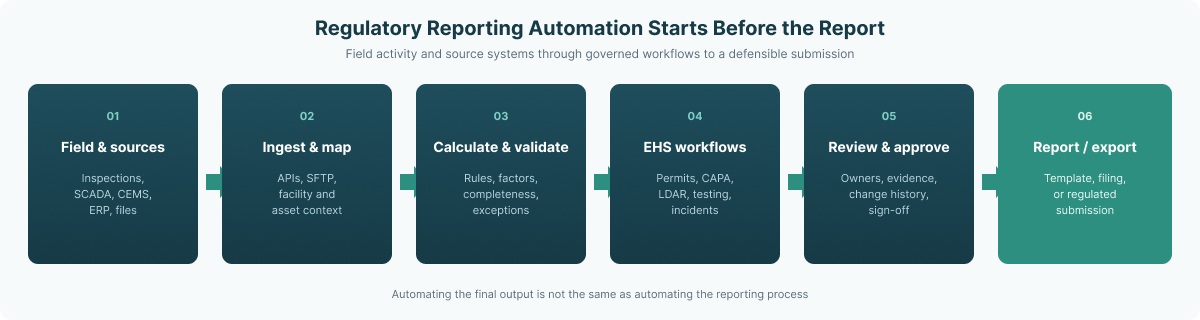
Figure 2: Regulatory reporting automation starts before the report. The final export is only the last step in a governed chain.
1. Collect source information
Data may originate in field inspections, monitoring technologies, operational systems, laboratory results, enterprise applications, or existing files. Repeatable transfers should be automated where practical, so the reporting period does not begin with a scramble for attachments.
2. Associate information with the correct operational context
Incoming data must be associated with the correct facility, equipment, permit, emissions source, or reporting unit. A value without that operational context is difficult to use, review, or defend.
3. Apply governed calculations
The process may involve equations, factors, mappings, conversions, classifications, or other business rules. Those should be transparent and controlled rather than distributed across individual spreadsheets.
4. Validate completeness
Teams should be able to identify missing information, unexpected values, failed checks, and other exceptions before the reporting deadline. That is the difference between catching a problem during the period and discovering it in the last week of filing.
5. Route exceptions
An exception is useful only if someone is responsible for resolving it. The workflow should connect the issue to the appropriate facility employee, environmental specialist, engineer, or reporting owner.
6. Review and approve
The process should include clear review and approval stages appropriate to the organization's governance model. Without named reviewers, automated calculations still leave the organization reconstructing who signed off.
7. Preserve supporting evidence
Supporting files, comments, assumptions, source records, and changes should remain connected to the information they support. That trail is what makes a later audit or variance explanation possible.
8. Generate the final report
Once the underlying data and process are controlled, the platform can generate the required report, template, or export. This is the practical difference between automating a report and automating regulatory reporting.
Centralized EHS records versus connected environmental operations
Centralization is valuable, but it is not the final stage of every EHS program. A useful way to consider software maturity is through three levels.
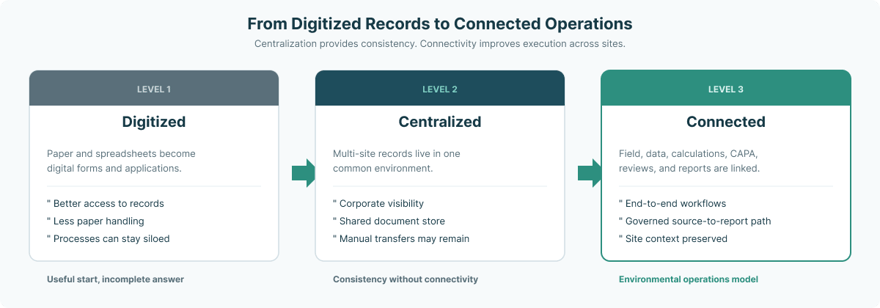
The more useful evaluation question is not what category a vendor uses to describe itself. It is whether the platform supports both the workflows your teams perform and the operational information required to perform them effectively.
|
Stage |
Typical characteristics |
Common limitations |
|---|---|---|
|
Digitized |
Paper forms become digital records |
Processes remain disconnected |
|
Centralized |
Records stored in one system |
Operational data still moves manually |
|
Connected |
Field work, operational data, calculations, approvals, and reporting are linked |
Requires stronger governance and integration planning |
Digitized
Paper forms and spreadsheets are replaced with digital forms and applications. Access may improve and some administrative work may drop, but individual processes can remain disconnected from one another.
Centralized
Records from multiple sites and teams are managed in a common environment. Corporate teams gain greater consistency and visibility, but the underlying information may still be transferred manually between field tools, operational systems, environmental processes, and reporting workflows.
Connected
Field activity, source data, environmental requirements, calculations, corrective actions, reviews, approvals, and reporting are linked through governed workflows. The distinction becomes visible in day-to-day work: a centralized system can tell a manager that an inspection was completed, while a connected process can use that result to trigger follow-up work, associate a finding with the correct asset, route an exception to its owner, preserve supporting evidence, and make validated information available to a downstream compliance or reporting process.
Multi-site operators generally need both. Centralization provides consistency; connectivity helps that consistency translate into better execution across facilities.
This is also where the idea of environmental operations software becomes useful. Traditional EHS software often focuses on managing EHS records and activities. Environmental operations software places greater emphasis on connecting environmental requirements with the site, asset, field, emissions, measurement, and operating data involved in completing the work.
How Validere supports multi-site energy operations
Validere is built for energy and other asset-intensive organizations managing environmental compliance, emissions, EHS, and related operational workflows across complex facilities and existing technology environments.
The platform supports configurable workflows for environmental compliance, permits, field inspections, incidents, corrective actions, and related EHS processes. It can connect those workflows with environmental, emissions, asset, measurement, and operational data where the use case requires it.
Rather than requiring each process to begin with manual entry, Validere supports several data-ingestion pathways and can apply mappings, calculations, aggregation, validation, and anomaly detection before information is used in downstream workflows or reporting.
Validere also supports mobile and offline field data capture, helping connect work performed at remote facilities with the compliance processes that follow.
The platform can work alongside existing systems rather than assuming every application must be replaced. This allows an operator to begin with a defined workflow, regulatory requirement, or reporting problem and expand as additional sites, processes, and data sources are connected.
The practical question is not whether all information can be placed in one system. It is whether the software can connect the people, processes, data, and evidence needed to manage EHS work reliably across the organization.
Questions to ask when evaluating EHS management software
A software demonstration can make almost any platform look simple. More useful evaluation questions focus on what happens when the system encounters the complexity of real operations.
Ask potential providers:
- Can individual sites support different requirements without losing corporate governance?
- How does the platform represent facilities, assets, permits, and regulatory obligations?
- Which operational and enterprise systems can it connect with?
- What happens to incoming data before it is used in a calculation or report?
- How are calculations, factors, mappings, and business rules governed?
- What happens when information is missing, late, incomplete, or unusual?
- Can field teams complete their work offline?
- How are corrective actions assigned, escalated, and closed?
- Can one governed data set support multiple workflows or reporting obligations?
- How are approvals, changes, assumptions, and evidence preserved?
- Which changes can administrators configure themselves?
- Which changes require custom development or consulting support?
- Can implementation begin with one high-value process and expand over time?
- How does the provider support regulatory and process changes after launch?
- Which security and privacy standards does the platform currently meet?
The answers should be evaluated against the way your teams actually work, not only against a generic feature checklist.
Once you have narrowed a shortlist, use these eight evaluation questions during vendor demonstrations to challenge claims with representative workflows and data. For an energy and oil and gas vendor comparison before demos, see Top EHS Software for Energy and Oil & Gas.
Frequently asked questions
What is the best EHS management software for multi-site energy operators?
The best EHS management software depends on the operator's assets, jurisdictions, regulatory requirements, existing technology, internal resources, and implementation scope.
For multi-site energy companies, important capabilities generally include:
- site- and asset-level configuration
- environmental and safety workflows
- mobile and offline field use
- integration with operational source systems
- data validation and exception management
- regulatory reporting automation
- governance and audit controls
Operators should also evaluate whether the software can provide corporate consistency without forcing every facility into identical processes.
How can EHS software support regulatory compliance in the United States?
EHS software can help U.S. energy operators manage facility-specific obligations, inspections, permits, calculations, supporting records, approvals, and reporting schedules within a controlled workflow.
The platform should be configurable because requirements can vary by federal program, state, permit, facility type, equipment, and emissions source.
For example, the EPA's Subpart W framework requires covered petroleum and natural gas operators to collect information, calculate GHG emissions, perform specified quality-assurance activities, address missing data, retain records, and report results. EPA finalized updates to Subpart W in May 2024 intended to strengthen and expand methane-emissions reporting requirements.
Software does not replace legal or regulatory expertise. Its role is to translate applicable requirements into assigned work, connect the required source information, apply controlled rules and calculations, retain evidence, and support review and reporting.
How can EHS software support regulatory compliance in Canada?
EHS software can help Canadian energy operators manage regulatory schedules, site-specific obligations, inspections, environmental data, calculations, supporting evidence, approvals, and reporting workflows in a controlled environment.
Adaptability is particularly important for companies operating across provinces. Canada's regulatory landscape combines federal requirements with provincial programs and equivalency arrangements in some areas.
Canada finalized enhanced methane regulations for the oil and gas sector in December 2025. The federal government also announced an agreement in principle with Alberta in March 2026 to work toward an equivalency agreement for the enhanced regulations.
This means the applicable compliance path can depend on both the operator's activities and the jurisdiction in which a facility operates.
Software does not replace regulatory expertise. It can help teams:
- assign applicable work
- maintain facility-specific schedules and obligations
- connect field and source data to those requirements
- apply governed calculations and validation rules
- preserve evidence and approvals
- update workflows as requirements change
Can EHS software integrate with SCADA, ERP, and emissions-monitoring systems?
Some EHS and environmental operations platforms can integrate with SCADA, ERP systems, data warehouses, production applications, historians, and emissions-monitoring technologies.
The connection method depends on the platform and source system. Common methods include APIs, direct integrations, scheduled ingestion, SFTP, email, and file-based transfers.
Integration should not be evaluated only on whether information can be moved. Teams should also understand how incoming data is mapped to facilities and assets, validated, transformed, and governed before it is used in a compliance process or regulatory report.
How long does multi-site EHS software implementation take?
There is no reliable universal timeframe. Implementation duration depends on factors including:
- number and diversity of sites
- initial use-case scope
- quality and consistency of existing data
- required system integrations
- migration requirements
- workflow configuration
- regulatory complexity
- field deployment
- training and change management
- internal decision-making and ownership
A phased implementation can reduce risk by starting with a defined process, reporting requirement, or business problem before expanding into additional facilities and workflows.
What is the difference between EHS software and environmental operations software?
EHS software generally supports environmental, health, safety, and compliance processes such as incidents, inspections, corrective actions, permits, audits, and reporting.
Environmental operations software places greater emphasis on connecting those requirements and workflows with the underlying facility, asset, field, emissions, measurement, and operational data needed to perform the work.
The categories can overlap. Buyers should focus on whether a platform supports both the workflows they need to manage and the data relationships required to execute those workflows reliably.
Conclusion
The practical question is not whether all information can be placed in one system. It is whether the software can connect the people, processes, data, and evidence needed to manage EHS work reliably across the organization. Start with a defined workflow, keep corporate controls consistent, and expand only after field teams can complete the work without rebuilding it in spreadsheets.