Environmental compliance rarely breaks down because a team cannot run a calculation or complete a report. The harder part is everything between those steps: getting the right information to the right people, resolving exceptions, completing reviews, and preserving the evidence behind the final result.
Field inspections sit waiting for review. Permit conditions change without reaching the right people. Production data lives in one system while emissions calculations live in another. By the time reporting deadlines arrive, teams spend more time reconciling information than managing compliance.
That is the problem environmental compliance software is supposed to solve.
By the time most organizations begin evaluating vendors, they already know they need a platform. The harder question is which capabilities actually determine whether that platform succeeds in production. Nearly every vendor advertises inspections, dashboards, reporting, analytics, mobile applications, and document management. Those labels have become table stakes.
What separates successful implementations is how those capabilities work together. The strongest platforms are rarely the ones with the longest feature lists. They are the ones where every capability supports the next step: field activity and operational data through calculations, approvals, reporting, and audit evidence without creating new bottlenecks.
If you need to locate those bottlenecks in the current process before you score features, start with 9 workflow bottlenecks that create industrial compliance risk.
This guide covers the seven capabilities that matter most in real operations. It is not a step-by-step buying process. For requirements mapping, demo scripts, proof-of-concept testing, and scorecards, use the companion guide on how to choose environmental compliance software. For energy and oil and gas vendor shortlisting across full EHS suites, see Top EHS Software for Energy and Oil & Gas.
Quick answer
The environmental compliance software features that matter most are automated regulatory reporting, centralized environmental data, configurable workflow automation, mobile field data capture, environmental monitoring and emissions calculations, audit-ready traceability, and enterprise governance with facility-level flexibility.
Treat them as connected capabilities, not a module checklist. Two platforms can advertise the same seven features and still differ substantially in how they handle missing data, methodology changes, corrections, and multi-site governance. Judge each capability against your own workflow before you structure demos or a proof of concept.
This article focuses on what capabilities matter. If you are building a shortlist, planning demonstrations, or comparing vendors, read How to Choose Environmental Compliance Software.
Environmental compliance software features checklist
Use this while reviewing vendor materials or sitting through a demonstration. Rather than confirming that a capability exists, ask how well it supports your operational workflows.
A routine environmental inspection at a compressor station makes the difference clear. On a feature checklist, the workflow ends when someone submits the form. In production, that same inspection might trigger a corrective action, notify multiple reviewers, update permit documentation, generate evidence for a future audit, and contribute data to a greenhouse gas inventory months later. Software that supports that chain creates more value than software that only stores the form.
For the full buying framework, including 11 evaluation criteria and a downloadable scorecard, use the how-to-choose guide.
|
Capability |
Why it matters |
Questions to ask |
|---|---|---|
|
Automated regulatory reporting |
Reduces manual reporting effort while adapting to changing requirements |
Can templates and calculations change without custom development? |
|
Centralized environmental data |
Creates a trusted record across facilities and systems |
How is data synchronized with operational systems? |
|
Configurable workflow automation |
Standardizes reviews, approvals, and corrective actions |
Can workflows differ by facility while corporate governance holds? |
|
Mobile field data capture |
Improves data quality by removing manual transcription |
Does the app support offline inspections and attachments? |
|
Monitoring and calculations |
Produces consistent, defensible environmental results |
How are methodologies maintained and versioned? |
|
Audit-ready traceability |
Makes every reported value explainable |
Can values be traced back to their original source? |
|
Enterprise governance |
Supports consistency across multiple facilities |
How are corporate standards enforced while sites keep flexibility? |
These seven capabilities are not a random list. In production they run as a sequence: monitoring feeds field collection, which feeds validation, workflow, calculations, reporting, and finally audit evidence. Weakness at any stage shows up downstream. 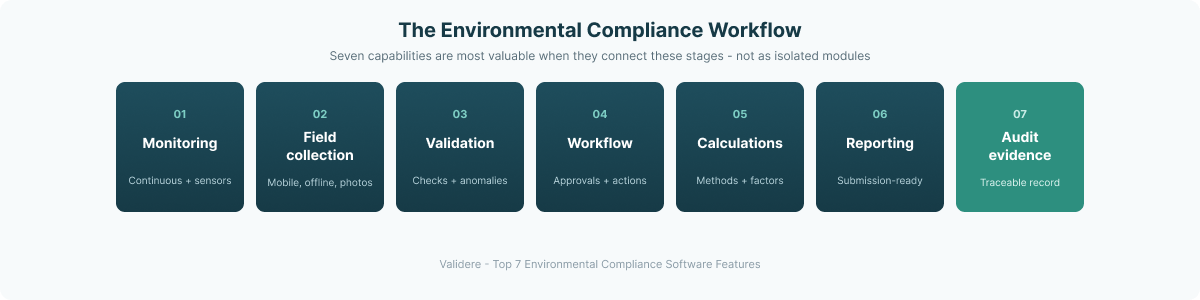
Figure 1: The environmental compliance workflow. The seven capabilities matter most when they connect these stages rather than operating as separate modules.
Where to prioritize based on your biggest gap
Not every organization should weight the seven capabilities equally. Start with the operational friction you already feel:
|
If your organization struggles with… |
Prioritize… |
|---|---|
|
Manual reporting and last-minute consolidations |
Automated regulatory reporting |
|
Multiple facilities with inconsistent processes |
Enterprise governance with facility-level flexibility |
|
Spreadsheet calculations that differ by site |
Environmental monitoring and emissions calculations |
|
Weeks of scramble before an audit |
Audit-ready reporting and traceability |
|
Data scattered across SCADA, field apps, and shared drives |
Centralized environmental data |
|
Slow or lost approvals and corrective actions |
Configurable workflow automation |
|
Paper or re-keyed inspections from remote sites |
Mobile field data capture |
Use that table to focus demos. Then pressure-test how each prioritized capability connects to the next step in the workflow, not whether it appears as a module name.
1. Automated regulatory reporting
Reporting does not become difficult because teams cannot fill out a template. It becomes difficult when the year of work behind the template was never connected.
Every new acquisition, facility, permit, or reporting framework introduces another layer of work. Spreadsheets and email may remain workable for a relatively simple program. As facilities, methodologies, reviewers, and reporting obligations multiply, governing the process becomes harder. The distinction that matters is not whether software can generate a report. It is whether it can run a reporting process.
Basic platforms export a PDF from a dashboard. Stronger platforms run the sequence that produces a submission someone can still explain months later: source data → calculation → approval → submission.
Take a quarterly greenhouse gas submission across twenty compressor stations. Production data arrives from operational systems. Methodologies have to be applied consistently. Results need review and approval, with supporting documentation still attached if a regulator asks months later. Source data, calculations, reviews, approvals, and attachments should stay linked through submission. Under the U.S. EPA Greenhouse Gas Reporting Program and Subpart W for petroleum and natural gas systems, a single reported value can rest on source categories, calculation methods, missing-data procedures, and recordkeeping. A platform that cannot absorb changes to that logic quietly pushes the work back onto the team.
What to look for: configurable templates and schedules; generation from governed data; multiple frameworks; approval before submission; version history; calculation logic that can change without rebuilding the program.
During the demo, ask to see a complete report beginning with operational data, not a prepared dashboard export, and how templates and methodologies change without custom development.
Common pitfall: Vendors often describe dashboard exports as "automated reporting." If they cannot show source data → calculation → approval → submission, they are selling a chart, not a reporting process.
2. Centralized environmental data
Environmental compliance depends on information that almost never starts in the compliance system.
Production data may come from SCADA or historians. Inspection records live in mobile applications. Permit documentation sits in SharePoint or shared network drives. Laboratory results arrive through another system. Emissions calculations often still live in spreadsheets maintained by individual teams.
None of those systems are broken. The problem is that none of them were designed to tell the complete environmental story, so environmental teams stitch them together every reporting cycle. Two facilities can report the same emissions using different assumptions, approvals, and evidence trails. The reports may match. The documentation behind them often does not.
Centralization is not about dumping files into one repository. It is about giving everyone confidence they are looking at the same answer, and knowing where each value came from.
Integration with operational systems
For most industrial operators, full replacement of SCADA, ERP, laboratory, and asset systems is neither practical nor necessary. The more important question is whether the platform can bring together the information needed for reporting, inspections, calculations, and day-to-day environmental management without forcing a parallel set of spreadsheets outside the system.
Some vendors treat "centralized data" as document storage with a search bar. Stronger platforms treat it as governed ingestion: mapping incoming operational data to facilities and assets, validating it, retaining context, and making it available to the workflows that follow. Integration quality often matters more than any polished feature screen.
Month-end reporting often needs production throughput, inspection completion, laboratory results, and permit limits for the same facilities. When each input lives in a different system, someone exports CSVs, reconciles names and units in Excel, and emails a "final" workbook that becomes the unofficial source of truth until the next cycle. Connected data means operational feeds and environmental records share facility and asset context, duplicates and missing inputs surface before submission, and historical values keep their provenance after the person who built last quarter's workbook has moved on.
During the demo, ask to see a live feed from an operational system, then press on how duplicates are handled, whether historical records keep their context, and whether a user can see where an imported value came from and when it changed.
3. Configurable workflow automation
Every environmental workflow starts with a relatively simple task. An inspection identifies a finding. A monitoring system flags an anomaly. A permit renewal approaches its deadline. None of those activities are difficult on their own. Complexity comes from everything that happens afterward: review, corrective action, documentation, deadlines, and records that still have to be available years later.
When those handoffs depend on email, spreadsheets, or individual memory, work falls through the cracks. The gap usually surfaces during an audit, not during the original inspection.
Basic platforms digitize forms and task lists. Stronger platforms keep compliance moving without manual chase emails, while still allowing facilities to work differently.
A workflow is not complete when someone submits a form. It is complete when the issue is reviewed, resolved, documented, and ready to support future reporting and audits. Corporate governance should remain consistent; execution has to reflect local permits, assets, and regulatory obligations. Platforms that force every site into one process create friction. Platforms that let every site invent its own create inconsistent reporting and weak enterprise oversight.
When a field technician identifies an emissions-related issue during an inspection, a disconnected process leaves the observation in a form or email until someone remembers to open a corrective action, notify engineering, update environmental, and eventually adjust the inventory. Months later, a regulator asks about the reported value, and the chain is incomplete. Connected workflows can create the corrective action, route engineering review, notify environmental, and leave a trail that still supports the inventory. The best workflow is often the one users barely notice, because the next step happens without a chase email.
Pressure-test this by asking whether environmental teams can configure workflows without vendor support, whether approval processes can vary by facility while corporate rules stay fixed, and what happens when a corrective action becomes overdue. Then have the vendor follow one real inspection from creation through corrective action, approval, closure, and reporting.
4. Mobile field data capture
Environmental inspections lose value the moment they become disconnected from the work that follows.
Compliance work starts where operations actually happen: well pads, compressor stations, tank batteries, gathering systems, terminals, and refineries. If information is incomplete or inaccurate at the point of collection, every downstream step inherits the problem.
Many teams still rely on paper forms or spreadsheets that someone re-enters later. That handoff creates delay, transcription errors, and missing documentation that often surfaces only when reporting or an audit begins. Digitizing a form is not the goal. Capturing information once, and keeping it available for corrective actions, calculations, reporting, and future audits, is.
Basic platforms offer a mobile form that syncs when convenient. Stronger platforms make the field record the first durable step in a governed process, including offline capture on remote routes.
On a leak detection and repair (LDAR) route across sites with unreliable connectivity, observations, photographs, equipment identifiers, and follow-up flags have to be captured correctly the first time. Re-keying later creates gaps that only appear when reporting or an audit begins. Connected field capture lets inspectors document findings offline, attach photos and identifiers, and flag components requiring follow-up. When connectivity returns, findings synchronize, create work items, notify supervisors, and preserve the record for later reporting. Offline capability means creating and editing inspections without a signal, not merely viewing existing records.
What to look for: full offline capture with automatic sync; photo and document attachments tied to the record (GPS when the workflow needs location context); configurable templates by facility or permit; validation at the point of entry.
One simple way to evaluate this: ask whether the app works fully offline, how it reconciles on sync, whether inspectors can capture photos and documents during an inspection, and how quickly field data becomes available for reporting.
5. Environmental monitoring and emissions calculations
Collecting environmental data is only the beginning. Organizations still need governed calculations that produce results they can defend months later. That is where many compliance programs become vulnerable.
One facility updates an emissions factor while another continues using last year's methodology. A spreadsheet formula changes without documentation. A reported value cannot be reproduced six months later because no one remembers which assumptions were applied. Most reporting errors are process failures disguised as calculation errors.
Teams should always be able to answer three questions: Which source data was used? Which methodology generated this value? Can we reproduce this result exactly as it was originally reported?
Stronger platforms treat monitoring and calculations as part of the same compliance workflow: source inputs, versioned methodologies, validation before reporting, and the submission they eventually support. Factor sources and calculation references have to stay inspectable. Under programs such as the Greenhouse Gas Reporting Program, methodology changes are expected. Software should absorb them without forcing a rebuild, and without losing the ability to reproduce a prior period as submitted.
The best question you can ask is whether a historical report can be reproduced using the methodology that applied at the time, and how methodologies are versioned when requirements change. Follow with how validation works before reporting and how inconsistent or missing data is surfaced.
For complex emissions programs, also compare this capability against the dedicated emissions management software buyer's guide. That page owns platform evaluation for inventories, source-level calculations, measurement response, and exception-path demos.
6. Audit-ready reporting and complete traceability
Audit readiness is an outcome, not a module. Most environmental teams do not prepare for audits once the auditor arrives. They prepare every day, or they discover under pressure that they did not.
Every inspection, approval, calculation, document revision, and reported value either strengthens or weakens the organization's ability to defend its compliance program months later. When documentation has to be reconstructed from spreadsheets, email chains, and shared folders, teams spend weeks answering questions they should already know the answers to.
An audit log that shows a user changed a value is not enough. A defensible process shows where the value originated, how it was transformed, which methodology applied, what supports it, and who approved it.
Basic platforms store documents and change logs. Stronger platforms preserve the story behind every reported value as work happens, not as a scramble before the meeting.
When a regulator asks about an emissions value submitted eight months ago, a disconnected environment sends the environmental manager into a spreadsheet, email threads, and hopes that the production extract still exists. A capable platform should surface the original operational data, the methodology and factors applied, supporting field observations, who reviewed and approved the result, when changes were made, and why, in minutes rather than as a reconstruction project. The EPA's Audit Policy is a useful reminder that compliance programs depend on discovering, documenting, and correcting issues. Software should support that trail; it cannot replace the judgment behind it.
A useful test: ask the vendor to pick a value in a sample report and walk backward through every material step, including a correction after approval. Confirm that approval history is permanently retained and that a previous reporting period can be reproduced exactly as submitted.
7. Enterprise governance with facility-level flexibility
Corporate teams govern the rules. Facilities configure how those rules are executed against local permits, assets, and operations. That tension is where buyers should spend the most scrutiny.
Corporate teams need standardized reporting, common methodologies, shared approvals, and consistent oversight. A refinery should not operate like a compressor station. A pipeline should not follow the same inspection schedule as a gas processing facility. Different permits create different obligations; different assets require different inspections.
Basic platforms offer either rigid global templates or unconstrained site customization. Stronger platforms treat governance and execution as different problems: corporate standards stay fixed while facility execution adapts. Forcing every site into one process creates workarounds. Letting every site invent its own creates reporting drift. Either extreme becomes difficult to govern at scale.
A midstream operator running a compressor station and a processing plant under different permit conditions makes the point. Corporate needs one set of reporting methodologies and approval rules. Each site needs different inspection schedules, obligation tracking, and local workflows. Connected governance lets corporate set standards, methodologies, approvals, and oversight while facilities configure inspections, permits, schedules, and operational processes for local reality, without losing the ability to report and audit as one organization.
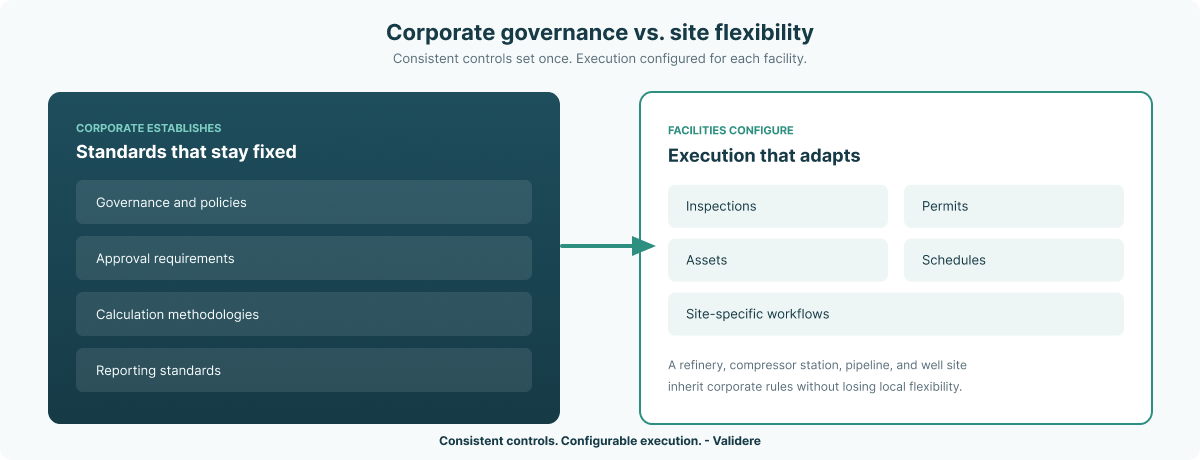
Figure 2: Corporate governance vs. site flexibility. Corporate standards stay fixed; facility execution adapts to local permits, assets, and conditions.
In the room, ask them to show how two facilities with different permits operate inside the same environmental program, then how organization-wide reporting requirements are enforced, whether permissions can vary by business unit, and how a governance change is deployed across many sites at once.
Common mistakes when judging environmental compliance software features
Because most platforms advertise similar modules, it is easy to confuse a feature label with a working capability. These mistakes are about misreading features, not the full buying process covered in the companion how-to-choose guide.
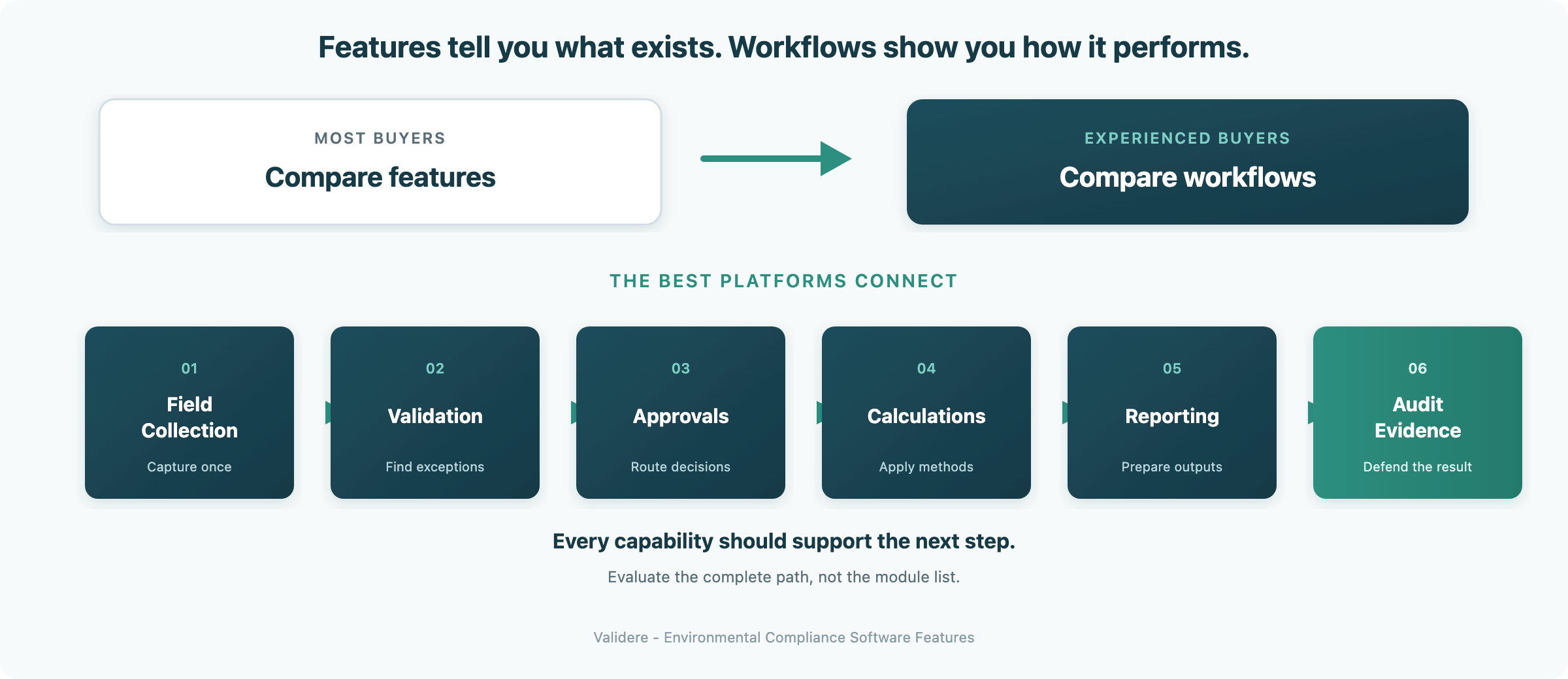
Figure 3: Features tell you what exists. Workflows show how the work actually performs.
|
Mistake |
Better approach |
|---|---|
|
Comparing feature lists |
Compare operational workflows |
|
Treating dashboard exports as automated reporting |
Ask vendors to complete a report from source data through approval |
|
Ignoring integrations behind "centralized data" |
Trace how operational data actually moves into the platform |
|
Assuming one workflow fits every facility |
Test multi-site governance with two different site types |
|
Judging only today's requirements |
Ask how templates, methodologies, and workflows change over time |
|
Treating compliance as document storage |
Follow review, approval, correction, and evidence, not just file uploads |
One useful exercise during demonstrations: give every vendor the same scenario. Ask them to show how an inspection moves from field collection through approvals, calculations, reporting, and audit preparation. That workflow usually reveals more than an hour of feature screens.
Taking these questions into vendor demos?
Download the one-page environmental compliance vendor checklist → For a full demo brief (requirements context, exception scenarios, and a structured script), use the how to choose environmental compliance software guide.
Frequently asked questions
What features should environmental compliance software include?
At a minimum: automated regulatory reporting, centralized environmental data, configurable workflow automation, mobile field data capture, environmental monitoring and emissions calculations, audit-ready traceability, and enterprise governance with facility-level flexibility. The right combination depends on your regulatory environment and operating model. Judge how those capabilities connect (from field data through calculations, review, reporting, and evidence) rather than whether each appears on a feature list.
How is environmental compliance software different from EHS software?
Environmental compliance software focuses on environmental obligations, reporting, permits, emissions-adjacent work, and environmental evidence. EHS software is broader: it usually includes that environmental work alongside health and safety capabilities such as incident management, occupational safety, training, and risk management. This page stays on capability depth. For the fuller buying split, see how to choose environmental compliance software. For the energy shortlist and definition grounded in oil and gas operations, see Top EHS Software for Energy and Oil & Gas.
Can environmental compliance software automate regulatory reporting?
Yes, but "automated reporting" is one of the most overstated feature claims in the category. Strong platforms can collect operational data, apply calculations, route reports for approval, and generate regulatory documentation. Weaker ones mainly export a dashboard. Confirm how templates, calculations, and regulatory updates are maintained, and ask the vendor to demonstrate a complete report starting from source data.
Does environmental compliance software support emissions reporting?
Many environmental compliance platforms include emissions reporting or integrate with dedicated emissions management software. Confirm support for your methodologies, source-level traceability, and reporting requirements, not only a corporate GHG total. When emissions quantification and inventories drive the buy, use the emissions management software buyer's guide.
Which environmental compliance software features matter most for multi-site industrial operators?
Enterprise governance with facility-level flexibility, centralized environmental data, configurable workflow automation, and audit-ready traceability usually carry the most weight. Corporate teams need consistent methodologies and reporting standards; facilities need different permits, inspections, and local workflows. Either extreme becomes difficult to govern at scale: one forced process for every site, or every site inventing its own.
From features to confidence
Environmental compliance software should not simply make reporting easier. It should make the report the last step of work that already happened.
When inspections, calculations, approvals, operational data, and documentation remain connected throughout the year, filing week is confirmation, not a reconstruction project that starts two weeks before the deadline.
Most platforms advertise reporting, automation, inspections, dashboards, and analytics. The difference only becomes visible once real operational complexity enters the picture: different facilities, changing regulations, multiple reviewers, incomplete field data, methodology updates, unexpected audits. That is where connected workflows matter more than feature lists.
Evaluate whether a platform makes environmental compliance easier to operate every day, not whether it includes another module name.
When you are ready to turn that judgment into a shortlist, demos, and a proof of concept, use how to choose environmental compliance software. For energy and oil and gas vendor comparison, see Top EHS Software for Energy and Oil & Gas. See how Validere connects environmental compliance software workflows across inspections, evidence, and reporting.