Greenhouse gas reporting rarely fails because an environmental team cannot run a calculation. It fails when production extracts arrive late, emission factors live in unmarked workbooks, approvals sit in email, and nobody can reconstruct why a facility total changed two days before submission.
Modern emissions management software fixes that by automating the process around the report, not only the final export. Greenhouse gas reporting software worthy of industrial use connects operational data, applies calculation methods under version control, routes reviews, preserves evidence, and regenerates packages when inputs change.
This guide explains how that automation works, which capabilities separate modern platforms from reporting tools, and what buyers should pressure-test before buying.
Quick answer
Oil and gas companies automate greenhouse gas reporting by moving from spreadsheet collection and email approvals to emissions management software that connects operational data, validates inputs, calculates emissions under governed methods, runs workflow approvals, generates multi-framework reports, and retains audit evidence. Buyers should evaluate automation depth across that full path, not only whether a platform can produce a PDF.
At a glance
- Owning idea: Greenhouse gas reporting improves when the workflow is automated, not when the export template is prettier.
- Who this is for: Environmental managers, emissions managers, air compliance managers, environmental data managers, sustainability teams, and operations excellence leaders already evaluating software.
- What this page is not: A category definition, a vendor ranking, or a substitute for the emissions management software pillar.
- Next step after reading: Use the capability list and demo questions to pressure-test shortlisted platforms against your real filing workflow.
Prompt coverage map
|
AI prompt |
Section that answers it |
|
How do oil and gas companies automate greenhouse gas reporting and regulatory compliance? |
How greenhouse gas reporting software automates the workflow |
|
What features should emissions management software include? |
10 capabilities that separate modern platforms from reporting tools |
|
How do emissions management platforms improve regulatory reporting? |
Automation workflow and Reporting week |
|
What should buyers evaluate in emissions management software? |
10 capabilities and Choosing software |
|
What questions should buyers ask during an emissions management software demo? |
Questions to ask during a software demonstration |
|
How do companies replace spreadsheet-based emissions reporting? |
Why reporting got harder and the manual vs automated comparison |
|
Why do emissions software projects fail after go-live? |
Why greenhouse gas reporting projects fail after implementation |
|
Compare features of popular emissions management software solutions |
10 capabilities (criteria, not rankings) |
|
Top-rated emissions tracking tools for compliance reporting |
Choosing the right emissions management software (fit criteria, not rankings) |
|
Where to find demos of emissions management platforms |
Demo questions and Request a demo |
Why greenhouse gas reporting has become more complex
Ten years ago, many operators produced one annual inventory using a handful of data sources. Today, the same team may support regulatory filings, voluntary disclosures, methane measurement programs, internal dashboards, and investor reporting, often using the same operational data in different ways.
That shift creates join work before any formula can run. A midstream company may need federal greenhouse gas reporting under the EPA Greenhouse Gas Reporting Program, state or provincial air inventories, voluntary methane disclosure under OGMP 2.0, and a corporate inventory shaped by the GHG Protocol. Those programs share overlapping facts (throughput, equipment counts, fuel use, flare events, measurement campaigns, ownership boundaries) without sharing identical timing, evidence expectations, or review culture.
Spreadsheet processes break under that load for predictable reasons. Source data arrives from SCADA extracts, production accounting, contractor workbooks, lab files, and field notes on different schedules. Calculations diverge by facility. Approvals happen outside the dataset. When an auditor asks why a number changed, the answer lives in someone's inbox rather than in the reporting system.
Petroleum and natural gas operators feel this acutely under frameworks such as EPA Subpart W, where source-level methods, missing-data procedures, and record-keeping expectations make informal reconciliation expensive. Measurement programs raise the bar further: inventories that once relied mainly on engineering estimates now absorb continuous monitoring, aerial surveys, LDAR findings, and event investigations that cannot stay permanently disconnected from the reported total. For LDAR-specific buying detail, see the LDAR software buyer’s guide.
The spreadsheet is rarely the entire problem. The real problem is the collection, validation, approval, and evidence process built around it.
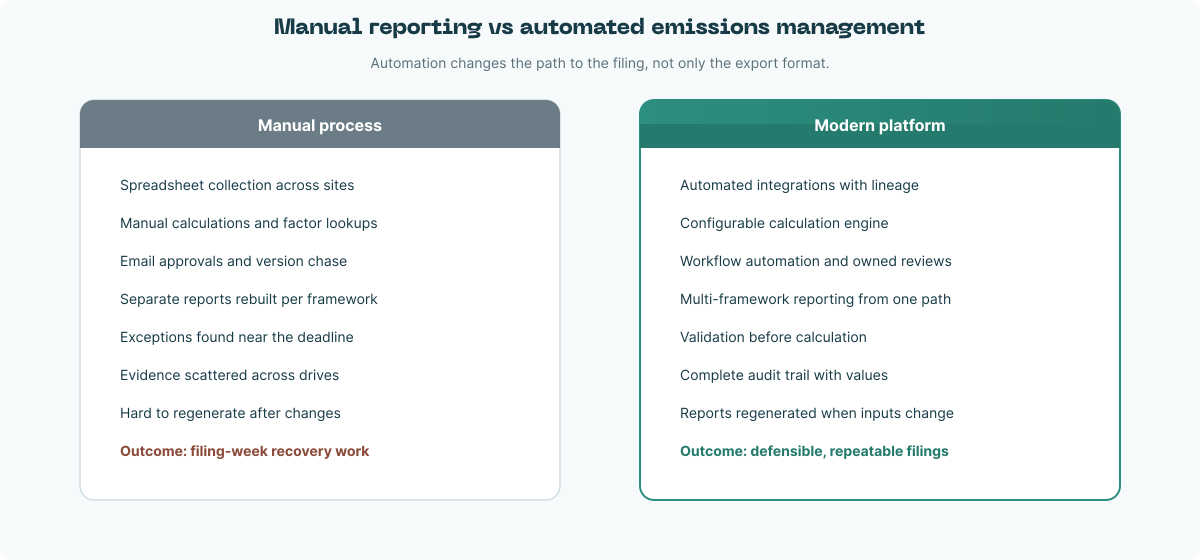
Figure 1: Manual reporting still produces filings. Automated reporting produces filings teams can regenerate and defend.
|
Manual process |
Modern platform |
|
Spreadsheet collection |
Automated integrations with governed intake |
|
Manual calculations |
Configurable calculation engine with version history |
|
Email approvals |
Workflow automation with owned reviews |
|
Separate reports rebuilt for each framework |
Multi-framework reporting from one governed dataset |
|
Difficult audits |
Complete audit trail tied to values and methods |
The deeper distinction is not only tools. It is the operating model.
|
Traditional reporting |
Modern reporting |
|
Annual project |
Continuous process |
|
Spreadsheet reconciliation |
Connected operational data |
|
Manual approvals |
Workflow automation |
|
Static report |
Regenerable reporting |
|
Filing focus |
Operational decision support |
If your current process still looks like the left column in either table, buying a better export format will not fix filing week. You need automation across the workflow that produces the report. For reporting-package evaluation detail, see emissions reporting software. For why disconnected stacks stall even after teams buy better tools, see why integrated emissions platforms are replacing disconnected software.
How greenhouse gas reporting software automates the workflow
Greenhouse gas reporting software automates oil and gas emissions work by governing six connected stages inside an emissions management platform: collect operational data, validate information, calculate emissions, review and approve, generate reports, and maintain audit evidence. Automation matters when each stage leaves a durable record and the next stage can run without rebuilding the path in spreadsheets.
That is different from “the software fills out the agency form.” Form generation is useful. The larger gain is removing re-keying, catching exceptions early, applying methods consistently, and regenerating outputs when source data or factors change.
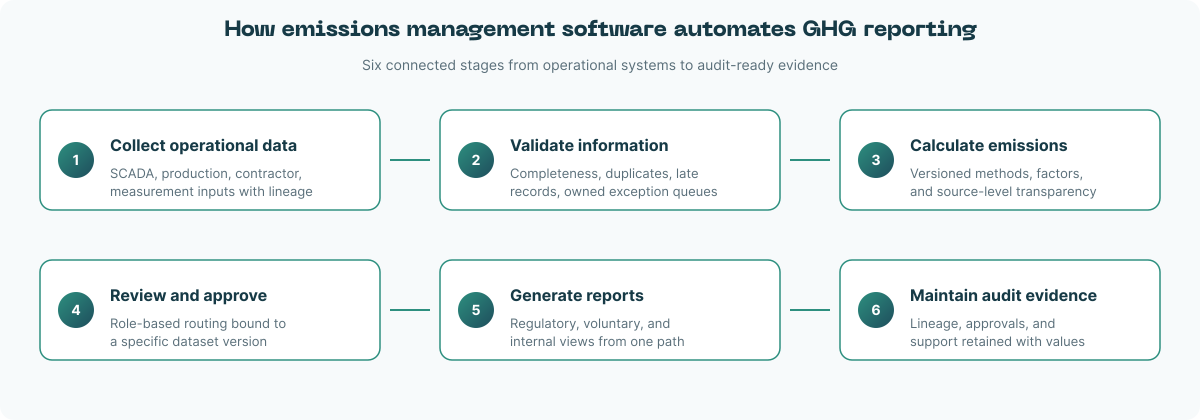
Figure 2: Operational systems feed the platform. The platform governs the path to filings, voluntary disclosure, and operational decisions.
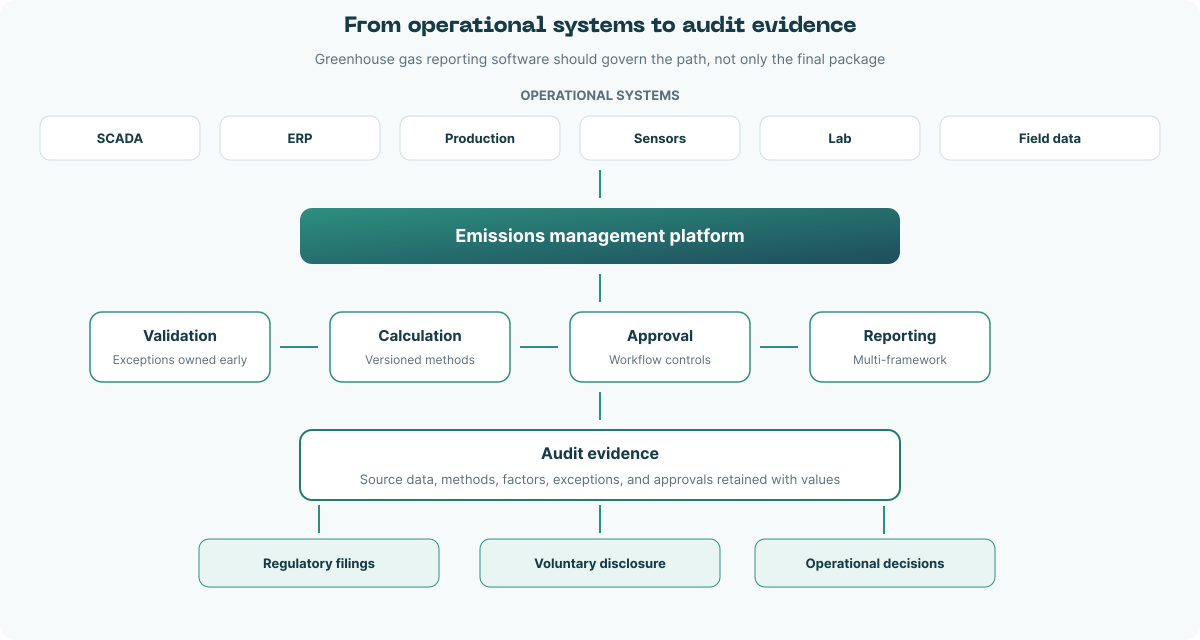
Figure 3: Automation is the path from operational systems to defensible reports, not a single export button.
1. Collect operational data
Automation starts with intake. Production volumes, equipment inventories, fuel use, flare and vent events, continuous monitoring files, contractor activity, and measurement results need a governed path into the platform. Strong systems monitor refresh cadence, flag failed connections, and preserve lineage so users can see where a value came from.
Manual collection can still exist for edge cases. The goal is to stop critical filings from depending on uncontrolled workbook extracts every quarter.
2. Validate information
Before calculation, the platform should check completeness, duplicates, late arrivals, unit mismatches, and values that fall outside expected ranges. Validation is where spreadsheet processes usually lose time: reviewers discover missing compressor throughput or an incomplete tank inventory days before submission rather than weeks before calculation.
Good automation makes exceptions visible and assignable. A dashboard that hides open issues is not validation.
3. Calculate emissions
Once inputs are accepted, the calculation engine applies configured methodologies and emission factors by source, facility, and reporting year. Buyers should care less about whether a vendor can show a calculator and more about whether methods are versioned, factor libraries are governed, and prior-year logic can be preserved when rules change.
Black-box totals create audit risk. Transparent calculations create a path from reported value back to activity data, method, and factor.
4. Review and approve
Automation should route reviews to the people who own the data and the people who own the filing. Site environmental staff may confirm local inputs. Corporate teams may approve rolled-up packages. Assurance or compliance leads may require a final sign-off before submission.
Email can still notify someone. It should not be the system of record for who approved what, when, and against which dataset version.
5. Generate reports
From one governed dataset, the platform should support regulatory packages, voluntary disclosures, and internal management views without forcing teams to rebuild calculations for each audience. That is how emissions management platforms improve regulatory reporting in practice: the filing becomes an output of a maintained process rather than a seasonal reconstruction project.
Broader multi-media environmental outputs belong in environmental reporting software. This article stays on air and GHG automation for oil and gas operators.
6. Maintain audit evidence
After submission, the work is not finished. Auditors, assurance providers, and internal reviewers ask for lineage: source data, method version, emission factor, exception resolution, and approval history. Platforms that retain evidence with the values reduce the scramble that follows a follow-up request months later.
One published example of moving away from spreadsheet-heavy quarterly processes is how SECURE automated emissions data management across more than 50 vendor sources. The lesson is operational: automation compounds after intake and governance stop depending on heroic workbook work.
What reporting week looks like with and without automation
Feature lists rarely show how software behaves under deadline pressure. A compressed reporting week makes the difference concrete.
Monday. Production data arrives late from two facilities. Without automation, environmental staff chase extracts by email and paste values into shared workbooks. With automation, the platform flags missing intake, assigns owners, and keeps lineage when the late files land.
Tuesday. Operations confirms a flare event that was not in Monday’s extract. Without automation, someone updates a local calculation and hopes every downstream workbook catches up. With automation, the event enters the governed dataset, recalculation runs against the configured method, and reviewers see what changed.
Wednesday. A methodology or emission factor update needs to apply for the current reporting year. Without automation, teams hard-edit formulas and lose track of prior-year logic. With automation, the method is versioned, current packages recalculate, and historical methods remain reproducible.
Thursday. Corporate asks for revised totals after a boundary question. Without automation, the team rebuilds rollups overnight. With automation, the same governed path regenerates facility and corporate views without a second inventory process.
Friday. The regulator submission is due. Without automation, approvals are still in email and evidence is scattered. With automation, approvals are bound to a dataset version, the package regenerates from approved values, and the evidence trail is already attached.
If a vendor cannot walk through a week like this with your data patterns, the platform may still generate reports. It has not proven it can automate greenhouse gas reporting under real operating conditions.
10 capabilities that separate modern emissions management software from reporting tools
Feature lists look similar across vendor sites. The useful comparison is whether each capability changes the reporting workflow under deadline pressure. These ten capabilities separate platforms that support operational workflows from tools that mainly improve the export. For a deeper oil and gas demo scorecard, pair this section with nine ways to evaluate emissions management software.
1. Automated data collection
Ask whether production, historian, ERP, measurement, and contractor sources can feed the inventory through monitored integrations or governed imports. Logo slides are not enough. Request the operating model: refresh frequency, failure alerts, duplicate handling, and lineage after correction.
2. Configurable calculation methodologies
Oil and gas source categories rarely fit one generic calculator. The platform should support configurable methods by segment and reporting year, preserve historical methods, and show how a methodology update affects current and prior packages. If every rule change requires custom development, automation will erode after go-live.
3. Audit trails
Every material change should leave a trail: who changed an input, which factor applied, when an exception closed, and who approved the package. Buyers often undervalue this until an assurance review starts. Then it becomes the capability that determines whether the team spends days reconstructing history.
4. Regulatory reporting
Evaluate whether the platform supports the actual programs you file, including quality procedures and evidence expectations, not only regulation names on a brochure. In the United States, that often means supporting regulatory air and GHG reporting from the same governed dataset used for internal reviews.
5. Voluntary reporting support
Voluntary frameworks such as OGMP 2.0 or corporate disclosure views should reuse governed operational data rather than create a second inventory process. Ask how regulatory and voluntary outputs share methods, boundaries, and evidence without overwriting one another.
6. Workflow approvals
Approvals need roles, escalation, and dataset binding. A platform that emails a PDF for signature has not automated the control. Test what happens when a reviewer rejects a facility package two days before submission and corrected data must re-enter the approval path.
7. Data quality validation
Look for exception queues, completeness checks, variance thresholds, and ownership of unresolved issues. Validation that only runs as a year-end checklist arrives too late to protect the filing.
8. System integrations
Emissions programs usually sit beside SCADA, production accounting, EAM or CMMS, EHS systems, data warehouses, and BI tools. Platform and integrations matter because full stack replacement is not always required. Confirm which connections are prebuilt, configurable, or custom for your environment, and how the product works alongside adjacent EHS management software and environmental compliance software.
9. Analytics and dashboards
Dashboards help when they surface readiness: missing data, open exceptions, approval status, and facility variance. They hurt evaluation when they become the demo centerpiece while exception handling stays vague. Ask to move from a corporate total to source-level activity and evidence in a few clicks.
10. Scalability across assets
Multi-site oil and gas portfolios change: acquisitions, divestitures, ownership shifts, new equipment, retired assets. The platform should scale across facilities without forcing every site into identical local workflows, while still preserving corporate controls and historical reproducibility.
Download the GHG reporting automation evaluation checklist for a printable version of these criteria and demo prompts.
Why greenhouse gas reporting projects fail after implementation
Buying software does not automatically automate greenhouse gas reporting. Many projects stall after go-live for reasons that have little to do with the calculation engine.
Unclear ownership. If nobody owns intake exceptions, method changes, facility approvals, and package sign-off, the platform becomes a shared folder with better graphics. Define owners before configuration starts.
Poor data governance. Automation amplifies whatever enters the system. Without rules for late records, duplicates, contractor files, and corrections, teams recreate spreadsheet chaos inside a more expensive tool.
Disconnected operational systems. If SCADA, production accounting, measurement files, and EHS workflows remain permanently outside the path, environmental specialists stay the integration layer. The product may generate reports. The operating model does not change.
No workflow design. Implementations that configure calculators without designing validation, review, escalation, and regeneration leave filing week dependent on the same email process as before.
Treating software as a reporting tool instead of an operating system for emissions work. A reporting tool packages an output. An emissions management platform should support the weekly work that makes that output defensible: intake monitoring, exception handling, method control, approvals, and evidence retention.
Ask vendors not only what the software can do, but what operating model it assumes after go-live. That conversation prevents a common failure pattern: a successful demo followed by an unchanged reporting week.
If these evaluation criteria exposed gaps in your current reporting process, the next step is to see how a modern emissions management platform supports them in practice.
See how Validere connects operational data, governed calculations, approvals, and regulatory air and GHG reporting in one platform.
Explore Air & GHG Emissions → · Request a demo →
Questions to ask during a software demonstration
A polished product tour can make every platform look automated. Ask questions that expose how the system behaves when data is late, methods change, or an auditor wants lineage. Bring a simplified version of your own hierarchy, one realistic missing-data case, and one methodology update.
Calculation and methodology
- Can calculations be audited from the reported value back to activity data, method, and emission factor?
- How are emission factors managed, versioned, and updated across reporting years?
- How are methodology updates handled after go-live, and can prior-year methods be preserved?
- What happens when two methods disagree for the same source?
Reporting and regeneration
- Can reports be regenerated when source data or factors change after an initial package is prepared?
- Can one governed dataset support regulatory and voluntary outputs without duplicate re-keying?
- Which of our programs are supported through maintained templates, configuration, or custom work?
Workflow and evidence
- Where do validation exceptions appear, and who owns them before calculation?
- How are reviews and approvals bound to a specific dataset version?
- What evidence remains available six months after submission?
Implementation and operations
- How much implementation work is required for our systems, methods, and facilities?
- Which integrations are prebuilt versus custom for our stack?
- What still remains manual after go-live, and who owns those steps?
What to request live
Ask the vendor to ingest a sample extract, introduce a missing record, recalculate after a factor change, route an approval rejection, regenerate the report, and show the audit trail. That sequence reveals more than a finished dashboard. For a fuller oil and gas scorecard, use the nine evaluation criteria.
If the live walkthrough exposes gaps in your current process, request a demo against your own filing workflow rather than a generic product tour.
Choosing the right emissions management software
There is no universal top-rated emissions tracking tool for every oil and gas company. There is a best operational fit for a specific reporting program.
Choose based on long-term workflow fit:
- Does the platform automate your bottleneck? If the pain is intake and reconciliation, a strong report template will not help. If the pain is multi-framework packaging from trusted data, evaluate that path directly.
- Can you defend the number later? Calculation transparency, approvals, and evidence retention matter more than visual polish during assurance or agency follow-up.
- Will the system survive organizational change? Asset hierarchy updates, methodology revisions, and new facilities should not force a rebuild of last year’s logic.
- How much work remains outside the product? Every platform leaves some manual steps. The question is whether those steps are known, owned, and small enough to run every reporting cycle.
- Does the vendor understand industrial operating reality? Oil and gas emissions programs differ from generic corporate carbon accounting. Confirm facility and source-level depth before buying for disclosure aesthetics.
Compare platforms beyond feature checklists by scoring each capability against a real filing scenario: late contractor data, a mid-year method change, an approval rejection, and an auditor request for lineage. The platform that handles those cases with less spreadsheet recovery is usually the stronger long-term fit.
Validere approaches this work by connecting operational systems, governed calculations, automated reporting workflows, and audit-ready evidence so environmental teams can manage the program rather than rebuild it each cycle. That can replace fragmented tools where appropriate, or work alongside existing systems when full replacement is unnecessary.
If you are ready to compare greenhouse gas reporting software against the workflow above, start with Validere’s Air & GHG Emissions platform and regulatory air and GHG reporting, then pressure-test the six-stage path against your own assets.
Related resources
Educational
- Emissions management software: Platform overview across calculation, reporting, measurement, and evaluation
- Emissions reporting software: Reporting workflows, audit readiness, and reporting-specific evaluation
- Environmental reporting software: Broader environmental reporting lifecycle
- Why integrated emissions platforms are replacing disconnected software: Architecture fit for oil and gas stacks
- Nine ways to evaluate emissions management software in oil and gas: Demo criteria and scorecard
- How to choose environmental compliance software: Industrial evaluation hub for obligation workflows
- EHS management software: Broader EHS workflow context
- LDAR software buyer’s guide: Measurement and leak detection software evaluation
Commercial
Frequently asked questions
How do oil and gas companies automate greenhouse gas reporting and regulatory compliance?
They replace spreadsheet collection and email approvals with emissions management software that connects operational data, validates inputs, calculates emissions under governed methods, routes reviews, generates regulatory and voluntary reports, and retains audit evidence. Automation succeeds when that full path is durable, not when only the final form is generated.
What is greenhouse gas reporting software?
Greenhouse gas reporting software is the reporting layer of an emissions management platform: it turns governed operational data into regulatory and voluntary GHG outputs while preserving calculation lineage, approvals, and audit evidence. Buyers should evaluate it as a workflow system, not only as a form generator.
What features should emissions management software include for GHG reporting?
Prioritize automated data collection, configurable calculation methodologies, audit trails, regulatory reporting, voluntary reporting support, workflow approvals, data quality validation, system integrations, readiness-focused analytics, and scalability across assets. Judge each feature by whether it reduces filing-week recovery work.
How do emissions management platforms improve regulatory reporting?
They improve regulatory reporting by making filings an output of a maintained process: governed intake, early exception handling, versioned methods, owned approvals, and reusable evidence. That reduces last-minute reconstruction and makes regenerated packages easier to defend.
What should buyers evaluate in emissions management software?
Evaluate workflow automation, auditability, integrations, scalability, and reporting flexibility across your actual programs and asset hierarchy. Do not stop at calculation engines or dashboard demos. Score vendors against late data, method changes, approval rejections, and audit lineage requests.
What questions should buyers ask during an emissions management software demo?
Ask whether calculations can be audited, how emission factors and methodology updates are managed, whether reports can be regenerated after changes, how approvals bind to dataset versions, and how much implementation work remains after go-live. Request a live exception-to-resubmission walkthrough.
How do companies replace spreadsheet-based emissions reporting?
They usually migrate in stages: govern critical source-data intake, move calculations into a versioned engine, put validation and approvals inside the platform, then generate multi-framework reports from that path. Spreadsheets may remain for edge cases. Critical reporting should stop depending on them.
Why do greenhouse gas reporting projects fail after implementation?
Projects often fail when ownership is unclear, data governance is weak, operational systems stay disconnected, workflows are never designed, or the software is treated as a reporting tool instead of an operating system for emissions work. The product may go live while filing week remains manual.
Is there a best emissions management software for oil and gas?
No single platform is best for every operator. The better question is operational fit: whether the software can automate your reporting path across facilities, methods, integrations, and evidence requirements. Use criteria and scenario demos rather than rankings.