An operator may have several facilities certified under MiQ, and those facilities will not necessarily hold the same methane-performance grade. For buyers, the relevant question is which certified facility and grade are associated with the certificates supporting their environmental-attribute claim.
A grade describes how one facility performed against the MiQ Standard during a certification period. A registry certificate associates that result with an eligible quantity of gas. A buyer may hold certificates in the registry and still need a retirement, with a named beneficiary, before those attributes can be used in an environmental claim. MiQ certificates document certified methane-performance attributes for defined quantities of gas. On their own, they do not establish the physical origin of gas delivered through a commingled network.
What does MiQ certification cover?
MiQ certification brings together an independent assessment, a facility grade, and certificates for eligible volumes of gas. People often use “certified” for all three, which is how a company-wide sentence can leave out the facility and the grade.
The standard sets the requirements, and the segment matters: an onshore production facility is assessed on a different scale from a gathering or processing facility. An independent auditing body assesses the facility and determines the grade under the applicable standard. That assessment evaluates the facility’s documented emissions performance, company practices, and monitoring deployment against the MiQ Standard. Registry approval of the audit submission, and the later issuance of certificates, are separate program processes. The certificate is the registry record for a defined quantity from that facility.
|
Part of the program |
What it contributes |
|---|---|
|
Standard |
The requirements the facility is assessed against |
|
Assessment |
The auditing body evaluates documented facility performance against the standard and determines the grade |
|
Grade |
The performance classification for that facility and certification period |
|
Certificate |
The registry record for a defined quantity and its certified attributes |
Operators comparing MiQ with other voluntary programs can review the differences in voluntary standards for natural gas. For a contract that already says MiQ, the distinction that changes the environmental claim is between the facility’s grade and the certificates issued against its eligible gas.
What does an MiQ grade tell you about a facility?
For operators, the facility grade helps substantiate how a specific asset performed under the MiQ Standard. It applies to one facility for one certification period of twelve calendar months. Two onshore natural gas production facilities at the same company can be assessed in the same year and receive different grades. A sentence that says the company’s gas is MiQ certified, without naming the facility, has not yet told the buyer which result they are being offered.
MiQ evaluates three elements: methane intensity, company practices, and monitoring technology deployment. The segment standard for the facility determines how those elements set the grade, from A to F.
Facilities receiving the same MiQ grade may have different methane-intensity results. Company practices and monitoring deployment count in that grade along with methane intensity. The thresholds for each letter are defined in the applicable segment standard, and a production grade is not on the same scale as a gathering grade. MiQ’s standard page is where the document for the facility is published.
The audit should not be read as a guarantee that every emission was independently measured, or that emissions stay at the audited level for the rest of the certification period.
The intensity later printed on a certificate follows a separate reporting rule, covered in the FAQ. Measurement and inventory records prepared for OGMP 2.0 may also be relevant to an MiQ assessment, where they meet MiQ’s requirements. OGMP 2.0 remains a measurement-based reporting framework with its own levels. An OGMP level does not assign the MiQ grade, and the grade does not complete an OGMP disclosure.
From a facility assessment to a buyer’s attribute claim. MiQ connects an independently assessed facility grade to certificates issued for eligible gas quantities, which can support attribute claims after retirement for a named beneficiary.
What does an MiQ certificate record?
For natural gas, each certificate represents 1 MMBtu of eligible gas associated with a specified facility and issue month. The issue month identifies the calendar month to which that eligible quantity relates. It has to fall within the facility’s certification period, which runs for twelve calendar months and sets the grade on the certificate. The registry administrator issues the certificate after the operator submits quantity evidence for the issue month and after the audit submission has been approved. Issuance is a registry step. It is separate from the auditing body’s determination of the grade
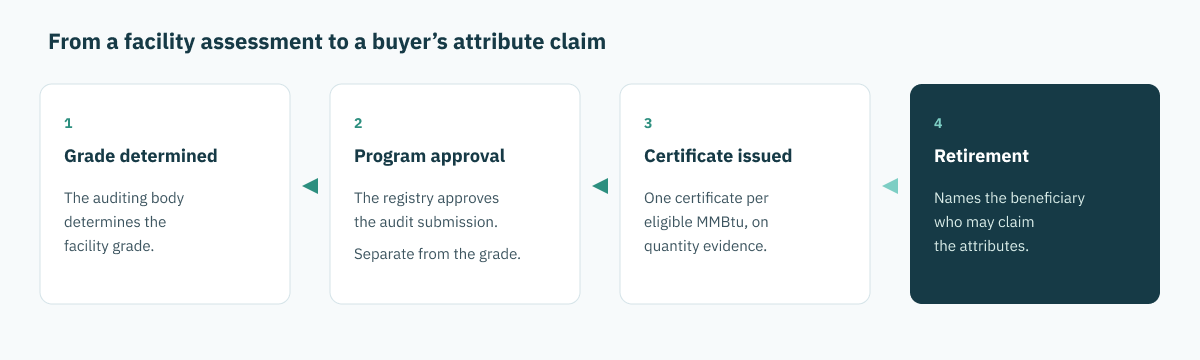
After issuance, certificates can be transferred between accounts and later retired for a named beneficiary. Issuance into the operator’s own account is a different registry status from a transfer to a buyer. Holding a certificate, in either account, does not by itself allow an environmental-attribute claim. The account holder retires the certificate and names the beneficiary. Once the certificates have been retired, the beneficiary named in the retirement record holds the right to make the associated attribute claim, subject to MiQ’s program rules. Section 9 of the Program Guide is the source for that sequence.
The registry’s retirement statement records the retirement and identifies the beneficiary. It is the disclosure record the program accepts. The guide says a beneficiary does not have to be handed the statement for the retirement to exist, and it also says a transfer confirmation or a trading-system extract is not a retirement statement. A buyer who wants to rely on the attributes should ask for the statement produced in the registry.
Certificates that have not been retired expire 36 calendar months after the last day of the issue month. After that, they cannot be retired or claimed. One certificate is issued per MMBtu and retired once, which reduces the chance that two parties claim the same unit. The retirement still leaves the underlying inventory to stand on its own evidence, and it is not an emissions reduction by itself.
Where does that leave the gas that was delivered?
Retirement supports an attribute claim for the certified quantity consumed in the certificate’s region. It does not establish the physical origin of delivered gas. Inside a region, gas from many facilities is commingled. The retirement statement identifies the attributes, the quantity, and the beneficiary. A supply contract can transfer title to physical gas without naming the certified facility. The retirement statement covers the certified attributes. Those are separate arrangements.
MiQ permits inter-regional certificate transfers under specified conditions. Buyers should verify those conditions before making a claim that involves gas consumed in another region. Matching certificate quantities to the volumes in a supply contract is a separate reconciliation. It does not change what a single retired certificate represents.
What should the operator or the buyer check?
Before treating “MiQ certified” as an environmental claim, the operator and the buyer should be able to point to:
- The certified facility and the certification period
- The MiQ grade, and which segment standard the facility was assessed against
- The certified quantity and the certificate’s issue month
- Retirement status, and the beneficiary named on the registry’s retirement statement
- Whether that claim fits the certificate region and the consumption the program allows for the retirement
Once the supporting records are confirmed, the named beneficiary can make an attribute claim consistent with MiQ’s rules. The buyer should verify that the beneficiary, certified quantity, facility grade, and intended claim all align. The list is a way to read the audit report, the certificates, and the retirement statement. It does not authorize every marketing line someone might want to put on a contract. Program rules still set the boundaries of the claim, including the region.
The same measurements and operating records may support an emissions inventory, an MiQ assessment, and voluntary reporting. Although these activities can draw on common evidence, each has different requirements for how that information is evaluated and reported. Keeping those records organized can make it easier to support multiple reporting activities without treating their results as interchangeable. Learn more about how Validere supports voluntary emissions reporting.
FAQ
Is the methane intensity on an MiQ certificate the same number as the facility’s inventory?
It may match, and it may not. Section 7 of the Program Guide calls the figure on the certificate the reporting methane intensity, in grams of methane per MMBtu. Where the program requires an approved measurement and reconciliation protocol, the certificate uses the estimated intensity in the audit report when the audit confirms a measurement-informed inventory under that protocol. When the audit does not confirm that, the certificate uses the high end of the grade band for the facility’s grade. Both figures are converted to grams of methane per MMBtu.