The request arrives on a Tuesday. An auditor wants the support behind last year's reported value: the source extract, the calculation version, who approved the correction, and what the field team recorded when the measurement changed. The number is in the report. The trail sits in three inboxes, a shared drive, and a workbook last saved under a different facility name.
That is how many environmental, health, and safety (EHS) and air compliance problems become visible. Filing week and audit requests expose them. The break usually happened earlier, when information, ownership, evidence, and decisions failed to reconnect between operational activity and the governed record. The question is where the environmental compliance workflow stalls, duplicates, or loses its trail.
What is a compliance workflow bottleneck?
The work is supposed to move from the field and the plant toward a review, an approval, and a report. A bottleneck is where that movement fails: the next step waits, the same information is entered twice, or the files that explain a number are no longer with the number. In industrial environmental compliance, that path rarely lives in one team or one system. It crosses field crews, operations, environmental specialists, engineering, contractors, management, and regulators. The failure often sits between those groups, not inside any one of them.
Those breakdowns tend to show up in four places: ownership, data, handoffs, and governance. That means who owns the next step, whether inputs arrive complete and on time, how work moves across people and systems, and whether methods, approvals, and evidence stay attached. A healthy environmental compliance workflow creates the record while the work happens; an unhealthy one reconstructs it afterward.
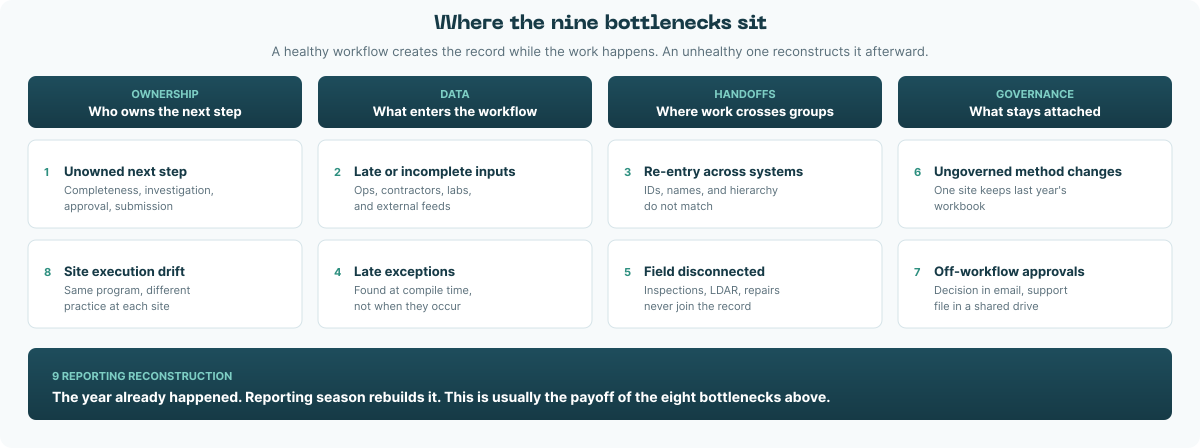
Figure 1: Where the nine bottlenecks sit. Some span more than one column. Reporting reconstruction is usually the payoff of the rest, not a separate kind of failure.
How to use this list
Use this as a self-diagnosis, not a software shortlist. Read for the failure you already recognize on a Tuesday morning, then mark the ones that showed up this quarter.
- Nobody clearly owns the next step
- Source data arrives late, incomplete, or inconsistent
- Teams re-enter and reconcile the same data across systems
- Exceptions are discovered too late
- Field activity gets disconnected from the compliance record
- Methodology and calculation changes are difficult to govern
- Approvals and supporting evidence live outside the workflow
- Sites execute the same program differently
- Reporting requires teams to reconstruct what already happened
After you recognize the pattern, decide which bottleneck to address first. Some need clearer ownership or a standard method. Others need better integration or a shared system of record. If you later evaluate platforms, diagnose the break first, then use how to choose environmental compliance software for buying criteria.
1. Nobody clearly owns the next step
The most common workflow failure is simpler than a missing tool: after an activity happens, nobody is clearly accountable for the next step. An inspection flags a deviation. Operations assumes environmental will open the investigation. Environmental assumes the site supervisor owns follow-up. On paper, completeness, investigation, approval, and submission each have an owner. In practice, the work waits for someone else to pick it up.
This happens because the work crosses functions that do not share a queue. Field, operations, environmental, engineering, and contractors each finish their piece, then hand the remainder into email or a shared drive. Procedures describe roles. They often do not name who owns completeness when the packet is short, who owns investigation when the finding is ambiguous, or who owns submission when reviewers disagree.
Deadlines then slip because the next action was unowned, and the record shows activity without showing who accepted the result. Better looks like named ownership at each gate: an accountable person, a due point, and a way to see that the step is still open. Software can make that queue visible. The organization still has to name who owns the step.
2. Source data arrives late, incomplete, or inconsistent
A contractor inspection file arrives three days before filing. The lab package is missing units. The operations extract uses a different date range than the inventory period. Environmental teams spend the last week of the cycle chasing inputs that were supposed to be routine.
Late and incomplete data is not only an ownership problem. Contractors close out jobs when the field work is done, not when the reporting calendar needs the file. Labs, production accounting, maintenance systems, and external feeds export on their own schedules, and formats drift after system changes.
Teams then accept placeholders and reconstruct the real values later if anyone asks. The compile waits for the last file, and the late file is harder to check. Can you see which sources are missing, incomplete, or inconsistent before the reporting compile starts?
3. Teams re-enter and reconcile the same data across systems
Operations uses one facility ID. The environmental inventory uses another. The same compressor station appears twice, or a well site disappears between the production extract and the emissions workbook. Analysts re-key volumes from a historian export into a spreadsheet, then into a reporting tool, then into a second template for a different program. That re-key is one place the work breaks; what is wrong with the tag, the gap, and the unit is covered in SCADA data for emissions reporting in oil and gas.
This is a hierarchy and naming problem as much as a typing problem. Asset lists, facility IDs, equipment tags, and site names evolve separately in operations, EAM, environmental inventories, and contractor files. When those identifiers do not match, every downstream calculation becomes a reconciliation project, and people become the integration layer.
Each re-entry introduces another chance of error. Audit defense gets harder when two systems use different identifiers for the same asset, and the compile waits until someone decides which ID is canonical. What reduces that work is one entry used many times: integration, a mapping layer, or a governed crosswalk people actually maintain.
4. Exceptions are discovered too late
Missing throughput for a compressor station shows up during the reporting compile, not on the morning the extract failed. A leak that should have started a repair clock sits in an unread inbox until someone notices the date.
Exceptions hide when there is no place they are expected to appear. Informal queues in email, chat, or a personal tracker only work when someone is already looking. Month-end and filing week become the discovery process because that is when someone finally compares sources, totals, and due dates. The issue may have been visible in a source system weeks earlier without being visible in the compliance workflow.
By then the work is less about resolving the exception than explaining why it waited. Late discovery compresses investigation, correction, and approval, which produces weaker notes and thinner support files. Repeat issues stay invisible as patterns. The exceptions need to interrupt the people who can act when they occur, not wait for the compile.
5. Field activity gets disconnected from the compliance record
An LDAR survey is completed and the leak is tagged in a work order, but environmental never sees the close-out. A permit inspection is captured on a tablet, emailed as a PDF, and filed in a shared folder, while the corrective action lives in a maintenance system. When someone later asks what was found, what was repaired, and whether the obligation was met, those facts exist. They do not exist together.
Field work and the compliance record diverge because they are optimized for different jobs. Technicians need a route and a way to close the shift. Maintenance needs a work order. Environmental needs the activity tied to an obligation and a reporting period. Each system can be working as designed and still leave the governed record incomplete.
Program managers then spend time matching inspections to repairs to reports. LDAR is a clear example, but the same break shows up in inspections, measurements, and corrective actions. For measurement-driven work, see emissions measurement and response when detection, response, and the later record keep coming apart. If someone asks what was found, repaired, and closed, can you retrieve that as one story?
6. Methodology and calculation changes are difficult to govern
Corporate updates a calculation method, and one site keeps last year's workbook because that is the file the analyst trusts. An emission factor changes, and two facilities still use the prior factor. When an auditor asks which method produced the reported value, the honest answer takes a week to assemble.
Methods drift because calculation logic lives in workbooks, desktop tools, consultant models, and site files that were never retired. Change control for a procedure does not automatically change the file people actually run. The same failure applies to missing-data rules and allocation methods, not only emission factors.
Two sites can then report different results from similar operations because they are not calculating the same way. Emissions management work is especially exposed, because inventories accumulate method choices all year. Better looks like a governed method that people actually use, with a record of what changed, when, and where it applied, so a reported number can be explained without reconstructing workbook archaeology.
7. Approvals and supporting evidence live outside the workflow
A measurement is corrected in the inventory. The approval lives in an email. The support file sits in a shared drive, named in a way only the author would search. Six months later, the reported value is still in the system. The reason it changed is not.
Review happens in inboxes because that is where people already work. Evidence accumulates wherever the file was convenient that day. The workflow that holds the number does not hold the decision or the support.
Filing can still happen on time. Later, reviewers and auditors cannot see who approved what, or on the basis of which file. If you are already comparing platforms on evidence and approvals, use environmental compliance software features and emissions assurance and verification. The record and the defense stay together only when the approval and the support file remain attached to the value they change.
8. Sites execute the same program differently
Two compressor stations run the same inspection program. One logs every attempt, including no-access events. The other logs completed inspections and treats the rest as noise. Both believe they are following the standard. Corporate sees two different pictures of the same obligation.
This is more human than a methods document going stale. Local supervisors adapt to access constraints, contractor habits, staffing, and how the site has always worked. Some variation is legitimate: a refinery and a well site should not fake identical execution. The bottleneck appears when variation is invisible, unnamed, and then treated as comparable performance.
Roll-ups then mix unlike practices. For the operating-model side of this, see EHS management software for multi-site operators. Corporate needs a shared program definition with room for local execution where the asset requires it, so approved variation is visible and silent drift is not. Comparable, explainable execution matters more than uniformity.
9. Reporting requires teams to reconstruct what already happened
The year already happened: inspections done, measurements taken, corrections emailed, work orders closed. Then reporting season starts, and the team rebuilds the story from extracts, inboxes, and site files, once for a federal GHG report, again for a state air inventory, again for a voluntary methane disclosure. Each program gets its own reconstruction of the same operational year.
That is the payoff of the earlier bottlenecks. Unowned steps, late data, mismatched IDs, late exceptions, disconnected field activity, ungoverned methods, off-workflow evidence, and local drift all land here. Reporting teams become historians of work other people already finished. Under EPA GHGRP and similar programs, reconstruction is a compliance risk, not only extra labor, because the organization may need to show how a reported value was produced.
Environmental reporting software and EHS software for energy compliance reporting both exist to reduce that rebuild. They only help if the underlying workflow produced a retrievable record in the first place. For submission-oriented product context, see regulatory air and GHG reporting. Better looks like reporting as retrieval. The program-specific template still has to be assembled, but the supporting year should not have to be reconstructed to assemble it.
What should you fix first?
Start by identifying the bottleneck creating the most risk, then choose the right lever: ownership, method, integration, or system of record.
Prioritize bottlenecks that:
- happen repeatedly
- affect multiple sites or programs
- force teams to reconstruct records
- delay decisions or submissions
- weaken the evidence behind reported information
A one-time late lab file is a nuisance. A quarterly pattern of unowned investigations, mismatched facility IDs, or reporting-season reconstruction is the work to take on.
Not every bottleneck requires new software. Unclear next-step ownership is often a RACI and queue problem. Site-to-site drift may need a clearer program definition. Late data may need contractor due dates and completeness checks before it needs a platform. Re-entry, disconnected field activity, off-workflow evidence, and reporting reconstruction more often point to integration or a shared system of record, because the break sits between systems and teams. If several bottlenecks are true at once, start where reconstruction and evidence are weakest, especially across sites or programs.
When the lever is software, evaluate it against the workflow you diagnosed. How to choose environmental compliance software and the features guide are the next reading for that job. Vendor questions belong even later; use 8 questions to ask before choosing EHS software once you are ready to shortlist.
Where Validere fits
If the diagnosis points to work falling between systems and teams, Validere is built for that gap. Validere connects the environmental and operational workflows that often fall between existing systems, keeping data, evidence, decisions, and reporting in a governed process without requiring organizations to replace the technology they already rely on.
See environmental compliance for how that connection works across obligations, investigations, and evidence. Emissions, measurement and response, and regulatory reporting are applications of the same workflow problem, not a separate diagnosis.
Request a demo to evaluate Validere against your current workflow →
Frequently asked questions
What is a compliance workflow bottleneck?
A bottleneck is where environmental compliance work stops moving cleanly: the next step waits, data is re-entered, or the evidence is no longer attached to the number. That usually shows up in ownership, source data, handoffs, exceptions, field activity, methods, evidence, site execution, or the reporting rebuild.
What causes environmental compliance workflows to break before deadlines?
They usually break earlier than filing week: unowned next steps, late or inconsistent source data, re-entry across systems, exceptions that stay hidden, field activity that never joins the record, ungoverned method changes, evidence left in email, and sites executing the same program differently. The deadline makes the break visible. It is often not where the break started.
How do you identify the highest-priority compliance bottleneck?
Prioritize bottlenecks that occur frequently, affect multiple programs or sites, force manual reconstruction, delay decisions or submissions, or weaken the evidence behind reported information. A recurring reconstruction problem that spans sites is usually a higher priority than a one-time late file from a single contractor.
Is a compliance bottleneck always a software problem?
No. Some bottlenecks need clearer ownership, standard methods, or visible due dates. Others need integration or a shared system of record because the work is falling between existing tools. Decide the lever before you decide on software.
How are workflow bottlenecks different from missing software features?
A bottleneck is an operating failure you can recognize in the current process, such as an unowned investigation or a facility ID mismatch. A missing feature is a vendor-evaluation gap. Diagnose the operating failure first. Feature lists are useful later, when you already know which break you are trying to close.
When should multi-site operators standardize methods vs allow local variation?
Standardize the method, identifiers, evidence expectations, and the definition of the program. Allow local variation where the asset, permit, or access conditions genuinely require different execution, and make that variation visible. Hidden drift is the problem. Named, approved adaptation is often necessary.
How do emissions and broader environmental compliance bottlenecks overlap?
Emissions workflows hit the same breaks as the rest of environmental compliance: late source data, identifier mismatches, ungoverned calculations, disconnected measurements, and reporting reconstruction. Emissions is one demanding application of that workflow, not a separate species of bottleneck. Inventory and measurement programs simply make the reconstruction cost obvious.