Some of the hardest environmental compliance work begins after the rules are known. A contractor file arrives in a different format than last month. A measurement looks wrong and needs investigation. Supporting documents do not tell the same story. Someone still has to decide what should happen next.
That work crosses operational systems, field records, monitoring technologies, laboratories, production data, spreadsheets, enterprise applications, approvals, and regulatory reporting. Much of it can already be automated. When the input is structured and the rule is known, software can ingest data, run calculations, track deadlines, send notifications, route work, and generate reports consistently.
AI becomes more useful when the work is less predictable: the information is messy or incomplete, an exception needs context, or someone has to make sense of several records before deciding what to do next.
The useful question is not whether AI can “do environmental compliance.” It is which parts of the workflow should use rules-based automation, which benefit from AI assistance, and which still require a person who can stand behind the decision.
Where does AI fit in environmental compliance?
Not every part of environmental compliance needs the same technology.
If a calculation follows a known methodology, use deterministic logic. If a recurring deadline needs to trigger a task, automate it. If a contractor file arrives with unfamiliar fields or an exception needs context from several records, AI may help. If the decision changes a governed record, methodology, or regulatory submission, a qualified person should remain accountable.
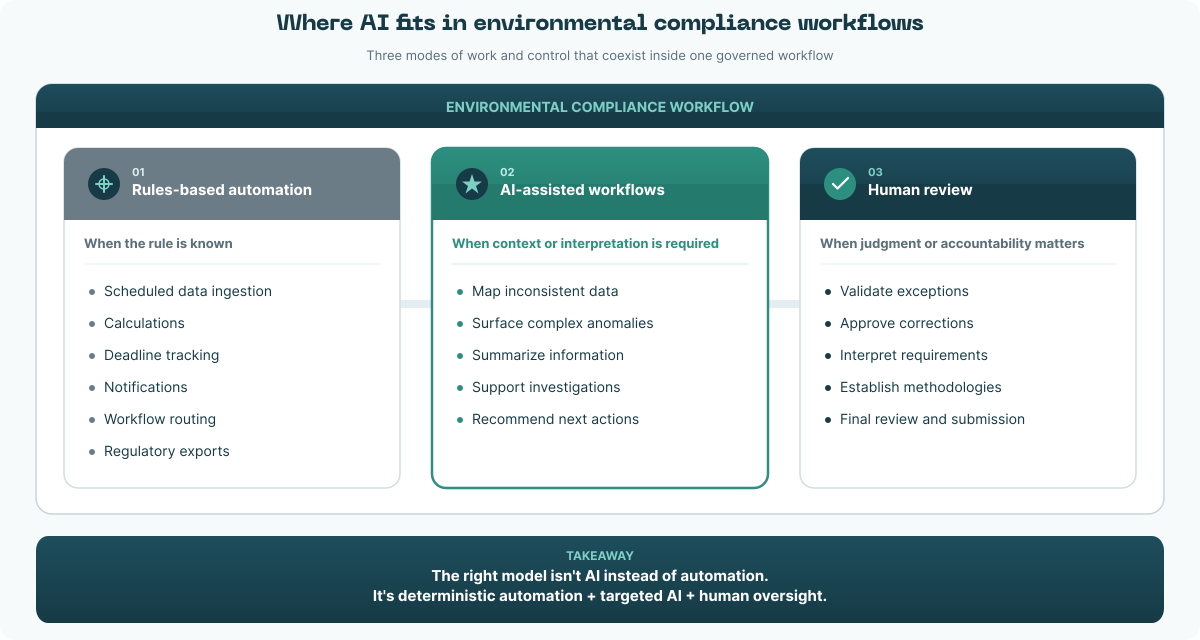
Figure 1: Where AI fits in environmental compliance workflows. Three modes of work and control that coexist inside one governed workflow, not a mandatory sequence from automation to AI to human review.
|
Workflow type |
Best suited for |
Examples |
|---|---|---|
|
Rules-based automation |
Predictable, repeatable processes |
Calculations, deadlines, notifications, routing, regulatory exports |
|
AI-assisted workflows |
Interpretation, investigation, messy or unstructured information |
Data mapping, anomaly surfacing, summarization, investigation support, next-action recommendations |
|
Human review |
Judgment, accountability, consequential decisions |
Exception approval, regulatory judgment, methodology decisions, final review and submission |
An AI recommendation should not become an autonomous compliance determination. Surfacing an issue, summarizing evidence, or recommending a next step is assistance. Deciding what the organization will accept, correct, approve, or submit remains a human responsibility.
How can AI support environmental compliance workflows?
AI is most useful when it has access to the records and context behind the work. A generic chatbot sitting beside the process may produce a fluent answer while leaving the environmental team to find the source file, understand the exception, identify the owner, and determine the next step themselves.
Inside the workflow, there are five places where AI can be more useful.
1. Map and normalize messy environmental data
Environmental data rarely arrives in one clean format. A contractor uses a different equipment name. A lab changes a column heading. Production exports identify an asset differently than the environmental inventory. Field forms and older spreadsheets may follow structures that were never designed to work together.
Conventional integrations work well once those relationships are known. The manual work comes when someone has to determine what an unfamiliar field means, which asset it belongs to, and where it should land in the environmental record.
AI can help propose those mappings. An environmental professional can review the exceptions, correct weak matches, and approve mappings that should be reused. The governed schema and downstream calculations still follow defined controls, and the original source should remain traceable.
The point is not to let AI silently clean up environmental records. It is to spend less time interpreting inconsistent inputs while keeping the source and the mapping decision visible.
2. Identify anomalies and exceptions that require attention
A missing production volume, abrupt change in a measured value, conflicting equipment identifier, or incomplete contractor package can sit unnoticed until someone starts preparing the report.
Known problems are often better handled with rules. If a required field is blank or a value crosses a defined threshold, deterministic checks can flag it every time.
Other problems are harder to express that way. The value may be unusual only compared with nearby assets, prior periods, related records, or the operating history of that equipment. AI can help surface those patterns and put the unusual records in front of the people who need to investigate them.
That changes the job from checking every record to deciding which exceptions deserve attention.
It does not change who makes the compliance determination. An unusual value is a reason to investigate, not evidence by itself that a violation occurred. Prioritization is not adjudication. The system can point to where the problem may be. A person still decides what it means and whether anything in the governed record needs to change.
This distinction matters in emissions programs as well, where anomaly review often sits between inventory construction and filing. For the broader workflow, see the Emissions Management Software buyer’s guide.
3. Support investigations and diagnose workflow bottlenecks
An exception is identified. Now someone has to figure out what happened.
Was the source file late? Did an asset ID change? Is a measurement actually unusual, or did the methodology change? Has someone already investigated the same issue? Who owns the next action?
Too often, answering those questions means searching inboxes, shared drives, ticket systems, prior-period files, and comments left in different tools. The calculation may take seconds. Rebuilding the context takes an afternoon.
AI can help pull that context together: related records, previous exceptions, open tasks, supporting documents, changes, and workflow status. Instead of starting the investigation with a search, the environmental professional can start with the records most likely to matter.
Ownership, escalation, and approval should still follow defined workflow rules. The professional still decides what the evidence means.
This is also where the broader workflow matters. If investigations repeatedly stall because evidence, ownership, or source data cannot be found, the problem may be larger than the individual exception. See 9 workflow bottlenecks that create industrial compliance risk for the common breaks that create that reconstruction work.
4. Summarize environmental and regulatory information
A reviewer may receive a measurement package, investigation notes, supporting attachments, and a technical report before they can approve one correction. The information exists. Reading enough of it to understand what changed and why is the work.
AI can help summarize that material and surface the parts most relevant to the review. That is especially useful when the summary is generated from the records already attached to the workflow rather than from documents pasted into a separate chat.
But the summary is not the evidence.
A reviewer should still be able to move from a statement in the summary back to the measurement, report, field note, or supporting record behind it. Retention and audit controls should preserve the original material, and the reviewer still decides whether the evidence is sufficient.
The benefit is faster orientation, not replacing the underlying record.
5. Recommend the next action in a workflow
This is where AI embedded in a workflow becomes different from a chatbot.
Imagine an inspection identifies an exception. The supporting file is incomplete, a follow-up task is already overdue, and the next step normally requires environmental review before a correction can be approved.
A chatbot can answer a question about that process. Workflow-aware AI can see where the work currently sits and suggest what should happen next: request the missing file, assign an investigation, route the record for review, escalate the overdue task, or prepare the evidence for approval.
The recommendation can save someone from reconstructing the process state themselves. The controls around it should remain predictable. Routing, permissions, approval gates, and changes to governed records do not become optional because AI suggested the action.
For consequential actions, the useful pattern is simple: suggest, show why, preserve the trail, and require confirmation.
What environmental compliance tasks should use traditional automation instead?
A lot of environmental work does not need AI.
When the rule is known, the input is structured, the required action is predictable, and the same logic needs to run consistently, traditional automation is usually the better tool.
That includes:
- Scheduled data ingestion. Move known data between connected systems on a defined schedule.
- Calculations. Apply governed calculation methodologies consistently, with versioning and lineage.
- Deadline tracking. Track known regulatory deadlines and recurring obligations.
- Notifications. Alert defined users when known conditions occur.
- Workflow routing. Move records through established review and approval processes.
- Report generation and exports. Produce required outputs from governed data when the reporting logic is already defined.
Adding AI to those steps simply because AI is available can make a predictable process harder to validate.
Buyers evaluating environmental compliance software should therefore ask vendors a basic question: what is actually AI here, and why does this task need it?
A scheduled calculation and an AI-generated recommendation are different capabilities and should be evaluated differently.
Where should humans remain in the loop?
The closer a decision gets to changing what the organization accepts, corrects, approves, or submits, the stronger human accountability should become.
An AI-generated summary of a measurement package is one thing. Approving a correction based on that package is another. Surfacing an unusual emissions value is one thing. Deciding that it represents a reportable event is another.
Environmental professionals should remain responsible for consequential regulatory interpretation, methodology decisions, unusual exceptions, material corrections, final regulatory review, and submission.
The same principle applies when AI is uncertain. Traditional software can execute a known rule and be tested against its formula, version, and inputs. AI may return a recommendation rather than a reproducible calculation. In that case, the reviewer needs access to the supporting evidence and a clear way to accept, reject, or escalate the recommendation.
Good environmental AI should make uncertainty visible enough to manage. It should not turn an incomplete record into a confident answer.
The NIST AI Risk Management Framework points in the same direction: organizations using AI should define accountability, human roles, and oversight rather than treating the technology as the accountable party.
For environmental compliance, the practical model is straightforward: evidence and context first, professional judgment next, approval last. AI can help prepare the first part. It should not own the last.
How should teams evaluate AI in environmental compliance software?
“AI-powered compliance” is not a useful capability description on its own.
Ask the vendor to show what the AI actually does inside a real environmental workflow. The broader environmental compliance software buying guide covers software selection more generally. For AI specifically, ask:
- What environmental data can the AI access? Is it working from governed environmental and operational records, or only from text someone pastes into a chatbot?
- What specific task does it perform? Mapping assistance, anomaly prioritization, investigation support, summarization, next-action recommendation, or something else?
- Can users inspect the source information behind the output? If the answer matters, the evidence should remain accessible.
- How are outputs validated? Can users distinguish an AI recommendation or generated summary from a calculated value or approved record?
- Where is human review required? Which actions need confirmation before data, decisions, or submissions change?
- Are AI-assisted actions captured in the history? Can the team later see what was suggested, what someone accepted or rejected, and who made the decision?
- What happens when the AI does not have enough information? Ask the vendor to show how uncertainty is surfaced, escalated, or held for review.
Then test those answers with a messy example.
Give the vendor an incomplete package, conflicting records, or an unusual value and ask them to work through it. If the AI looks impressive only when the data and workflow are perfectly prepared, you have learned something important about the feature. If the vendor cannot demonstrate those controls with a realistic exception, the AI feature is still a demo artifact.
For multi-site environmental and EHS programs, repeat the test across facilities with different permits, operating conditions, and local practices. See EHS management software for multi-site operators when the evaluation expands beyond one workflow.
From AI assistant to AI embedded in the workflow
Putting a chatbot on top of environmental data does not automatically make the environmental workflow smarter.
The useful difference is context.
Does the AI know which facility and reporting period are involved? Can it see the source records behind the issue? Does it know an investigation is already open, who owns it, what evidence is missing, and which approval has to happen next?
Without that context, a system can produce a polished answer while the environmental team still has to reconstruct the actual work.
Embedded AI is more useful when it works with governed data and workflow status, while predictable steps continue to run through deterministic automation and consequential decisions remain with people.
That is also the split Validere is built around: automation for repeatable work across the data lifecycle, with targeted AI for work that is harder to handle with rules alone, including mapping messy incoming data, surfacing anomalies, summarizing regulatory reports, recommending next actions, and supporting workflow bottleneck investigation and report analysis.
The important point is broader than Validere. AI is one part of an environmental workflow. It is not a substitute for the workflow, its controls, or the professionals accountable for it.
Frequently asked questions
What is AI used for in environmental compliance?
AI is most useful for interpretation, investigation, and messy information: mapping inconsistent files, surfacing anomalies, summarizing packages, supporting investigations, and recommending a next workflow step. It is assistance inside a controlled process, not an autonomous compliance determination.
What environmental compliance tasks should use AI vs traditional automation?
Use traditional automation when the rule and inputs are known: scheduled ingestion, governed calculations, deadline tracking, notifications, routing, and defined exports. Use AI when the next step depends on context the rules do not fully encode: inconsistent source files, ambiguous notes, pattern-based exceptions, or synthesizing related records for review.
Can AI automate environmental compliance?
No. AI can prepare work and shorten the path to evidence. It should not become the accountable party for what the organization accepts, corrects, or submits. Predictable steps still belong to deterministic automation; consequential decisions stay with people.
Where should humans remain in the loop?
Humans should own consequential regulatory interpretation, validation of AI outputs that affect governed records, unusual exceptions, methodology decisions, and final review and submission. Oversight should rise with consequence and uncertainty.
How should companies evaluate AI in environmental compliance software?
Ask what environmental and operational data the AI can access, what concrete task it performs, whether outputs are inspectable against source records, where human confirmation is required, whether AI-assisted actions hit the audit trail, and what happens when the system is uncertain.
What are the risks and limitations of AI in environmental compliance?
The main risks are treating fluent recommendations as decisions, hiding uncertainty behind confident answers, and skipping inspectable evidence. AI that cannot show what it used, what it suggested, and who accepted it creates faster reconstruction work later, not better compliance.
Conclusion
AI has a useful role in environmental compliance, but it should not be everywhere.
Use automation when the rule is known. Use AI when the work requires interpretation, investigation, or making sense of messy information. Keep people accountable for the decisions that change methodologies, governed records, approvals, and regulatory submissions.
The goal is not autonomous compliance. It is to remove the searching, reconciling, and repetitive coordination around environmental work so professionals can spend more time on the decisions that actually require them.
See how Validere supports environmental compliance across inspections, corrective actions, and program execution.