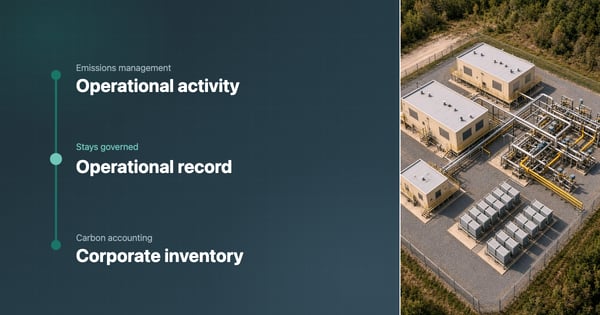
Venting and flaring emissions rarely arrive ready to enter an emissions inventory. A flare meter may record the volume of gas sent to a flare. An operations log may record when a compressor was depressurized and how long the blowdown lasted. An equipment update may show that pneumatic controllers were replaced, which changes the device count and the emission factors used to calculate vented emissions.
Each tells you something different about the emissions calculation. The gas volume still has to be tied to the correct source and asset. Gas composition may be needed to determine methane content, while a flare calculation may also depend on whether the flare was lit and which destruction efficiency applies. Only then can the resulting emissions be carried into the inventory and the applicable report.
What are venting and flaring?
A pneumatic controller bleeds gas because that is how it controls the process. That release is venting. A flare sends gas to a combustion device rather than releasing it directly to atmosphere, whether the reason is excess associated gas, a startup, an upset, or a safety release. That combustion path is flaring.
A gas volume is not yet an emissions value. Gas composition, combustion assumptions, source and asset assignment, and the applicable reporting method determine how that volume is converted into emissions and where those emissions belong in the inventory.
Programs draw the line between venting, flaring, and leaks in their own words, and the words are not identical. EPA’s Natural Gas STAR materials treat designed releases, including pneumatic vents and planned blowdowns, as vents rather than equipment leaks. Canada’s current upstream methane regulations define venting as a controlled release other than combustion, from the design of the equipment, from operating procedures, or from an over-pressure event (SOR/2018-66, s. 2). Those regulations include flaring in the destruction of hydrocarbon gas, meaning conversion for a purpose other than useful heat or energy. A device that burns gas for useful heat is defined separately. OGMP 2.0 asks operators to report venting separately from incomplete combustion, including flaring.
Fuel gas burned in an engine or a heater is combustion for useful energy. That is separate from venting and from flaring, even when one measurement system later splits a single meter volume across a fuel, flare, and vent report.
Venting, flaring, and fugitive emissions
A leak from a valve, connector, or flange that should have held tight is a fugitive emission. How those leaks are found, and how a survey finding becomes an inventory entry, is covered in fugitive emissions in oil and gas.
An optical gas imaging camera can show methane at a pneumatic controller that is supposed to vent. The image confirms that methane is present, but the equipment and the release pathway determine whether that observation is a designed vent or a fugitive leak from a fitting beside the controller. Unburned methane leaving a flare is not gas escaping a component that failed to hold tight.
Where venting and flaring occur
Source classification follows what the gas did, not the name on the equipment.
A pneumatic controller that bleeds by design is a vent. A loose connector beside it is a fugitive leak. If every camera hit is entered as a leak, designed venting can end up in the leak inventory. If every hit is treated as normal venting, a leaking connector can miss the repair workflow. Both can occur on the same skid.
A tank can send vapor to atmosphere, to a flare, or to recovery. Until someone records which of those happened, “tank emissions” does not say whether the release was vented or flared. Flash gas from liquid dumped into an atmospheric tank is a different release from vapor piped to the flare, even though both started at the tank.
Associated gas produced with the oil may have been sold, reinjected, flared, or vented. The well type does not say which. If gas sent to the flare is still included in a vent estimate, the inventory can overstate venting while understating flaring. The disposition of that gas is what keeps the vent estimate and the flared volume apart.
A blowdown depressurizes equipment by releasing the contained gas, often before maintenance or other planned work. Operations opens a vessel, writes a start time and an end time, and moves to the next job. If that log stays in the operations notebook, the inventory keeps the emission factor already assigned to that compressor or line, and the estimated blowdown volume never enters the calculation.
A flare header gathers waste gas that would otherwise have been vented, plus purge gas and pilot gas that only keep the flare ready. Those are separate gas volumes. An hour the flare was unlit is not an hour it was burning, even when one flare meter counted all of the gas that passed.
How venting and flaring volumes are quantified
Environmental staff rarely receive methane emissions from the flare. They receive a flare-meter volume, a blowdown log, or a pneumatic-controller count, and each leaves different questions open.
A flare meter says how much gas passed that meter. It does not give gas composition, pilot status, or a destruction efficiency. A metered flare volume still has to stay connected to the composition used in the calculation, the assumed destruction efficiency, and any period when the flare was unlit. Otherwise the inventory can look measurement-based even though the methane result depends heavily on assumptions.
Blowdowns are often not directly metered. EPA treats blowdowns as controlled venting. The volume may instead be estimated from the duration of the event and a measured or calculated release rate. If operations records a two-hour blowdown that actually lasted four hours, the emissions estimate will follow the wrong duration unless that record is corrected. Keeping the duration and rate with the estimate lets a reviewer see where the calculation came from.
Pneumatic venting usually is not a measured volume until someone applies a bleed rate or an emission factor. EPA describes natural-gas pneumatic controllers as devices that bleed continuously or emit when they are actuated. The calculation starts from a count of controllers or pumps, the device type, and that bleed rate or emission factor. When controllers are replaced with devices that have a different emissions profile, the equipment count, device classification, or applicable factor has to change before vented emissions are recalculated. A camera crew that tags one leaking fitting has not made that change.
An engineering estimate is what teams use when there is no meter and a device count does not fit the question. EPA’s Subpart W information sheet describes engineering calculations and emission factors alongside direct measurement. An estimated gas volume during a flare-meter outage, or a calculated tank-vent volume, can be a legitimate stand-in for a measurement. The problem starts when that estimated volume is stored in the same column as a metered flare volume and the row no longer says which was estimated. “Estimated” and “metered” have to stay on the row. Drop the label, and the next person who uses it can treat the estimated volume as measured.
Destruction efficiency describes the share of hydrocarbons assumed to be destroyed by combustion. The applicable calculation method then determines the reportable emissions, including how CO2 and unburned methane are treated. Destruction efficiency does much of the work between the metered volume and the methane emissions. If the workbook carries a default because that is what the method allows when the flare met the conditions for it, the workbook should say so. A default nobody can find is still driving the methane emissions from that flare.
A default destruction efficiency for a lit flare cannot simply be applied to a period when the flare was unlit. Gas kept leaving the header, and it was not destroyed at the assumed efficiency, for a specific set of hours. The operations note, the pilot-status alarm, or a time-stamped slice of the flare-meter volume has to show those hours and the gas volume that passed. How a program classifies that interval depends on the program. OGMP’s flare-efficiency guidance treats gas through an unlit flare as venting, and treats methane that escapes a lit flare as incomplete combustion reported under flaring. The operations note does not have to settle every program’s source classification, but it does have to preserve when the flare was unlit and how much gas passed. Applying one destruction efficiency to the entire monthly volume will hide that interval, and the methane emissions will follow the default.
From an operational volume to an emissions inventory
Take the flare at one pad. The month’s flare-meter total is the gas volume sent to that flare. A sample, or a stated default, supplies the gas composition and the methane concentration. Destruction efficiency is whatever the calculation method allows for the hours the flare was lit. The unlit interval has to come out of that monthly volume, or carry its own destruction efficiency, before the lit-flare assumption is applied to the full month. The method then calculates the methane and CO2 emissions assigned to that flare. Once reviewed, those emissions can replace the existing value for that source in the inventory.
A factor based on oil production does not update because a flare-meter total arrived in an inbox. If the reviewed calculation is what the report will use, that factor has to come off the line. The meter total, the composition, the destruction efficiency, and any unlit interval have to stay with the emissions that replace it, so a reviewer can see which of those changed them.
How that revised inventory value is reviewed, how the prior inventory value stays in history, and how the flare-meter volume and destruction-efficiency assumption stay with it is the subject of from methane measurement to inventory.
How reporting programs treat venting and flaring
EPA Subpart W treats vented emissions and flares as different sources for petroleum and natural gas systems. EPA’s Subpart W information sheet describes CO2 and methane from vented emissions, and CO2, methane, and nitrous oxide from flares. Which equation applies depends on the industry segment, and those methods sit in the Subpart W guide. The Greenhouse Gas Reporting Program is the facility program those reports belong to. A flare-meter total on an operational dashboard is not yet the source total in that filing.
OGMP 2.0 separates venting, fugitive emissions, and incomplete combustion. For flares, its flare-efficiency guidance treats methane that escapes a lit flare as incomplete combustion, reported under flaring, and treats gas passing through an unlit flare as venting. The Level 4 and Level 5 methods stay in the OGMP guide.
Canada’s current upstream methane regulations keep venting distinct from combustion. Flaring is included in the destruction of hydrocarbon gas, not in the controlled release defined as venting (SOR/2018-66, s. 2).
The same operating event may be reported under more than one program, and those programs do not necessarily classify it the same way. What has to carry across is the source classification, how the gas volume was quantified, and which destruction-efficiency or emission-factor assumption was used. Evaluating software to run those calculations across sites is covered in the emissions management software guide.
Where vent and flare volumes break down
A metered flare volume and an estimated flare volume often exist for the same flare, and both can look finished. If the inventory keeps the estimate because that is what last year’s workbook used, the metered volume never changes the emissions. If someone overwrites the estimate with the meter total and drops the note that several days were estimated during an outage, the later problem is the reverse: the inventory value looks measured for a period that was not. The line has to show which gas volume was used, and why. Saying the two volumes did not match is not a finding until you can say they were for the same flare and which one the inventory kept.
A camera hit causes a different miss. Methane at a pneumatic controller is coded as a fugitive leak because the image looks like one, while the controller was venting as designed. The leak survey and the vent calculation then both describe that release, or the vented-emissions line is never opened because the tag was closed in the inspection system and environmental only heard that a leak was repaired.
A fuel-meter volume left entirely in the vent column overstates vented emissions and leaves combustion emissions out. Splitting that volume across fuel, flare, and vent is a volume-reporting task. Fuel burned in equipment is still combustion.
The same default destruction efficiency can sit in the workbook every month while operations has already logged an unlit interval and left the note in the control room. Methane emissions from the flare then follow the default, not the month the flare was unlit. The note already exists. It has not reached the person calculating the inventory.
The depressurization, the metered volume, or the unlit interval happened, and the flare or vent emissions in the facility inventory did not change. When operating records do not make it back into the emissions calculation, the facility can report a value that no longer reflects what happened in the field.
Frequently asked questions
What is venting in oil and gas?
Venting is the release of gas through a designed or operational pathway without combustion. Common examples include gas released from pneumatic equipment and planned blowdowns. Unlike a fugitive leak, the release occurs through an intended operating pathway.
What is flaring in oil and gas?
Flaring sends gas to a combustion device rather than releasing it directly to atmosphere. The reason may be excess associated gas, a startup, an upset, or a safety release. Where the flare is metered, that measurement is the gas sent to the flare, not the methane emissions that follow from it.
Are venting and flaring the same as fugitive emissions?
No. Fugitive emissions are unintentional leaks from components that should have held tight. Venting and flaring follow a designed or operational pathway. How those leaks are found and entered in an inventory is covered in fugitive emissions in oil and gas.
How are venting and flaring volumes quantified?
A flare may have a metered volume. A blowdown is often estimated from the duration of the event and a release rate. Pneumatic venting often starts from a device count and an emission factor. An engineering estimate can stand in when a flare meter is out, or when a tank vent was not metered. Composition, destruction efficiency, and any period the flare was unlit still have to be applied before those volumes become emissions.
How do vent and flare volumes get into a GHG inventory?
Assign the volume to the right source and asset, and keep the composition and combustion assumptions with it, before replacing the line already in the inventory. A flare-meter total sitting in an inbox has not done that. How a reviewed inventory value keeps its history is covered in from methane measurement to inventory.
How do EPA reporting rules treat vents and flares?
Under the Greenhouse Gas Reporting Program, Subpart W treats vented emissions and flares as different sources. Flares include nitrous oxide in the reported emissions along with CO2 and methane. The calculation method depends on the industry segment. Those methods are in the EPA Subpart W reporting guide.
Is fuel gas the same as flaring?
No. Fuel gas burned in an engine, heater, or other equipment is combustion for useful energy. Canada’s current upstream methane regulations include flaring in the destruction of hydrocarbon gas, not in gas burned for useful heat. A monthly fuel, flare, and vent report can still contain all three volumes from one measurement system. The split has to be made before that meter volume is treated as a single source.
From the operational record to the reported total
A flare volume, blowdown duration, or controller count still has to be assigned to the correct source and asset. The composition, calculation method, and combustion assumptions behind the resulting emissions also need to remain available for review.
Validere connects those operating records to the calculations and reporting workflows that use them. A flare-meter volume can be carried into the emissions calculation with the relevant gas composition, destruction efficiency, and operating exceptions intact, rather than being copied into the inventory without that context. It can sit beside the measurement and production systems that already collect the volumes. The inventory and reporting side of that work is emissions management software for air and GHG.
If you want to walk a flare-meter total, an unlit interval, and the inventory line they should change, book a walkthrough.
See Validere in action
See how Validere connects and automates environmental workflows.

Darren Belgrave
darren.belgrave@validere.comDarren Belgrave is Marketing Manager at Validere, where he focuses on environmental operations, emissions management, and industrial software strategy.