.png)
Leadership asks what happens to emissions if the drilling program adds a rig, a vapor-recovery project slips into next year, or a compressor station retires in June. The inventory on the table still describes last year.
Someone usually answers by carrying that total forward, sometimes with a growth rate on top. The resulting chart can be presented as a plan even though it will not change when the drilling program, the project date, or the retirement date changes. Operators who already file an inventory still need a way to say what could happen next before a budget or a production case is locked.
What is emissions forecasting?
Emissions forecasting estimates future emissions by applying defined calculation logic to forward production, asset, operating, and project assumptions. The result should change when those plans change.
A useful forecast is not last year’s inventory drawn forward. If the only step was to copy the prior total, or to multiply it by a growth rate, the file still does not know that a pad comes online in April, a project starts in October, or a facility shuts down at mid-year, and the slope of the chart does not supply that information.
Keeping the method consistent from one case to the next makes the effect of a single decision easier to see. Methods, factors, and inventory boundaries can still change, either from the reported year or between cases. The GHG Protocol Corporate Standard treats consistency as a condition of comparison: if boundaries, methods, or data change, the change has to be documented and justified, or the time series stops meaning what it appears to mean. A forecast has the same problem when a lower number could be either a project that started or a new factor.
Operators do not share one method for this work. Some build the case from source-level calculations. Others start from facility totals and adjust a few large drivers. Either approach can be honest if the assumptions are written down and the calculation approach is visible. What fails is a single company-wide number that no asset owner can trace to a production case, a project date, or a method version.
How is emissions forecasting different from emissions reporting?
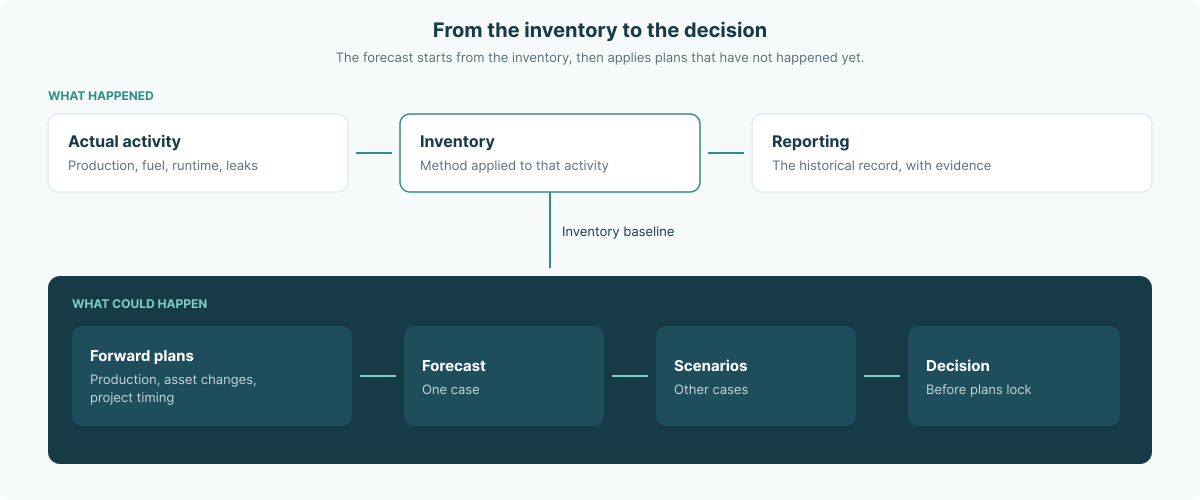
Emissions reporting documents what already happened, under a stated method, with evidence a reviewer can follow. Emissions forecasting tests what could happen next, under assumptions someone has named.
A reported inventory is tied to activity that occurred: throughput, fuel, runtime, leaks found, venting that was designed, and the factors or measurements the method allows. EPA’s scope 1 and scope 2 inventory guidance describes that work as compiling facility data, choosing emission factors, and calculating emissions. Under the EPA’s scope 1 and scope 2 inventory guidance, covered facilities use the methods specified for their source category and submit an annual report for the prior calendar year. Emissions reporting software is built for that historical job, including the review and the file that goes out the door.
A forecast borrows a defined calculation approach and then replaces activity that occurred with activity the plan expects. A reported inventory has to withstand scrutiny of the historical evidence: the activity, the method, and the review trail. A forecast has to withstand scrutiny of its assumptions, including which production case, which project dates, and which method version were used. Treating the forecast as if the activity had already been documented is how a planning case ends up in a filing workbook.
|
Emissions reporting |
Emissions forecasting |
|
|---|---|---|
|
Question it answers |
What happened |
What could happen if these plans hold |
|
What it is built from |
Activity that occurred, a method, and evidence |
Defined calculation logic plus forward production, asset, and project plans |
|
What it is for |
The historical record and the submission |
Decisions before capital and operating plans lock |
|
What it is not |
A plan for next year |
A substitute for the reported inventory |
A forecast can use the same factors, the same asset list, and the same calculation version as the inventory, which makes the planning case and the reported case easier to compare. Until the activity occurs and the evidence exists, the forward number is still a case. If the method changes, that change belongs in the record of the case, where a reviewer can see it, rather than inside a result that looks like an operating change.
What is a useful emissions forecast built from?
A usable forecast starts from an inventory the team can explain and trace, then changes the activity that inventory was built on. The plans that usually have to be explicit are the production or throughput case, the asset and operating changes, the reduction projects, and the dates each of those takes effect.
The harder problem is keeping each assumption attached to the calculation it actually changes. A change in throughput should update the sources whose underlying activity is actually affected, rather than applying a growth rate to the company-wide total. If a compressor retires in June, the forecast should drop that equipment from July onward, not treat it as missing for the whole year. If a vapor-recovery project slips from April to October, the reduction applies only in the months after it starts.
If those plans are missing, or if they are present but not tied to a source, the file is last year carried forward. The longer checklist for each input already sits in the forecasting and scenario modeling use case, including how historical emissions, production cases, and project timing are handled separately.
The baseline still has to be an inventory the team can explain and trace. Gaps in measurement, classification, or how a detection becomes a reported source are a different problem, covered in from methane measurement to inventory.
What is emissions scenario modeling?
Emissions scenario modeling compares alternative operating and project pathways while the calculation approach stays visible, so the decision under test can change without the method changing at the same time.
A single forecast is one case: this production plan, these projects, these dates. A scenario set asks what else is plausible. One case keeps the drilling program and slips the vapor-recovery unit to November. Another retires the compressor in June and leaves the project on its original date. A third raises throughput and makes no equipment changes. If each case uses a different factor set, the comparison no longer isolates the decision.
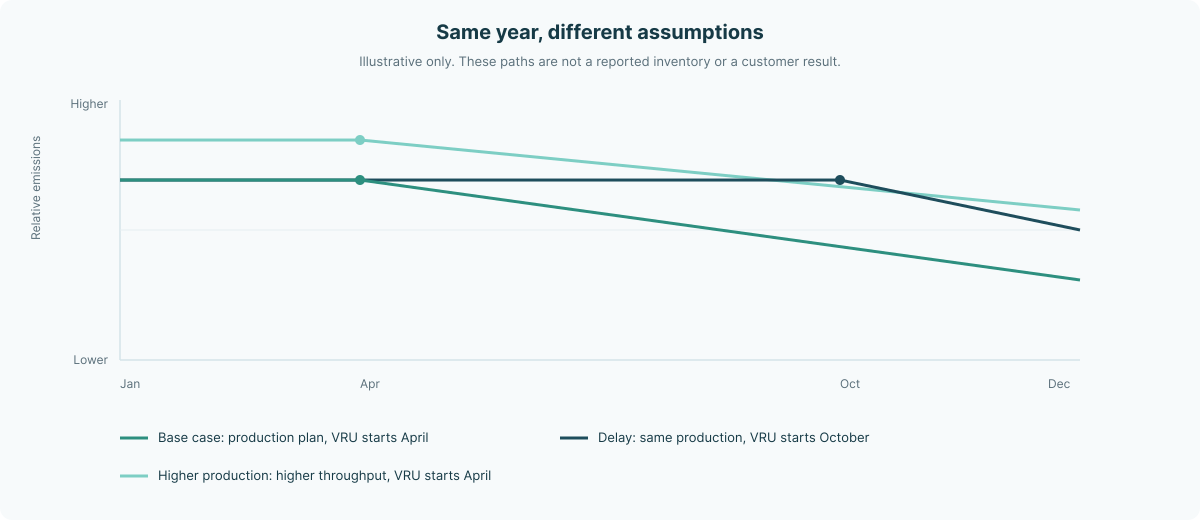
Figure 2: Illustrative paths only. Not a reported inventory or a customer result.
Absolute emissions and emissions intensity have to stay labeled, because they answer different questions. The GHG Protocol Corporate Standard describes an absolute target as a reduction in a quantity of emissions, typically tonnes, and an intensity target as a reduction relative to a business metric such as output. It also notes that absolute emissions can rise even when intensity falls, if output increases, and that a company using an intensity target should still report the absolute emissions covered by that target. A higher-production case can improve intensity and still increase total tonnes. Name which figure the decision is supposed to change, and keep the other one visible.
Some teams also compare reduction projects by cost per tonne. UNFCCC training materials on mitigation assessment describe marginal abatement cost curves as a way to compare options by incremental cost relative to a baseline, expressed per unit of greenhouse gas reduced. That comparison is an economic lens on project cost, not the emissions forecast itself. A project that looks inexpensive on the curve can still miss the year if it does not start until December, and a project already assumed inside the production case should not be counted again as a reduction on top.
Where emissions forecasts break
The forecast goes stale when the production case moves and the emissions file does not. Reservoir engineering issues a revised case in March. Environmental is still planning on the January file, because the handoff has no owner and the forecast does not show which production version it used. By budget season, the emissions case and the production case describe different futures. That is the same kind of broken handoff as any other record that did not follow the work, which is the subject of 9 workflow bottlenecks that create industrial compliance risk.
A useful forecast needs the assumptions written down, a person accountable for each of them, and a way to tell when they changed. Someone reviewing the result should be able to trace it to the production case, the project timing, and the calculation method that produced it, including which version of each was in force.
Reduction gets counted twice when the same change is applied in two places. The vapor-recovery project sits on a list with a start date and an expected tonne reduction, while the baseline case already reflects that project’s expected emissions reduction. Counting it in both places shows a cut the operation will not see.
Intensity and absolute totals get mixed in the same discussion, so a case that misses the limit the company actually has is still presented as an improvement. A scenario can also be pasted into the reporting workbook and treated as the inventory. When the assumptions live in three spreadsheet versions and no one owns them, the copy used in the meeting may not be the one the production or project team last updated, and no one can reconstruct which production case or project dates it contains.
How often should emissions forecasts be updated?
Update the forecast when a material plan changes: a revised production case, a project that slips or starts, an asset that comes online or retires, or a planning assumption that changes what has to be counted. Budgeting and the annual plan are the natural times to do that work, because those are the meetings where the decisions lock. The refresh only helps if someone owns the new assumption and the prior version is still visible.
A mid-year drilling change is a reason to refresh even if the budget presentation is already finished. There is no universal calendar for this. A file that still matches January in November usually means the case was not reopened after the operation changed.
Whether a software platform should run that refresh, and what to require of it, is a separate evaluation. The Emissions Management Software buyer’s guide covers that buying question. The forecast is still the planning case, with or without a new system.
Frequently asked questions
Can a forecast replace a GHG inventory?
No. The inventory is the historical record, built from activity that occurred, under a method, with evidence. A forecast is a case about a plan that has not been run yet. Submitting the forecast as if the activity had already occurred skips the evidence the report is supposed to carry.
What data do you need to forecast emissions?
You need a baseline inventory the team can explain and trace, plus the production or throughput plan, the asset and operating changes, the reduction projects, and the dates those take effect. Each of those has to stay tied to the calculation it changes. A June retirement should not be treated as a full-year absence, and a project that slips to October should not reduce emissions from January. The input checklist is in the forecasting and scenario modeling use case.
How often should an emissions forecast be updated?
Refresh when the plan changes enough to move a decision, and at the budget or annual planning cycle where those decisions are made. A new production case or a slipped project date is a reason.
How does emissions forecasting support target or compliance planning?
A forecast can show whether a planned case is moving toward or away from an emissions target, an operating constraint, or another obligation the organization already tracks. It does not determine whether a filing is complete, and it does not calculate a tax or a penalty. Reporting still has to document what happened, under the method that applies.
From the inventory to the decision
The work is to keep the calculation approach explicit, write down the production case and the project dates, and compare cases before the capital or the operating plan is locked. When those plans change, the forecast has to change with them, and a reviewer should still be able to see which version produced the number.
Validere can bring the inventory, the production plan, and the project list into the same forecasting case, and it can sit beside the planning tools a company already uses rather than requiring those tools to be replaced. See forecasting and scenario modeling.