A team can mark a fugitive emissions survey complete while a detected leak still needs repair and verification. Under NSPS OOOOb, the monitoring method, the survey frequency, and the repair timing depend on the facility and on how the emission was identified.
What NSPS OOOOb fugitive monitoring covers
NSPS OOOOb establishes fugitive emissions monitoring and repair requirements for certain affected facilities in the Crude Oil and Natural Gas source category. Section 60.5397b sets how that monitoring is conducted, how often surveys occur, and what repair follows a detected emission. Whether §60.5397b applies at a particular site is the company’s determination under §60.5365b.
Fugitive emissions differ from intentional venting and flaring. Fugitive emissions in oil and gas explains that distinction. EPA’s fugitive emissions FAQ is the agency’s shorter account of the monitoring program. The eCFR text cited here is current through October 22, 2026.
Which sites can be affected
Section 60.5365b applies this subpart to an owner or operator of listed onshore affected facilities in that source category when construction, modification, or reconstruction commenced after December 6, 2022. Facilities located inside, and including, the local distribution company custody transfer station are not subject to the subpart.
The fugitive emissions components affected facility, defined in §60.5365b(i), is the collection of those components at a well site, a centralized production facility, or a compressor station. A well, a compressor, a process controller, a storage vessel, or a pump may have its own standard under the same subpart. A covered collection of fugitive emissions components is still subject to §60.5397b.
Modification can also bring an existing fugitive emissions components affected facility under the subpart. Section 60.5365b(i) sets different modification criteria for a well site, a centralized production facility, and a compressor station. Equipment records help show what changed. The operator still has to evaluate those changes against that test. An incorrect classification can lead to unnecessary monitoring, or to the omission of a required survey.
Why the survey method is tied to the site
Under §60.5397b(g), the monitoring method and the minimum frequency depend on the facility type. At a multi-wellhead only well site, after the initial survey, the rule requires monitoring at least quarterly using audible, visual, and olfactory inspection (AVO), or any other detection method, and a separate survey at least semiannually using optical gas imaging (OGI) or EPA Method 21.
The operator may use OGI for the quarterly survey, because that survey allows AVO or any other detection method. The semiannual survey has to be OGI or Method 21, and consecutive semiannual surveys have to fall at least four months apart and no more than seven months apart.
Section 60.5397b(f) sets the method and the timing for the initial survey. Section 60.5398b is the alternative-standards route. Using another detection method on a survey that paragraph (g) already permits is separate from adopting those standards.
What happens after a fugitive emission is detected
When a survey identifies a fugitive emission, §60.5397b(h) requires a repair, and the first-attempt deadline depends on how that emission was identified.
Consider a hypothetical multi-wellhead only well site where the quarterly survey is already complete. During the semiannual OGI survey, a field crew finds a fugitive emission at a valve and stores the image with the survey. An environmental lead tracks the open finding, and an operations coordinator has to arrange the first repair attempt. The coordinator needs the valve’s location, the detection date, and the repair deadline.
Because this emission was identified on the required OGI survey, §60.5397b(h)(1)(ii) requires the first repair attempt no later than 30 calendar days after detection. That provision sets the same 30-day first attempt when the operator is complying with paragraph (g)(1)(i) through (vi) using OGI or Method 21.
Fugitive emissions identified using AVO have a first attempt no later than 15 calendar days after detection, under §60.5397b(h)(1)(i). Section 60.5397b(h)(2) then measures completion from that first attempt: as soon as practicable, and no later than 30 calendar days on the OGI or Method 21 path, or 15 calendar days on the AVO path.
If the coordinator’s list does not include the detection date and the repair deadline from the survey record, the first attempt may be missed even though the emission was documented.
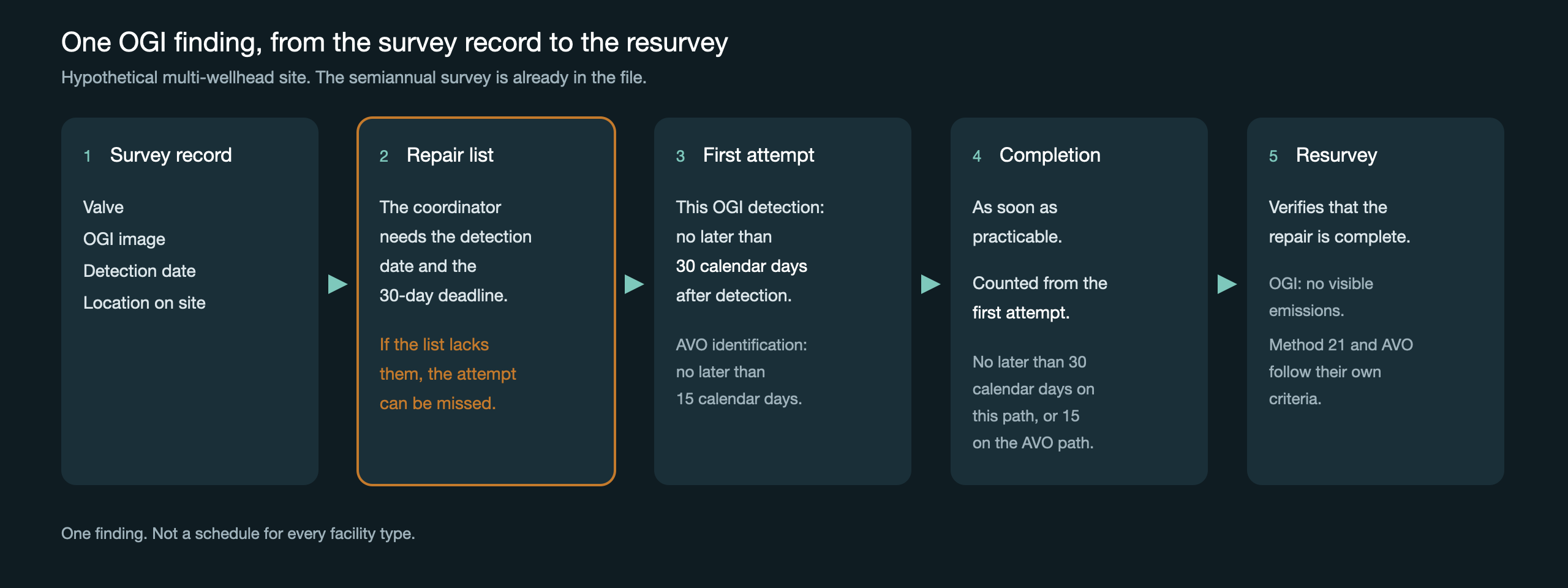
Figure 1. The survey record holds the valve, the image, and the detection date. The repair list has to carry that date and the deadline through the first attempt, completion, and the resurvey.
A delay of repair is available only when the conditions and the timing in §60.5397b(h)(3) are met.
Section 60.5397b(h)(4) requires the operator to resurvey a detected fugitive emission to verify that the repair is complete. The operator may use OGI or Method 21. When the fugitive emission was identified using AVO, paragraph (h)(4)(v) also allows verification by AVO, and the component is repaired when that inspection shows no indication of fugitive emissions. An OGI resurvey meets paragraph (h)(4)(iv) when the instrument shows no indication of visible emissions, and a Method 21 resurvey has to meet paragraph (h)(4)(iii). If the component cannot be repaired during the survey that found the emission, the operator has to tag it during that survey, or photograph it with the date and a clear location within the site.
The monitoring plan and the required records
Section 60.5397b(b) requires a fugitive emissions monitoring plan for each fugitive emissions components affected facility within each company-defined area. Paragraphs (c) and (d) set the minimum elements.
In the plan, the company states the survey frequency, the detection technique, the procedures and timeframes for identifying and repairing components, how repairs are verified, and the records it will keep. The repair schedule has to meet paragraph (h). Where OGI is used, paragraph (c)(7) adds requirements for the camera and the procedure. Where Method 21 is used, the plan has to identify the components to be monitored and how they will be located in the field.
Section 60.5397b(k) requires the reports in §60.5420b(b)(1) and (9) and the records in §60.5420b(c)(14). For each fugitive emission identified, paragraph (c)(14)(v)(I) includes the date of the first repair attempt and the date of successful repair, including the resurvey and the instrument used for that resurvey. It also includes each component placed on delay of repair, with an explanation for the delay.
The operator decides who is assigned the repair, and whether that person can see these required records alongside the survey.
An OOOOb survey and repair record documents that monitoring path. A Subpart W equipment-leak total is a greenhouse-gas reporting result, and Subpart W has its own applicability test.
What to settle before you evaluate software
Before comparing software, the operator needs to know which surveys §60.5397b requires at the facility, and how a documented finding will move through the first attempt, the repair or an allowed delay, and the resurvey. The people doing that follow-up need the survey, the deadline, and the required repair records. The LDAR software guide sets out how to evaluate a system for that work.
Validere’s emissions measurement and response work includes measurement data, emissions-event detection, field response, and documentation of results. The owner or operator remains responsible for determining which requirements apply and for completing the required repairs. For a discussion of OOOOb monitoring requirements and compliance workflows, watch the recorded webinar Simplify OOOOb compliance.
Frequently asked questions
Does NSPS OOOOb fugitive monitoring apply to every oil and gas site?
No. Section 60.5365b applies the subpart to listed onshore affected facilities in the Crude Oil and Natural Gas source category when construction, modification, or reconstruction commenced after December 6, 2022. Fugitive monitoring covers the collection of fugitive emissions components at a well site, a centralized production facility, or a compressor station. Facilities located inside, and including, the local distribution company custody transfer station are outside the subpart.
Can an AVO inspection replace an OGI or Method 21 survey?
No. An AVO inspection does not satisfy a survey that §60.5397b(g) assigns to OGI or Method 21. The semiannual survey at a multi-wellhead only well site is one of those surveys. Where a survey allows AVO or any other detection method, the operator may use OGI for that survey.
What happens after a fugitive emission is detected?
Section 60.5397b(h) requires a repair. The first attempt is due no later than 15 calendar days after an AVO identification, and no later than 30 calendar days after detection when the operator is complying with paragraph (g)(1) using OGI or Method 21. Completion runs from that first attempt: no later than 15 calendar days after the attempt on the AVO path, and 30 calendar days on the OGI or Method 21 path. Paragraph (h)(4) is the resurvey. A delay has to meet paragraph (h)(3).